


Active Carbon Analysis

Active carbon (also known as activated carbon or activated charcoal) is a porous carbonaceous material with high adsorption capacity. Produced from natural materials such as coconut shells, wood, coal, or peat, it is widely applied in food, pharmaceutical, environmental, and industrial sectors for purification, detoxification, and quality enhancement.
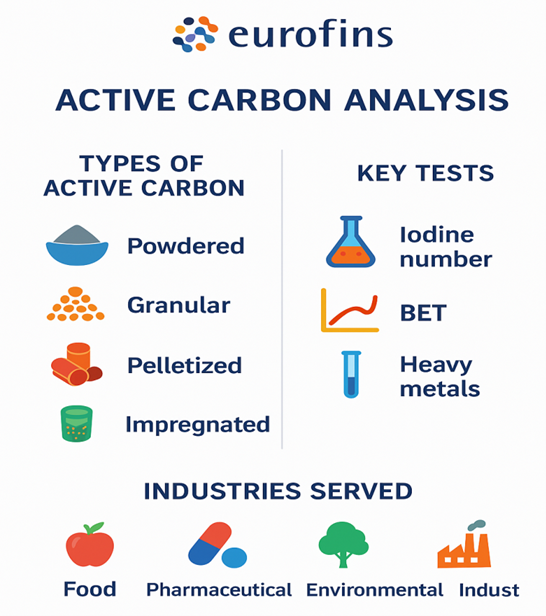 Eurofins provides advanced active carbon analysis services to evaluate physical, chemical, and microbiological properties. Testing ensures compliance with international standards, verifies adsorption efficiency, and safeguards consumer safety in global markets.
Why Active Carbon Analysis is Important
Active carbon testing is essential for:
- Ensuring adsorption efficiency in food processing, water purification, and pharma formulations.
- Preventing health risks from contaminants such as heavy metals or microbial impurities.
- Meeting regulatory compliance requirements under FDA, EU, Codex, and FSSAI standards.
- Supporting product quality across beverages, edible oils, nutraceuticals, and packaged water.
- Enabling industrial reliability in solvent recovery, gas purification, and effluent treatment.
Types of Active Carbon
- Powdered Activated Carbon (PAC): Fine powder used in beverages, sugar, and pharmaceuticals for rapid decolorization and adsorption.
- Granular Activated Carbon (GAC): Larger particle size, commonly used in water treatment and air purification systems.
- Pelletized Activated Carbon: Extruded into uniform pellets, ideal for industrial gas treatment.
- Impregnated Carbon: Enhanced with chemicals (e.g., silver, iodine) to improve specific adsorption properties.
Production Methods
- Physical Activation: Raw material is carbonized and activated using steam or CO₂ at high temperatures.
- Chemical Activation: Involves treatment with activating agents such as phosphoric acid or potassium hydroxide, followed by carbonization.
- Novel Approaches: Emerging techniques include microwave-assisted activation and green synthesis using agricultural residues.
Functional Properties of Active Carbon
- High Surface Area: Up to 3000 m²/g for adsorption of small and large molecules.
- Pore Structure:
- Micropores (<2 nm): Capture small molecules.
- Mesopores (2–50 nm): Adsorb larger organic molecules and dyes.
- Macropores (>50 nm): Act as transport channels.
- Surface Chemistry: Oxygenated functional groups (carboxyl, phenolic, lactone) influence adsorption behavior.
Common Applications of Active Carbon
|
Sector |
Application |
Examples |
|
Food & Beverage |
Decolorization, deodorization, purification |
Edible oils, sugar refining, bottled water, alcoholic beverages |
|
Pharmaceuticals |
Excipient, detox agent, drug delivery |
Tablets, oral suspensions, poisoning antidote |
|
Environmental |
Air and water purification |
Removal of pesticides, chlorine, dioxins, VOCs |
|
Industrial |
Gas separation, catalyst support, effluent treatment |
Petrochemicals, mining, chemical plants |
|
Healthcare & Personal Care |
Detoxification, cosmetic use |
Face masks, toothpaste, skin-care formulations |
Contaminants & Risks Linked to Poor-Quality Active Carbon
- Heavy Metals (Pb, Cd, Hg, As): Residual contamination from raw materials.
- Polycyclic Aromatic Hydrocarbons (PAHs): By-products of high-temperature processing.
- Microbiological Load: Contamination due to poor sterilization or storage.
- Excess Ash or Residual Chemicals: Lowers adsorption capacity and may compromise safety.
- Health Risks: Include metal toxicity, gastrointestinal irritation, reduced detox efficiency, and non-compliance in export consignments.
Standards and Regulations
|
S No. |
Regulatory Body |
Name of Processing Aid |
Functional / Technological Purpose |
Product Category |
Residue Level (mg/kg) (Not more than) |
Key Regulation / Reference Link |
|
1 |
FSSAI (India) |
Activated Carbon |
Adsorbent, Decolourizing Agent |
Sugars, Oils and Fats, Juices |
GMP (Good Manufacturing Practice) |
Food Safety and Standards (Food Products Standards and Food Additives) Regulations, 2011 (Compendium 2022) Link |
|
2 |
EU (EFSA) |
Activated Carbon |
Adsorbent, Decolourizing Agent |
Sugars, Oils and Fats, Juices; Food Contact Materials (e.g., oxygen absorbers) |
GMP; Ash content up to 10% max for vegetable carbon E153 in packaging |
EFSA Scientific Opinion 2012; 10(3):2643; Commission Directive 95/45/EC Link |
|
3 |
US FDA |
Activated Carbon |
Adsorbent, Decolourizing Agent |
Sugars, Oils and Fats, Juices |
GMP (Good Manufacturing Practice) |
CFR Title 21, Part 173.340; FDA GRAS status Link |
Analytical Methods for Active Carbon Testing
- Surface Area & Pore Analysis: BET (Brunauer–Emmett–Teller) method.
- Adsorption Efficiency: Iodine number, methylene blue value, molasses number.
- Moisture & Ash Content: Gravimetric analysis.
- pH & Conductivity: Water extract evaluation.
- Heavy Metals: ICP-MS or AAS for Pb, Cd, Hg, As.
- PAHs: GC-MS for organic contaminants.
- Microbiological Safety: ISO methods for Salmonella, E. coli, Listeria.
Active Carbon Testing Services We Offer
|
Service Area |
Description |
|
Adsorption Capacity |
Iodine number, molasses test, surface area evaluation |
|
Physical Properties |
Moisture, ash, density, particle size |
|
Chemical Purity |
Heavy metals, pH, conductivity |
|
Microbiological Safety |
Pathogen detection, total plate count |
|
Customized Applications |
Tailored methods for food, pharma, water, industrial use |
|
Export/Import Certification |
Testing for EU, FDA, Codex compliance |
Sustainability and Environmental Impact
Active carbon is increasingly being produced from renewable agricultural residues such as coconut shells, rice husk, and bamboo. These eco-friendly sources reduce dependency on coal-based carbon and minimize environmental footprint. Sustainable production aligns with UN Sustainable Development Goals (SDGs) by supporting circular economy practices and reducing industrial waste.
Who Needs Active Carbon Testing
- Food & Beverage Manufacturers: To ensure purity in sugar, oils, and beverages.
- Pharma Companies: For compliance with pharmacopeia standards.
- Water Treatment Providers: To validate filter performance.
- Exporters & Importers: For international regulatory compliance.
- Industrial Users: For gas purification, catalysts, and solvent recovery.
Common Issues and Eurofins Solutions
|
Issue |
Eurofins Solution |
|
Low adsorption capacity |
BET analysis & iodine number testing |
|
Heavy metal contamination |
ICP-MS with supplier verification support |
|
Microbial contamination |
ISO microbiological testing |
|
High ash content |
Gravimetric evaluation with corrective recommendations |
Case Study: Restoring Compliance for a Bottled Water Exporter
A bottled water exporter faced compliance issues in the EU due to residual arsenic leaching from activated carbon filters. Eurofins performed ICP-MS analysis, confirmed the source, and recommended switching to certified coconut-shell-based carbon. This corrective action allowed the exporter to regain compliance and secure EU market approvals.
Global Market Trends and Consumer Concerns
- Growing Demand: Driven by water treatment, food safety, and pharma applications.
- Stricter Quality Checks: Export markets tightening impurity limits.
- Sustainability Push: Shift toward renewable raw materials (coconut, bamboo).
- Technological Advances: AI-supported pore analysis and rapid adsorption modeling.
- Consumer Expectations: Demand for clean-label and contaminant-free products.
Future Perspectives & Innovations
- Nanostructured Carbons: Development of graphene-based and carbon nanotube composites.
- AI & Digital Tools: Predictive modeling for adsorption efficiency.
- Circular Economy Integration: Use of agro-waste for sustainable carbon production.
- Advanced Applications: Growth in pharmaceuticals, energy storage, and environmental remediation.
Why Choose Eurofins for Active Carbon Analysis
- Global Reach: 900+ labs in 50+ countries.
- Accreditations: NABL, ISO/IEC 17025, FDA-LAAF recognition.
- End-to-End Testing: Physical, chemical, and microbiological under one roof.
- Regulatory Expertise: Guidance for FSSAI, FDA, EU, and Codex compliance.
- Fast Reporting: Rapid turnaround to avoid trade delays.
Ensure your active carbon meets global standards for safety, purity, and efficiency. Partner with Eurofins Analytical Services India for complete, accredited testing solutions.
Enquire now: www.eurofins.in/food-testing/enquire-now/

