


Additives & Preservative Testing in Foods

Introduction
Food additives and preservatives are essential components of modern food production, used to enhance safety, stability, flavor, color, and texture. Additives include a wide range of substances intentionally added in small quantities to achieve specific technological purposes, while preservatives specifically prevent microbial growth and oxidative spoilage that can shorten shelf life.
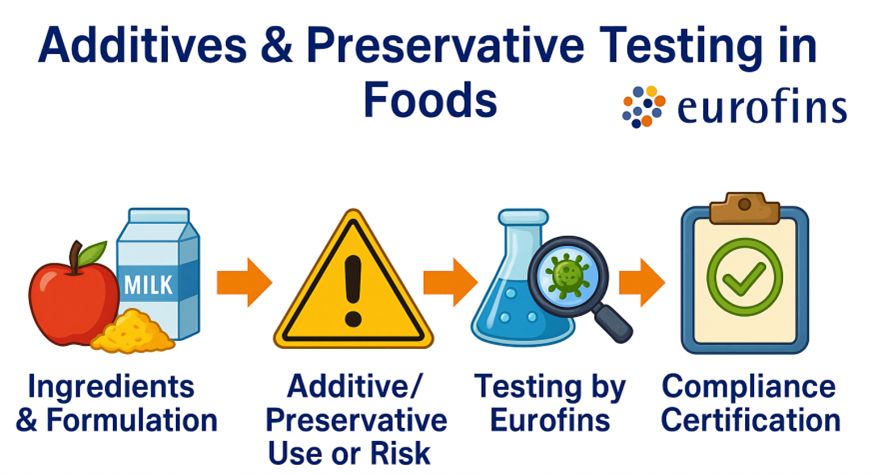
Although these substances are generally safe when used within approved limits, their misuse, overuse, or undeclared presence can pose health risks and regulatory violations. Unapproved synthetic colorants, excessive preservative residues, and substitution with unauthorized chemicals have been associated with food adulteration and consumer distrust.
To ensure public health and regulatory compliance, systematic testing and monitoring of additives and preservatives are essential. Eurofins Food Testing Laboratories deliver end-to-end solutions to verify additive levels, confirm label claims, and detect adulteration through scientifically validated and globally recognized analytical techniques.
Testing Importance and Objectives
The accurate testing of food additives and preservatives serves multiple scientific, regulatory, and commercial purposes. Reliable analytical data provide the foundation for safe manufacturing practices, transparent labeling, and consumer confidence.
|
Objective |
Description |
Expected Outcome |
|
Safety Assurance |
Ensures additives and preservatives are within permissible limits |
Prevents toxic exposure and allergic reactions |
|
Regulatory Compliance |
Aligns with national and international food safety standards |
Avoids product recalls and export restrictions |
|
Label Verification |
Confirms declared ingredients and additive codes (E-numbers) |
Builds trust and supports transparent labeling |
|
Adulteration Detection |
Identifies undeclared, substituted, or banned substances |
Prevents fraudulent practices and market penalties |
|
Quality Optimization |
Monitors additive degradation and effectiveness over time |
Improves shelf life and product performance |
|
Clean-Label Development |
Supports reduction or replacement of synthetic additives |
Enables reformulation towards natural alternatives |
Comprehensive additive testing not only ensures food safety but also helps manufacturers make data-driven decisions in formulation, processing, and marketing strategies.
Role of Additives and Preservatives in Food Systems
|
Function |
Description |
Examples |
Typical Products |
|
Preservation |
Prevents microbial spoilage and fermentation |
Sorbic acid, Benzoic acid, Nitrites |
Beverages, sauces, meats |
|
Antioxidation |
Delays rancidity and oxidation |
BHA, BHT, Tocopherols |
Oils, snacks, bakery |
|
Flavor & Color Enhancement |
Restores or improves sensory quality |
MSG, Tartrazine, Caramel |
Soups, confectionery |
|
Texture Modification |
Enhances structure and consistency |
Lecithin, Carrageenan, Pectin |
Dairy, bakery |
|
Sweetening |
Reduces sugar content while maintaining taste |
Aspartame, Sucralose, Stevia |
Beverages, desserts |
These components help maintain product stability and consumer appeal. However, imbalanced or improper use can lead to chemical residues, adverse reactions, or non-compliance.
Public Health and Adulteration Concerns
Unregulated or excessive use of additives can result in cumulative toxicity, hypersensitivity reactions, or interference with metabolic processes. In addition, adulteration such as the use of non-permitted dyes or synthetic preservatives to mask spoilage poses significant health and reputational risks.
Routine laboratory surveillance, combined with regulatory monitoring, is therefore essential to detect such practices and ensure food integrity.
Regulatory Framework
|
Jurisdiction |
Regulation / Authority |
Category |
Additive |
Key Standards & Requirements |
|
European Union |
Regulation (EC) No 1333/2008 |
Colorants in Spices |
Sudan Dyes |
Explicitly prohibited in spices and spice mixes. Ensures harmonized safety across the EU. |
|
Commission Regulation (EU) No 1129/2011 |
Authorized Additives |
General |
Establishes Union List of authorized food additives. Reinforces ban on unauthorized coloring agents in spices. |
|
|
India (FSSAI) |
Food Safety and Standards (Food Products Standards and Food Additives) Regulations, 2011 |
Food Colours |
Erythrosine (Red) |
- Dye content: ≥ 87% by mass - Loss on drying: ≤ 13% @135°C - Water-insolubles: ≤ 0.2% - Heavy metals: Pb ≤ 10 mg/kg, As ≤ 3 mg/kg, Zn ≤ 50 mg/kg - Free from: Cu, Hg, Cr, aromatic nitro compounds, cyanides, hydrocarbons, amines |
|
β-Carotene (Yellow) |
- Absorption: 456–484 nm - Purity: ≥ 96% - Heavy metals: Pb ≤ 10 ppm, As ≤ 3 ppm, Total ≤ 40 ppm - Subsidiary colors: ≤ 3% |
|||
|
Chlorophyll (Green) |
- ID: Blue in ethanol with red fluorescence - Heavy metals: Pb ≤ 10 ppm, As ≤ 3 ppm, Cu ≤ 30 ppm, Zn ≤ 50 ppm - Residual solvents: MeOH, EtOH, acetone, IPA, hexane ≤ 50 mg/kg; DCM ≤ 10 mg/kg |
|||
|
Riboflavin (Yellow–Orange) |
- Absorption: 220–225, 266, 371, 444 nm - Purity: ≥ 97% - Heavy metals: Pb ≤ 20 ppm, As ≤ 5 ppm |
|||
|
Other Approved Colours |
Tartrazine, Sunset Yellow, Indigo Carmine, Caramel, Annatto, etc. |
Each with specific purity criteria and heavy metal limits |
||
|
Flavouring Agents |
Natural Flavours |
Must comply with GMP |
||
|
Nature-Identical Substances |
Must comply with GMP; meet standards for emulsifiers, stabilizers, antioxidants, anti-caking agents |
|||
|
Artificial Flavours |
Must comply with GMP Synthetic amorphous silica (INS 551) allowed in powdered flavours: max 2% |
https://eur-lex.europa.eu/legal-content/EN/TXT/?uri=CELEX%3A32008R1333&qid=1731566850591
https://eur-lex.europa.eu/legal-content/EN/TXT/?uri=CELEX%3A02011R1129-20131121&qid=1731573970478
Factors Affecting Additive Residue Levels
|
Factor |
Description |
Impact |
|
Formulation Accuracy |
Variations in additive dosing |
Overuse or underperformance |
|
Processing Conditions |
High heat, pH, or pressure |
Decomposition or formation of by-products |
|
Food Matrix |
Fat, moisture, or sugar content |
Affects solubility and extraction |
|
Storage & Packaging |
Light, temperature, and air exposure |
Alters stability or migrates residues |
|
Regulatory Revisions |
Updated limits and permissible lists |
Requires periodic compliance review |
Eurofins Analytical Testing Capabilities
Eurofins laboratories utilize advanced, accredited methodologies for reliable detection and quantification of food additives and preservatives.
Analytical Platforms
- LC-MS/MS for quantitative detection of preservatives, antioxidants, and sweeteners
- GC-MS/MS for volatile additive profiling and flavor enhancer identification
- HPLC (UV/FLD/DAD) for routine analysis of colorants and parabens
- Ion Chromatography for sulfite, nitrate, and nitrite determination
- FTIR and UV-Vis spectroscopy for rapid colorant and adulterant screening
Complementary Analytical Solutions
Eurofins offers integrated testing for related quality and safety parameters:
- Detection of artificial and natural sweeteners (Aspartame, Stevia, Acesulfame K)
- Identification of synthetic and natural colorants (Tartrazine, Carmine, Beet extract)
- Quantification of preservative residues (Benzoates, Sorbates, Nitrites)
- Migration testing for additives from packaging materials
- Shelf-life and degradation kinetics under simulated storage
Eurofins Additive Compliance Framework
|
Step |
Objective |
Eurofins Solution |
|
Ingredient Profiling |
Detect undeclared additives and precursors |
LC-MS/MS and GC-MS/MS screening |
|
Process Validation |
Ensure correct incorporation of additives |
On-site process audit and batch verification |
|
Product Testing |
Quantify residues and confirm compliance |
Targeted multi-analyte testing |
|
Label Verification |
Cross-check with analytical results |
Compliance documentation and review |
|
Monitoring & Reporting |
Continuous quality tracking |
SmartLIMS™ digital reporting tools |
Digital Traceability and Data Transparency
|
Platform |
Function |
|
SmartLIMS™ |
Manages sample lifecycle and certificate generation |
|
SmartView™ |
Graphical visualization of additive trends |
|
AI-Based Risk Models |
Predicts potential non-compliance events |
|
Blockchain Integration |
Enables traceable, secure data sharing for audits |
Case Study: Preservative Optimization in Ready-to-Drink Beverages
Challenge:
A beverage producer experienced repeated rejections due to benzoic acid levels above permissible limits and inconsistent pH control.
Eurofins Intervention:
- LC-MS/MS quantification of preservatives and degradation by-products
- Process optimization to stabilize formulation and pH balance
- Verification testing under accelerated storage conditions
Outcome:
Benzoic acid reduced by 40%, meeting EU and FSSAI benchmarks. The product maintained flavor, microbial stability, and market acceptability.
Why Choose Eurofins
- Network of ISO/IEC 17025-accredited laboratories across regions
- Detection capabilities from trace (µg/kg) to formulation levels
- End-to-end service from raw material screening to finished product validation
- Rapid turnaround time of 48–72 hours with online reporting
- Expertise in formulation consultancy and clean-label reformulation
- Trusted partner across beverage, bakery, dairy, confectionery, and nutraceutical sectors
Ensure the integrity, safety, and compliance of your products through scientific precision and validated methods.
Partner with Eurofins Food Testing Laboratories to:
- Evaluate additive and preservative usage with accuracy
- Detect undeclared or adulterated compounds
- Support clean-label, compliant, and export-ready food production
Enquire now: www.eurofins.in/food-testing/enquire-now/

