


Aflatoxin M1 in Dairy Products - A Global Challenge

Introduction
Aflatoxin M1 (AFM1) is a toxic metabolite of Aflatoxin B1 (AFB1), a highly potent mycotoxin produced by Aspergillus flavus and Aspergillus parasiticus. When dairy animals consume AFB1-contaminated feed, it is metabolized in the liver into AFM1 and excreted in milk. As a heat-stable compound, AFM1 persists through pasteurization and processing, posing a significant concern for both raw and processed dairy products.
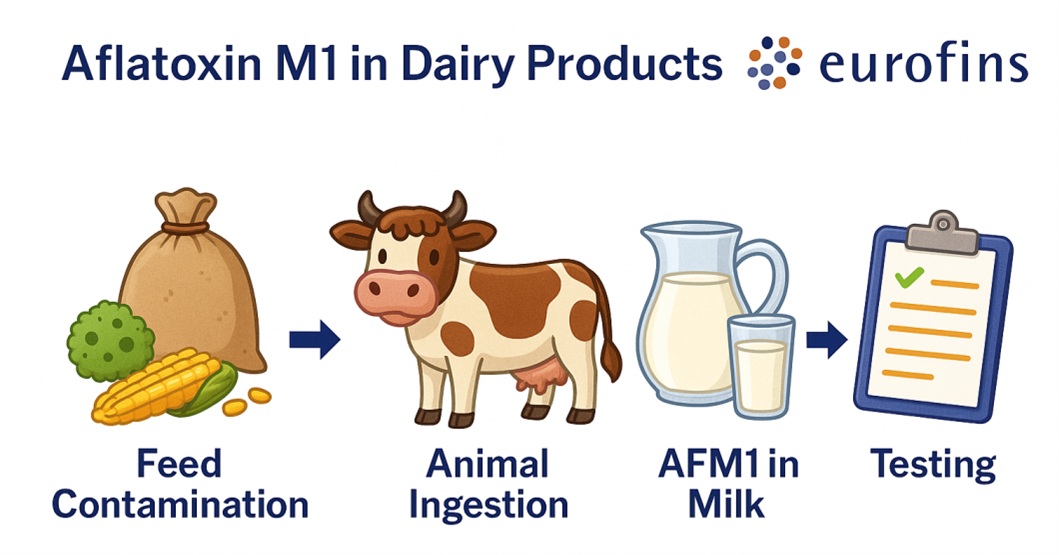
Eurofins offers comprehensive testing and risk management services to detect, quantify, and prevent AFM1 contamination in milk and dairy products. Our global network of ISO/IEC 17025 accredited laboratories integrates advanced analytical platforms with feed traceability programs to ensure safety from farm to finished product.
Types of Aflatoxins
Aflatoxins are a group of structurally related compounds known for their high toxicity and carcinogenic potential. The table below summarizes key aflatoxins relevant to the dairy industry:
|
Aflatoxin |
Produced By |
Common Occurrence |
Toxicological Concern |
|
Aflatoxin B1 (AFB1) |
Aspergillus flavus, A. parasiticus |
Feed grains, oilseeds, nuts |
Most potent carcinogen; precursor of AFM1 |
|
Aflatoxin B2 (AFB2) |
A. flavus |
Feed and cereals |
Moderate toxicity |
|
Aflatoxin G1 (AFG1) |
A. parasiticus |
Maize, peanuts |
Carcinogenic |
|
Aflatoxin G2 (AFG2) |
A. parasiticus |
Oilseeds |
Lower toxicity |
|
Aflatoxin M1 (AFM1) |
Metabolite of AFB1 |
Milk, cheese, butter |
Carcinogenic and heat-stable |
|
Aflatoxin M2 (AFM2) |
Metabolite of AFB2 |
Milk |
Mild toxicity |
AFM1 and AFM2 are of primary concern in the dairy industry due to their direct presence in consumer products.
Formation and Transmission Pathway
- Contaminated Feed: Dairy animals ingest feed (grains, oilseeds, silage) contaminated with AFB1.
- Metabolic Conversion: AFB1 is converted to AFM1 in the animal's liver.
- Excretion in Milk: AFM1 is excreted in milk within 12–24 hours of exposure.
- Persistence in Processing: AFM1 remains stable during pasteurization, boiling, or cheese maturation.
Due to its heat resistance, AFM1 persists in dairy derivatives such as milk powder, cheese, and yogurt, posing a continuous risk to consumers.
Health Implications
AFM1 is classified as a Group 1 carcinogen by the International Agency for Research on Cancer (IARC). Chronic exposure may lead to:
- Liver cancer and cirrhosis
- Suppressed immune response and reduced growth in children
- Mutagenic effects and reproductive toxicity
- Nutritional interference and oxidative stress
Infants and children are particularly vulnerable due to high milk consumption and lower detoxification capacity.
Analytical Testing Capabilities at Eurofins
Eurofins provides state-of-the-art analytical solutions for AFM1 detection across various dairy matrices.
Testing Techniques
- Liquid Chromatography–Tandem Mass Spectrometry (LC-MS/MS): Confirmatory analysis with high sensitivity.
- High-Performance Liquid Chromatography (HPLC-FLD): Precise quantification.
- Enzyme-Linked Immunosorbent Assay (ELISA): High-throughput screening.
Testing Coverage
- Raw and pasteurized milk
- Cheese, butter, yogurt, ghee, milk powder
- Animal feed and feed ingredients
All methods comply with Codex Alimentarius, FSSAI, EU, and FDA standards and are validated under ISO/IEC 17025 accreditation.
Regulatory Framework
Food Safety and Standards Authority of India (FSSAI)
- Liquid Milk: 0.5 µg/kg
- Skimmed Milk Powder: 6 µg/kg
- Whole Milk Powder: 4 µg/kg
European Union (Regulation (EC) No 2023/915)
- Milk (Liquid and Powdered): 0.05 µg/kg
- Infant Formula and Follow-on Formula: 0.025 µg/kg
https://fssai.gov.in/upload/uploadfiles/files/Comp_Contaminants_Regulations_2_4_2025_VIII.pdf
https://eur-lex.europa.eu/eli/reg_impl/2023/2782/oj/eng
Sources and Risk Factors
|
Stage |
Source |
Risk Factor |
Control Measure |
|
Feed |
Contaminated maize, groundnuts, cottonseed |
Fungal growth in storage |
Moisture control, antifungal agents |
|
Farm |
Animal ingestion |
Poor feed hygiene |
Regular feed testing, ration monitoring |
|
Collection |
Bulk tank mixing |
Cross-contamination |
Segregation of contaminated milk |
|
Processing |
Pasteurization, drying |
Heat-resistant AFM1 |
Routine intake and process testing |
|
Storage |
Packaging or handling |
Contamination during storage |
Temperature and humidity control |
Eurofins Feed-to-Milk Surveillance
Eurofins provides integrated monitoring systems to trace contamination from feed to final dairy products:
- Feed sampling and mycotoxin mapping
- Animal exposure assessment through metabolite monitoring
- Milk screening at collection and processing points
- Data trend analysis and regional contamination forecasting
Risk Management and Prevention
- Maintain feed moisture below 13% through proper drying and storage.
- Conduct regular AFM1 screening at farm and plant levels.
- Use mycotoxin binders or adsorbents in cattle feed.
- Monitor seasonal risk patterns (e.g., monsoon and post-harvest periods).
- Maintain supplier certification and traceability records.
Case Study: Restoring Export Compliance
A multinational dairy brand faced repeated export rejections due to AFM1 levels exceeding permissible limits. Eurofins conducted a root-cause analysis using feed and milk correlation studies, identifying contamination from poorly stored maize silage. By implementing revised feed sourcing and predictive weather-linked monitoring, AFM1 levels stabilized within global safety limits within two production cycles, restoring export certification and customer confidence.
Emerging Trends and Research
- Predictive Modeling: AI-driven forecasting of aflatoxin outbreaks.
- Natural Additives: Development of antifungal feed additives and probiotics.
- Molecular Tools: Rapid detection of Aspergillus contamination.
- Zero-Tolerance Policies: Stricter regulations for infant and organic milk categories.
Eurofins Service Portfolio for Dairy Safety
- Feed and milk testing for AFB1 and AFM1
- Predictive mycotoxin modeling and early-warning systems
- Regulatory guidance and documentation for export markets
- Consumer safety assurance programs and product certification
Why Choose Eurofins?
- Decades of expertise in mycotoxin and food contaminant testing
- Advanced analytical technology with parts-per-billion (ppb) detection
- Pan-India and global laboratory network for fast turnaround
- Integrated farm-to-fork food safety support
- Regulatory-compliant reporting with actionable insights
Protect your dairy products and safeguard consumer trust with Eurofins’ Aflatoxin M1 testing and risk management solutions. Our experts deliver reliable results, preventive insights, and full regulatory compliance to ensure product quality and global market access.
Enquire now: www.eurofins.in/food-testing/enquire-now/

