


Allergen Testing Capability

Food allergens are among the leading causes of food safety incidents, recalls, and consumer health risks worldwide. Even trace levels of undeclared allergens can trigger severe allergic reactions, including anaphylaxis, making allergen control a critical responsibility for food manufacturers and brand owners.
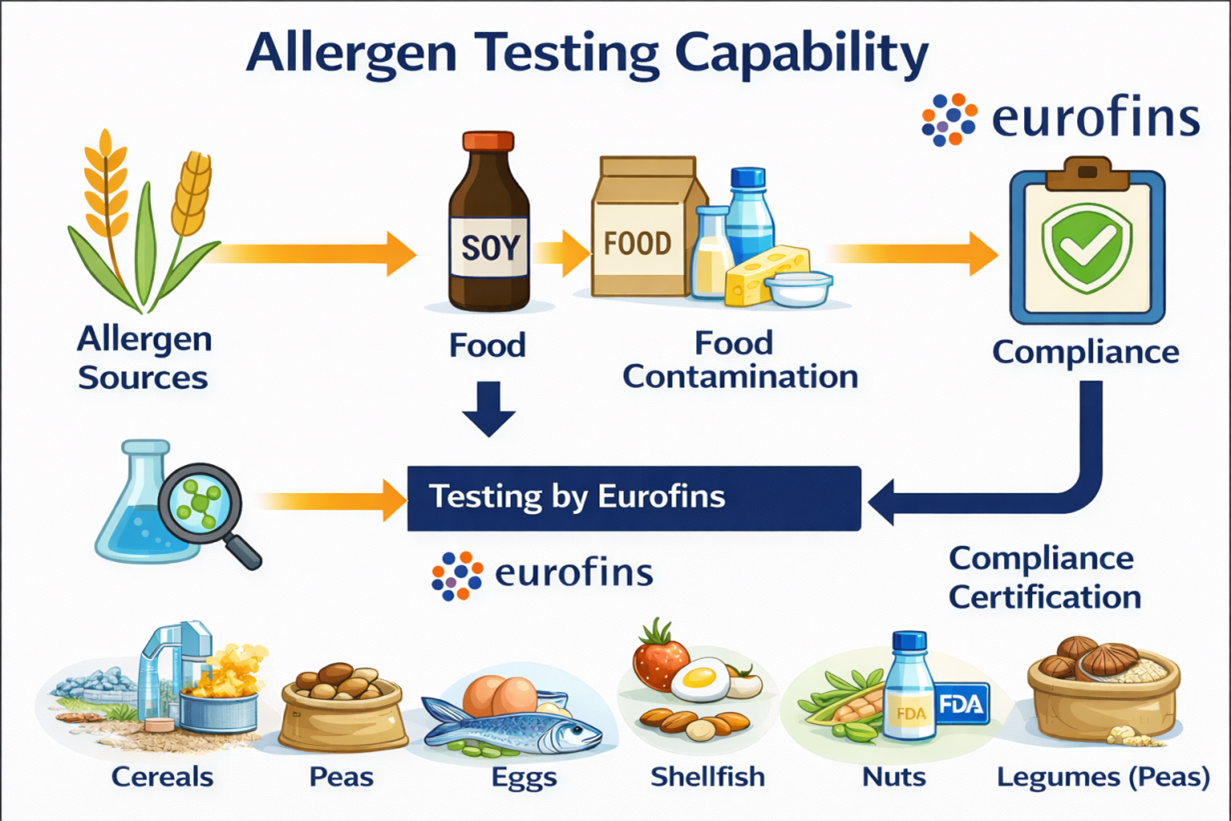
Eurofins delivers comprehensive allergen testing capabilities through its global network of ISO/IEC 17025-accredited laboratories. Using validated analytical methods, robust sampling strategies, and expert regulatory interpretation, Eurofins helps food businesses detect, control, and prevent allergen contamination while meeting global regulatory and labeling requirements.
Why Allergen Testing Is Essential
Allergen contamination can occur at multiple points in the supply chain, from raw material sourcing to final packaging. Effective allergen testing enables manufacturers to protect consumers, ensure compliance, and maintain brand trust.
|
Key Benefit |
Purpose |
|
Consumer safety |
Prevents allergic reactions and health incidents |
|
Regulatory compliance |
Meets FSSAI, EU, FDA, Codex, and GFSI requirements |
|
Accurate labeling |
Supports correct allergen declarations |
|
Recall prevention |
Reduces costly withdrawals and market damage |
|
Export assurance |
Ensures acceptance in global markets |
Major Food Allergens Monitored
Eurofins testing programs cover all globally recognized priority allergens.
|
Allergen Category |
Examples |
|
Cereals containing gluten |
Wheat, barley, rye, oats |
|
Nuts |
Almonds, cashews, peanuts, walnuts |
|
Dairy |
Milk, lactose, whey |
|
Eggs |
Whole egg, egg white, egg yolk |
|
Soy |
Soybeans, soy lecithin |
|
Seafood |
Fish, crustaceans, mollusks |
|
Seeds & others |
Sesame, mustard, celery, sulphites |
Products Commonly Tested
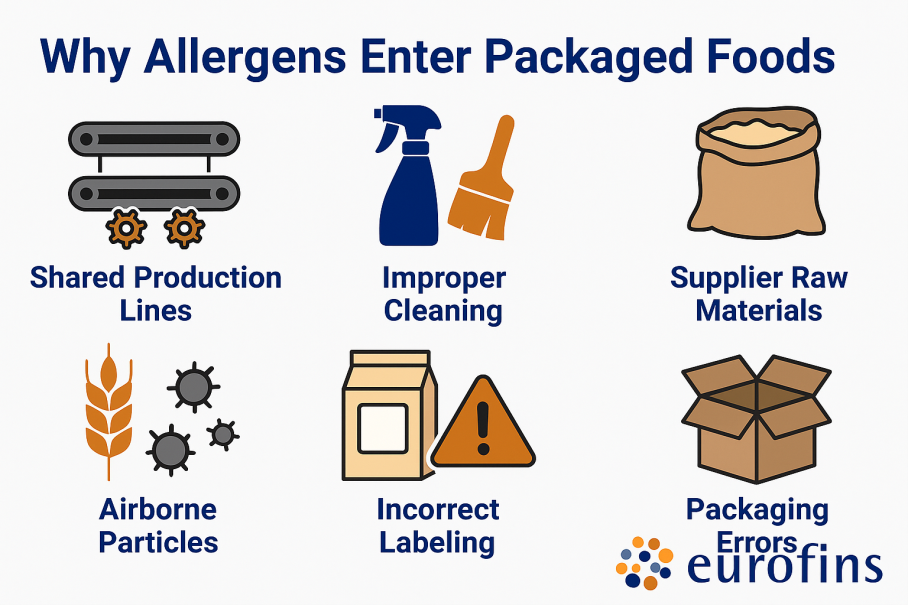 Allergen risks vary by product type, processing method, and facility design.
- Packaged and processed foods
- Bakery and confectionery products
- Dairy and infant nutrition
- Ready-to-eat meals
- Spices, herbs, and seasoning blends
- Plant-based and vegan foods
- Nutraceuticals and supplements
Sources of Allergen Contamination
|
Stage |
Typical Risk Factors |
|
Raw materials |
Undeclared allergens in ingredients |
|
Processing |
Shared equipment, cross-contact |
|
Cleaning |
Inadequate sanitation validation |
|
Packaging |
Label errors or mix-ups |
|
Storage & transport |
Cross-contamination between products |
Eurofins supports root-cause identification and preventive control strategies to minimize these risks.
Parameters to Test in Allergen Screening
|
Parameter |
Description |
|
|
1 |
Allergen-Specific Proteins |
Detection of key proteins that trigger immune responses. |
|
2 |
Allergen Traces from Cross-Contamination |
Verification of very low-level residues in multi-ingredient or shared-line products. |
|
3 |
Gluten Quantification |
Ensures compliance for “Gluten-Free” (≤ 20 ppm) and low-gluten label claims. |
|
4 |
Processed Food Allergen Stability |
Analyzes allergens that may survive baking, extrusion, frying, or roasting. |
|
5 |
Allergen Panel Testing |
Comprehensive multi-allergen screens for complex packaged foods. |
|
6 |
Verification of Cleaning Effectiveness |
Confirms that equipment sanitation removes allergenic residues. |
Eurofins Allergen Testing Capabilities
Analytical Methods
- ELISA for routine allergen screening
- PCR-based DNA analysis for species-specific detection
- LC-MS/MS for multiplex allergen confirmation
- Lateral flow devices for rapid on-site checks
Testing Scope
- Single-allergen and multi-allergen panels
- Raw materials, in-process samples, and finished products
- Cleaning validation and environmental swabs
Allergen Compliance Workflow
|
Step |
Objective |
Eurofins Solution |
|
Ingredient screening |
Identify allergen presence |
Targeted ELISA / PCR |
|
Process verification |
Prevent cross-contact |
In-process monitoring |
|
Cleaning validation |
Confirm sanitation effectiveness |
Swab and rinse testing |
|
Finished product testing |
Label accuracy verification |
Multi-allergen panels |
|
Reporting |
Audit and export readiness |
Digital CoA and trend analysis |
Regulatory and Labeling Alignment
Regulations and Standards
Food Allergens – FSSAI Guidelines (India)
As per Food Safety and Standards (Labelling and Display) Regulations, 2020 and Direction dated 22nd October 2021 (effective from 1st July 2022), the following allergens must be clearly declared on pre-packaged food labels.
|
Allergen |
Declaration Requirement |
Specific Exemptions / Notes |
|
Cereals containing gluten |
Name of the cereal must be declared (e.g., wheat, rye, barley, oats, spelt or their hybridised strains) |
• Wheat-based glucose syrups including dextrose • Wheat-based maltodextrins • Barley glucose syrups • Cereals used for alcoholic distillates (gluten ≤ 20 mg/kg) |
|
Crustaceans and products thereof |
Declare as “Crustacean” |
None |
|
Eggs and egg products |
Declare as “Egg” |
None |
|
Fish and fish products |
Declare as “Fish” |
None |
|
Peanuts and products thereof |
Declare as “Peanut” or “Nut” |
None |
|
Tree nuts and products thereof |
Declare as “Nut” (specific name recommended) |
None |
|
Soybeans and products thereof |
Declare as “Soy” |
None |
|
Milk and milk products |
Declare as “Milk” |
None |
|
Sulphites |
Declare as “Sulphite” when ≥ 10 mg/kg |
None |
|
Cross-contamination (voluntary) |
“May contain [name of allergen]” |
Only when unavoidable |
|
Highly refined oils & distilled alcoholic beverages derived from allergens |
No declaration required |
Applies to fully refined oils and distillates |
|
Raw agricultural commodities |
Completely exempt |
— |
Food Allergens – European Union (EU) Law
Regulation (EU) No 1169/2011 (Food Information to Consumers Regulation) – Annex II lists 14 substances or products causing allergies or intolerances that must always be declared and emphasised in the ingredients list (effective since 13 December 2014).
|
Allergen |
Declaration Requirement |
Specific Exemptions / Notes |
|
Cereals containing gluten |
Specific name of cereal (wheat, rye, barley, oats, spelt, kamut, etc.) |
• Wheat/barley glucose syrups & dextrose • Wheat maltodextrins • Distillates for spirits |
|
Crustaceans and products thereof |
“Crustaceans” |
None |
|
Eggs and products thereof |
“Eggs” |
None |
|
Fish and products thereof |
“Fish” |
• Fish gelatine/isinglass as fining agent or carrier |
|
Peanuts and products thereof |
“Peanuts” |
None |
|
Soybeans and products thereof |
“Soybeans” or “Soya” |
• Fully refined soybean oil & fat • Tocopherols, phytosterols from soy sources |
|
Milk and products thereof (incl. lactose) |
“Milk” |
• Whey/lactitol in distillates • Certain milk derivatives |
|
Nuts (tree nuts) |
“Nuts” + specific name (almond, hazelnut, walnut, cashew, pecan, Brazil nut, pistachio, macadamia/Queensland nut) |
• Nuts used in distillates & certain flavourings |
|
Celery and products thereof |
“Celery” |
None |
|
Mustard and products thereof |
“Mustard” |
None |
|
Sesame seeds and products thereof |
“Sesame seeds” or “Sesame” |
None |
|
Lupin and products thereof |
“Lupin” |
None |
|
Molluscs and products thereof |
“Molluscs” |
None |
|
Sulphur dioxide and sulphites |
“Sulphur dioxide and sulphites” when ≥ 10 mg/kg or 10 mg/L (expressed as SO₂) |
Threshold applies |
https://www.fssai.gov.in/upload/uploadfiles/files/Compendium_Labelling_Display_30_06_2022.pdf
Case Study: Preventing a Major Allergen Recall
A ready-to-eat food manufacturer detected trace peanut contamination in a non-nut product during export testing. Eurofins conducted targeted ELISA screening and environmental swab analysis, identifying cross-contact from shared packaging equipment. Corrective cleaning protocols and revised allergen zoning were implemented, preventing a large-scale recall and restoring export approvals.
Why Choose Eurofins
- Global network of accredited laboratories
- Comprehensive allergen coverage across food categories
- High-sensitivity, validated analytical methods
- Expert regulatory and labeling support
- Fast turnaround times with digital reporting
Strengthen your allergen control program with Eurofins’ advanced allergen testing capabilities. From raw material screening to finished product verification, our experts help you protect consumers, ensure compliance, and safeguard your brand.
Partner with Eurofins your trusted pathway to compliant, export-ready food
Enquire now: www.eurofins.in/food-testing/enquire-now/

