


Antibiotic & Hormone Residue Testing

Antibiotic and hormone residue testing is essential for ensuring the safety, quality, and regulatory compliance of food, feed, and agricultural products. Residues may remain in meat, milk, eggs, seafood, honey, and feed materials due to improper withdrawal periods, excessive or unauthorized veterinary drug use, contaminated feed, or cross-contamination during farming and processing.
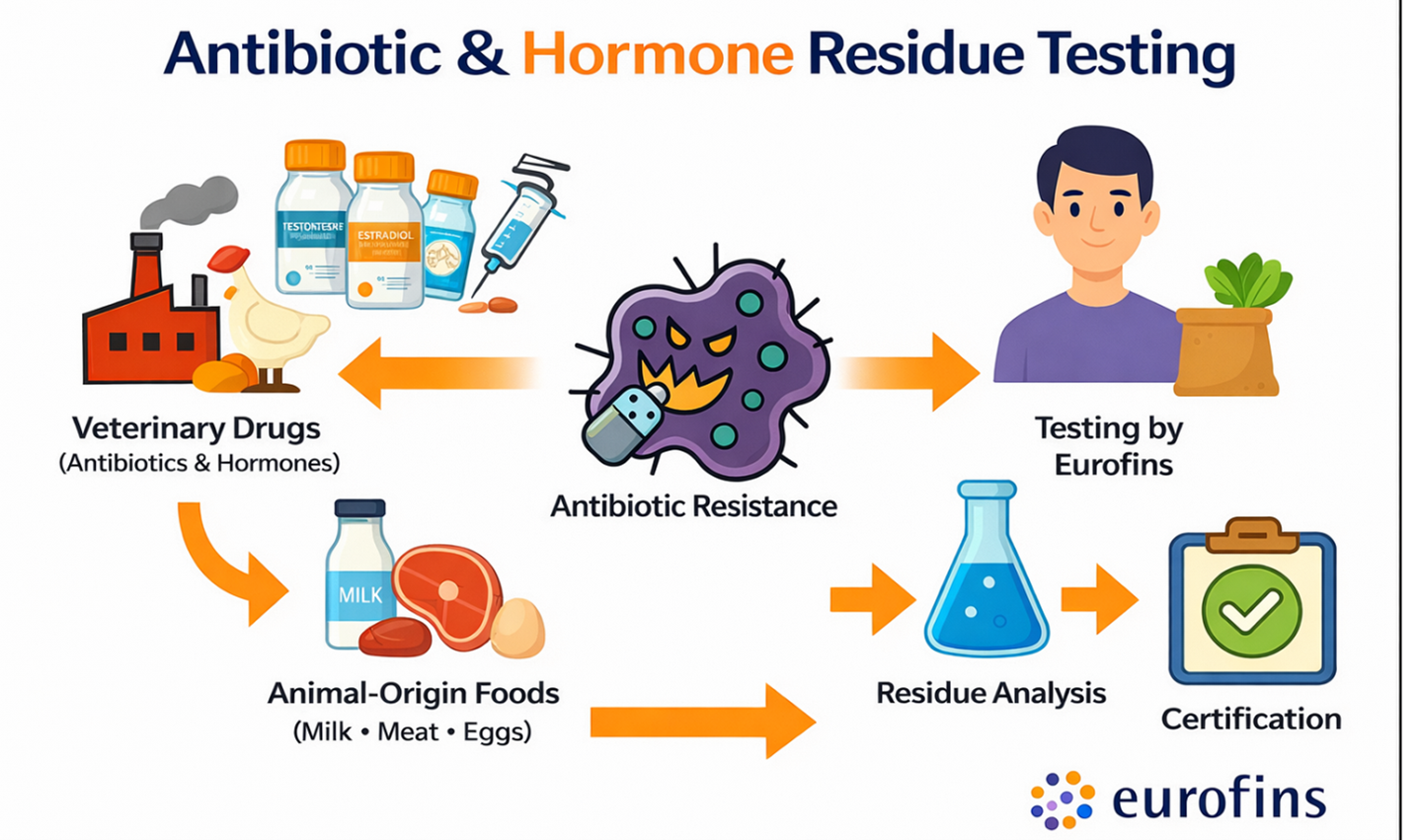
Even trace-level residues can contribute to antimicrobial resistance (AMR), endocrine disruption, allergic reactions, international trade restrictions, and rejection of products in domestic and export markets.
Eurofins provides comprehensive antibiotic and hormone residue testing services using advanced instrumentation and globally validated methods to help producers, processors, exporters, feed mills, and regulators detect residues, maintain compliance, and safeguard consumer health.
Why Antibiotic & Hormone Residue Testing Matters
|
Benefit |
Purpose |
|
Consumer safety |
Prevents exposure to harmful drug and hormone residues |
|
Regulatory compliance |
Meets FSSAI, EU, Codex, US FDA, and export regulations |
|
Animal health oversight |
Ensures correct withdrawal periods and responsible drug use |
|
Market acceptance |
Reduces risk of export rejections and recalls |
|
AMR & endocrine risk control |
Limits antimicrobial resistance and hormonal disruption |
|
Supply chain integrity |
Prevents misuse, overuse, and fraudulent practices |
Common Antibiotics & Hormones Detected
Major Antibiotic Classes Screened
- Tetracyclines
- Sulfonamides
- Aminoglycosides
- Fluoroquinolones
- Macrolides
- Beta-lactams
- Polypeptides
- Lincosamides
- Nitrofurans and metabolites
- Chloramphenicol
Hormones & Growth Promoters Monitored
- Natural steroid hormones (estradiol, testosterone, progesterone)
- Synthetic anabolic steroids
- Stilbenes
- Beta-agonists (e.g., clenbuterol, salbutamol)
- Thyreostats
- Corticosteroids
Hormones are tightly regulated or prohibited in many jurisdictions due to their endocrine-disrupting potential.
Products Commonly Tested
|
Product Category |
Examples |
|
Milk & Dairy |
Raw milk, processed milk, cheese, butter |
|
Meat & Poultry |
Chicken, mutton, beef, processed meats |
|
Seafood & Aquaculture |
Shrimp, fish, mollusks |
|
Eggs & Egg Products |
Table eggs, liquid eggs |
|
Animal Feed |
Poultry feed, cattle feed, aquafeed |
|
Honey & Bee Products |
Natural honey, comb, royal jelly |
|
Infant food raw materials |
Milk powder, proteins, fats |
Sources of Antibiotic & Hormone Residues
|
Source |
Description |
|
Improper withdrawal periods |
Animals slaughtered or milked before drug clearance |
|
Unauthorized drug or hormone use |
Illegal growth promotion or off-label use |
|
Contaminated feed |
Carry-over from medicated feed |
|
Cross-contamination |
Shared milking, feeding, or processing equipment |
|
Aquaculture misuse |
Unapproved antibiotics or hormones in ponds |
Health Risks from Residues
|
Risk Type |
Impact |
|
Antimicrobial resistance (AMR) |
Reduced effectiveness of antibiotics |
|
Endocrine disruption |
Hormonal imbalance, developmental effects |
|
Allergic reactions |
Hypersensitivity, anaphylaxis |
|
Gut microbiome disruption |
Long-term immunity and digestive effects |
|
Toxicity |
Chloramphenicol, nitrofurans, anabolic steroids |
Eurofins Instrumental & Analytical Services
|
Instrument / Platform |
Purpose |
|
LC-MS/MS |
High-sensitivity multi-residue detection of antibiotics & hormones |
|
GC-MS/MS |
Analysis of steroid hormones and metabolites |
|
HPLC-DAD / UV |
Quantification of specific veterinary drugs |
|
ELISA screening kits |
Rapidapid class-specific screening |
|
Microbial inhibition assays |
Broad-spectrum antimicrobial activity detection |
Detection limits meet MRL, EMRL, and MRPL requirements across global markets.
Global and Indian Regulations
The Food Safety and Standards (Contaminants, Toxins and Residues) Regulations, 2011, Version VIII (effective 01.04.2025), issued by the Food Safety and Standards Authority of India (FSSAI), establishes stringent limits on antibiotics and pharmacologically active substances in food to address antimicrobial resistance (AMR).
Section 2.3.2 sets maximum residue limits for antibiotics in seafood (e.g., Tetracycline at 0.1 mg/kg), bans specific antimicrobials like Chloramphenicol (EMRL 0.0003 mg/kg) in meat, milk, poultry, eggs, and aquaculture, and prohibits antibiotic use in honey production with Minimum Required Performance Limits (MRPLs, e.g., 0.3 µg/kg for Chloramphenicol) to detect misuse. It also specifies tolerance limits for antimicrobials in various foods to ensure safety and minimize AMR risks, aligning with global health standards. Below are the key tables summarizing these regulations:
Table 1: Antibiotics in Seafood
|
S.No. |
Name of Antibiotics |
Tolerance Limit (mg/kg or ppm) |
|
1. |
Tetracycline |
0.1 |
|
2. |
Oxytetracycline |
0.1 |
|
3. |
Trimethoprim |
0.05 |
|
4. |
Oxolinic acid |
0.3 |
Table 2: Prohibited Antimicrobials and Drugs in Veterinary Practices
|
S.No. |
Prohibited Substances |
|
1. |
Carbadox |
|
2. |
Chloramphenicol (EMRL: 0.0003 mg/kg) |
|
3. |
Chlorpromazine |
|
4. |
Clenbuterol |
|
5. |
Colistin |
|
6. |
Crystal Violet (Sum of Crystal Violet and Leucocrystal Violet) |
|
7. |
Glycopeptides |
|
8. |
Malachite Green (Sum of Malachite Green and Leucomalachite Green) |
|
9. |
Nitrofurans and its metabolites (furazolidone (AOZ), nitrofurazone (SEM), furaltadone (AMOZ), nitrofurantoin (AHD)) |
|
10. |
Streptomycin and its metabolite dihydrostreptomycin |
|
11. |
Nitroimidazoles (including Dimetridazole, Ronidazole, Ipronidazole, Metronidazole, and their metabolites) |
|
12. |
Steroids |
|
13. |
Stilbenes |
|
14. |
Sulphamethoxazole |
|
EMRL: 0.001 mg/kg for all except Chloramphenicol (0.0003 mg/kg). |
Table 3: Antibiotics in Honey
|
Serial No. |
Name of Antibiotics |
Maximum Residue Performance Limit (MRPL) (µg/kg) |
|
1. |
Chloramphenicol |
0.3 |
|
2. |
Nitrofurans and its metabolites |
1 |
|
3. |
Sulphonamides and its metabolites |
10 (individually or collectively) |
|
4. |
Streptomycin |
10 (individually or collectively) |
|
5. |
Tetracycline |
10 |
|
6(a). |
Oxytetracycline |
10 |
|
6(b). |
Chlortetracycline |
10 |
|
7. |
Ampicillin |
10 |
|
8. |
Enrofloxacin |
10 |
|
9. |
Ciprofloxacin |
10 |
|
10. |
Erythromycin |
10 |
|
11. |
Tylosin |
10 |
Table 4: Antimicrobials and Drugs in Various Foods
|
Serial No. |
Antimicrobials and Drugs |
Food |
Tolerance Limit (mg/kg) |
|
1. |
Ampicillin |
All edible animal tissues, Fats, Milk |
0.01 |
|
Finfish |
0.05 |
||
|
2. |
Amprolium |
Cattle (Kidney, Liver, Muscle) |
0.5 |
|
Cattle (Fat) |
2.0 |
||
|
Poultry (Kidney, Liver) |
1.0 |
||
|
Poultry (Egg) |
7.0 |
||
|
Poultry (Muscle) |
0.5 |
||
|
3. |
Apramycin |
All edible animal tissues except fish, Fats, Milk |
0.01 |
|
4. |
Albendazole |
Species not specified (Muscle, Fat, Milk, Fish) |
0.1 |
|
Species not specified (Liver, Kidney) |
5.0 |
||
|
5. |
Amoxicillin |
Cattle, Pig, Sheep (Muscle, Liver, Kidney, Fat) |
0.05 |
|
Cattle, Sheep (Milk) |
0.004 |
||
|
Finfish (Fillet, Muscle) |
0.05 |
||
|
6. |
Cloxacillin |
All edible animal tissues, Fats |
0.01 |
|
Milk |
0.03 |
||
|
7. |
Chlortetracycline/Oxytetracycline/Tetracycline |
Cattle, Pig, Poultry, Sheep (Muscle) |
0.2 |
|
Cattle, Pig, Poultry, Sheep (Liver) |
0.6 |
||
|
Cattle, Pig, Poultry, Sheep (Kidney) |
1.2 |
||
|
Cattle, Sheep (Milk) |
0.1 |
||
|
Poultry (Eggs) |
0.4 |
||
|
Giant prawn (muscle), Fish |
0.2 |
||
|
8. |
Ceftiofur |
Cattle, Pig, Sheep (Muscle) |
1.0 |
|
Cattle, Pig, Sheep (Liver) |
2.0 |
||
|
Cattle, Pig, Sheep (Kidney) |
6.0 |
||
|
Cattle, Pig, Sheep (Fat) |
2.0 |
||
|
Cattle (Milk) |
0.1 mg/l |
||
|
9. |
Cephapirine |
All edible animal tissues except fish, Fats |
0.01 |
|
Milk |
0.06 |
||
|
10. |
Clopidol |
All edible animal tissues except fish, Fats |
0.01 |
|
11. |
Closantel |
Cattle (Muscle, Liver) |
1.0 |
|
Cattle (Kidney) |
3.0 |
||
|
Cattle (Fat) |
3.0 |
||
|
Sheep (Muscle, Liver) |
1.5 |
||
|
Sheep (Kidney) |
5.0 |
||
|
Sheep (Fat) |
2.0 |
||
|
Milk (Bovine) |
0.045 |
||
|
12. |
Cefphacetrile |
All edible animal tissues except fish, Fats |
0.01 |
|
Milk |
0.125 |
||
|
13. |
Cephalexin |
All edible animal tissues except fish, Fats |
0.01 |
|
Milk |
0.1 |
||
|
14. |
Danofloxacin |
Cattle, Pig, Chicken (Muscle) |
0.2 (Cattle, Chicken), 0.1 (Pig) |
|
Cattle, Chicken (Liver, Kidney) |
0.4 |
||
|
Pig (Liver) |
0.05 |
||
|
Pig, Chicken (Kidney) |
0.2 |
||
|
Cattle, Pig, Chicken (Fat) |
0.1 |
||
|
15. |
Doramectin |
Cattle (Muscle) |
0.01 |
|
Cattle (Liver, Kidney) |
0.1, 0.03 |
||
|
Cattle (Fat) |
0.15 |
||
|
Cattle (Milk) |
0.015 |
||
|
Pig (Muscle) |
0.005 |
||
|
Pig (Liver, Kidney, Fat) |
0.1, 0.03, 0.15 |
||
|
16. |
Diminazene |
Cattle (Muscle) |
0.5 |
|
Cattle (Liver) |
12.0 |
||
|
Cattle (Kidney) |
6.0 |
||
|
Cattle (Milk) |
0.15 |
||
|
17. |
Erythromycin |
Chicken, Turkey (Muscle, Liver, Kidney, Fat) |
0.1 |
|
Chicken (Eggs) |
0.05 |
||
|
18. |
Flumequine |
Cattle, Chicken, Pig, Sheep, Trout (Muscle) |
0.5 |
|
Cattle, Chicken, Pig, Sheep (Liver) |
0.5 |
||
|
Cattle, Chicken, Pig, Sheep (Kidney) |
3.0 |
||
|
Cattle, Chicken, Pig, Sheep (Fat) |
1.0 |
||
|
19. |
Flunixin |
All edible animal tissues except fish, Fats, Milk |
0.01 |
|
20. |
Febantel/Fenbendazole/Oxyfendazole |
Cattle, Pig, Sheep, Goat (Muscle, Liver, Kidney, Fat, Milk) |
0.1 (Muscle, Fat, Milk), 0.5 (Liver, Kidney) |
|
21. |
Gentamicin |
Cattle, Pig (Muscle, Fat) |
0.1 |
|
Cattle, Pig (Liver) |
2.0 |
||
|
Cattle, Pig (Kidney) |
5.0 |
||
|
Cattle (Milk) |
0.2 mg/l |
||
|
22. |
Ivermectin |
Cattle (Milk) |
0.01 |
|
Cattle (Liver, Fat, Muscle, Kidney) |
0.8, 0.4, 0.03, 0.1 |
||
|
Pig, Sheep (Liver) |
0.015 |
||
|
Pig, Sheep (Fat) |
0.02 |
||
|
23. |
Lincomycin |
Cattle (Milk) |
0.15 |
|
Chicken, Pig (Muscle) |
0.2 |
||
|
Chicken, Pig (Liver) |
0.5 |
||
|
Chicken (Kidney) |
0.5 |
||
|
Pig (Kidney) |
1.5 |
||
|
Chicken, Pig (Fat) |
0.1 |
||
|
24. |
Levamisole |
Cattle, Pig, Sheep, Poultry (Muscle, Liver, Kidney, Fat) |
0.01 (Muscle, Kidney, Fat), 0.1 (Liver) |
|
25. |
Monensin |
Cattle, Sheep, Goat, Chicken, Turkey, Quail (Muscle, Kidney) |
0.01 |
|
Cattle, Sheep, Goat (Liver) |
0.1 (Cattle), 0.02 (Sheep, Goat) |
||
|
Cattle, Sheep, Goat, Chicken, Turkey, Quail (Fat) |
0.1 |
||
|
Cattle (Milk) |
0.002 |
||
|
26. |
Moxidectin |
Cattle (Muscle) |
0.02 |
|
Cattle, Sheep (Liver, Kidney) |
0.1, 0.05 |
||
|
Cattle, Sheep (Fat) |
0.5 |
||
|
27. |
Meloxicam |
Bovines (Muscle) |
0.02 |
|
Bovines (Kidney, Liver) |
0.065 |
||
|
Bovines (Milk) |
0.015 |
||
|
28. |
Neomycin |
Cattle, Chicken, Duck, Goat, Pig, Sheep, Turkey (Muscle, Liver, Fat) |
0.5 |
|
Cattle, Chicken, Duck, Goat, Pig, Sheep, Turkey (Kidney) |
10 |
||
|
Cattle (Milk) |
1.5 |
||
|
Chicken (Eggs) |
0.5 |
||
|
29. |
Nicarbazin |
Chicken (Kidney, Fat or skin, Liver, Muscle) |
0.2 |
|
30. |
Oxybendazole |
All edible animal tissues except fish, Fats |
0.01 |
|
31. |
Oxyclozanide |
All edible animal tissues except fish, Fats, Milk |
0.01 |
|
32. |
Parbendazole |
All edible animal tissues except fish, Fats, Milk |
0.01 |
|
33. |
Praziquantel |
Pig (All edible tissues) |
0.01 |
|
Sheep (All edible tissues) |
0.05 |
||
|
34. |
Penicillin G/Benzylpenicillin |
Pig, Chicken, Cattle (Muscle, Liver, Kidney) |
0.05 |
|
Cattle (Milk) |
0.004 |
||
|
35. |
Spectinomycin |
Cattle, Chicken, Pig, Sheep (Muscle, Liver, Fat) |
0.5, 2.0 (Liver), 2.0 (Fat) |
|
Cattle, Chicken, Pig, Sheep (Kidney) |
5.0 |
||
|
Cattle (Milk) |
0.2 mg/l |
||
|
Chicken (Eggs) |
2.0 |
||
|
36. |
Sulfadiazine |
All edible animal tissues, Fats, Milk |
0.01 |
|
37. |
Sulfanilamide |
All edible animal tissues, Fats, Milk |
0.01 |
|
38. |
Sulfaquinoxaline |
All edible animal tissues except fish, Fats, Milk |
0.01 |
|
39. |
Sulfadimidine |
Cattle (Milk) |
0.025 |
|
No Specified (Muscle, Fat, Kidney, Liver) |
0.1 |
||
|
40. |
SulfaChloropyrazine |
All edible animal tissues except fish, Fats, Milk |
0.01 |
|
41. |
Sulfamethazine |
All edible animal tissues except fish, Fats |
0.01 |
|
42. |
Sulfadimethoxine |
All edible animal tissues except fish, Fats, Milk |
0.01 |
|
43. |
Thiabendazole |
Cattle, Pig, Sheep, Goat (Muscle, Liver, Kidney, Fat, Milk) |
0.1 |
|
44. |
Triclabendazole |
Cattle (Muscle) |
0.25 |
|
Cattle (Liver, Kidney, Fat or skin) |
0.85, 0.4, 0.1 |
||
|
Sheep (Muscle, Liver, Kidney, Fat or skin) |
0.2, 0.3, 0.2, 0.1 |
||
|
Milk (All ruminants) |
0.01 |
||
|
45. |
Trimethoprim |
All edible animal tissues except fish, Fats |
0.01 |
|
Milk |
0.05 |
||
|
46. |
Tylosin |
Cattle, Pig, Sheep, Chicken (Muscle, Liver, Kidney, Fat or skin) |
0.1 |
|
Chicken (Eggs) |
0.3 |
||
|
47. |
Virginiamycin |
Poultry and egg |
0.01 |
|
48. |
Xylazine |
All edible animal tissues except fish, Fats |
0.01 |
|
49. |
Zinc Bacitracin |
All edible animal tissues except fish, Fats |
0.01 |
|
Milk |
0.1 |
https://www.fssai.gov.in/upload/uploadfiles/files/Comp_Contaminants_Regulations_2_4_2025_VIII.pdf
Global and National AMR Regulations
|
Jurisdiction |
Regulation / Standard |
Key Requirements / Objectives |
|
FSSAI (India) |
Food Safety and Standards (Contaminants, Toxins and Residues) First Amendment Regulations, 2024 (Effective April 1, 2025) |
Bans 14 antibiotics (e.g., chloramphenicol, colistin) in meat, milk, poultry, aquaculture, and honey. Sets residue limits (≤0.001 mg/kg) and aligns with Muscat Manifesto to reduce antimicrobial use by 30–50% by 2030. |
|
MoHFW (India) |
National Action Plan on AMR (NAP-AMR II, 2024–2029) |
Enforces One Health surveillance, regulates antibiotic sales, and aligns with FSSAI’s antibiotic limits. |
|
EU |
Council Recommendation on AMR (2023) and Regulation (EU) 2024/580 |
Limits livestock antibiotic use, bans growth-promoter antibiotics, and requires residue reporting to EFSA. |
|
WHO (Global) |
WHO Global Action Plan on AMR (Updated 2024) |
Targets 30–50% reduction in agrifood antimicrobial use by 2030, strengthens surveillance, and supports Muscat commitments. |
Eurofins Testing Capabilities
Comprehensive Residue Panels
- Multi-class antibiotic & hormone screening
- Quantification aligned with MRL / EMRL / MRPL
- Risk-ranked interpretation
Regulatory Compliance Testing
- FSSAI
- EU Regulation (EC) 37/2010
- Codex MRLs
- US FDA & USDA
Specialized Programs
- Aquaculture & shrimp export residue testing
- Dairy antibiotic & hormone monitoring
- Slaughterhouse compliance verification
- Feed contamination root-cause analysis
Eurofins Testing Workflow
|
Step |
Purpose |
|
Sampling plan |
Representative and compliant sampling |
|
Screening |
Broad-spectrum detection |
|
Confirmatory testing |
LC-MS/MS or GC-MS/MS quantification |
|
Interpretation |
Comparison with legal thresholds |
|
Reporting |
Digital CoA & export-ready documentation |
Case Study: Antibiotic & Hormone Residue Compliance
An export-oriented dairy and poultry producer partnered with Eurofins to strengthen antibiotic and hormone residue monitoring. Multi-residue LC-MS/MS testing detected trace non-compliances linked to withdrawal practices. Corrective actions and re-testing confirmed compliance with FSSAI and EU limits, enabling smooth exports and improved buyer confidence.
Why Choose Eurofins
- ISO/IEC 17025-accredited global laboratories
- Advanced trace-level detection capabilities
- Expertise across food, dairy, poultry, aquaculture, feed & exports
- Strong regulatory awareness across EU, US, and Asia
- Fast turnaround with secure digital reporting
- Trusted by manufacturers, exporters, integrators & regulators
Partner with Eurofins Antibiotic & Hormone Residue Testing Laboratories to:
- Detect residues with precision
- Ensure global regulatory compliance
- Protect consumer health and brand reputation
- Reduce rejections, recalls, and AMR risks
Partner with Eurofins your trusted pathway to compliant, export-ready food
Enquire now: www.eurofins.in/food-testing/enquire-now/

