


Antimicrobial Resistance (AMR): The Hidden Threat in the Food Chain

Introduction: A Global Food Safety Challenge
Antimicrobial resistance (AMR) is a silent but escalating threat that undermines the effectiveness of antibiotics the cornerstone of modern medicine and food safety. Once confined to clinical settings, AMR now spreads across farms, water bodies, processing units, and retail food systems. Resistant microorganisms can enter the food chain through animal products, plant-based foods, or contaminated environments, eventually reaching consumers.
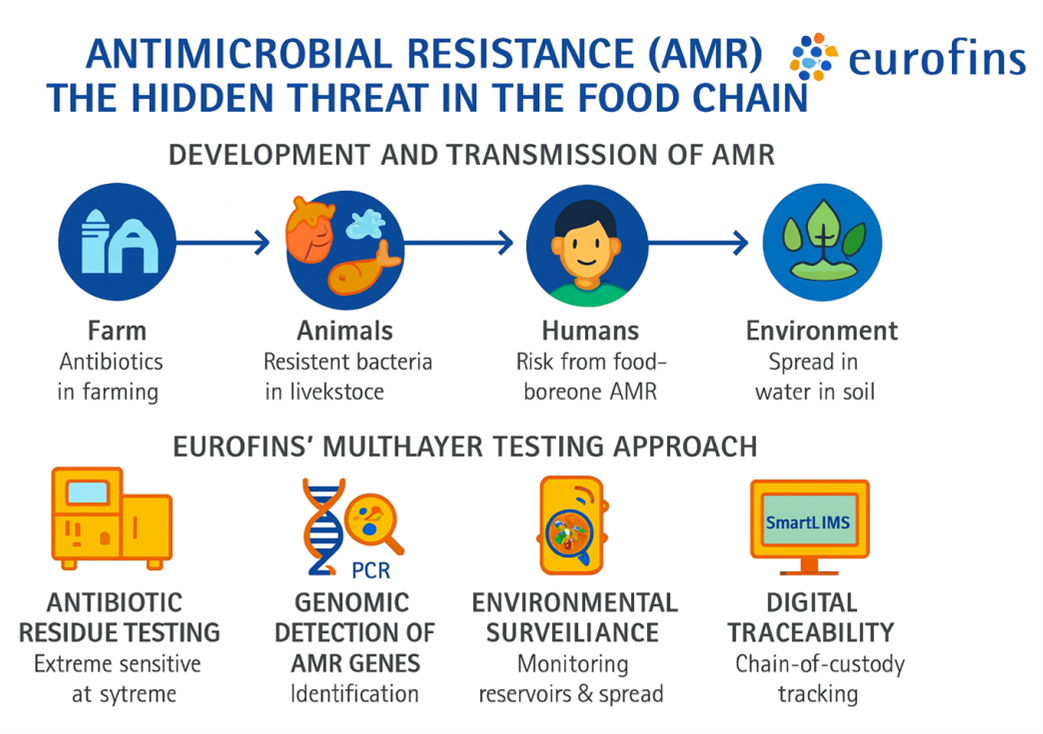 The World Health Organization (WHO) and FAO identify AMR as one of the top ten global public health threats, potentially causing 10 million deaths annually by 2050 if left unchecked.
At Eurofins Food Testing Laboratories, we recognize AMR not just as a health crisis but as a food safety and trade challenge. Through advanced genomics, residue analytics, and data-driven surveillance, Eurofins enables industries, regulators, and exporters to detect, manage, and mitigate AMR at every stage of the food chain.
Understanding AMR: How It Develops and Spreads
- What Is Antimicrobial Resistance?
AMR occurs when microorganisms (bacteria, fungi, or parasites) evolve mechanisms that render antimicrobial agents ineffective. This results in “superbugs”—pathogens that survive treatment, persist in food systems, and transfer resistance genes to other bacteria.
- Pathways of Resistance Formation
- Overuse and misuse of antibiotics in livestock, poultry, and aquaculture feed as growth promoters.
- Non-compliance with withdrawal periods, leading to residual antibiotics in edible products.
- Cross-contamination during slaughtering, food handling, or storage.
- Environmental spread via water, soil, and waste contaminated with antibiotics or resistant bacteria.
- The One Health Perspective
AMR connects human health, animal health, and the environment—a “One Health” issue. Resistant bacteria and genes move seamlessly between ecosystems, meaning controlling AMR in food systems is vital to protecting both people and the planet.
The Food Chain Pathway of AMR
|
Stage |
Source of Resistance |
Path of Transmission |
Example |
|
Farm |
Antibiotic overuse in animal husbandry |
Feed and water contamination |
Tetracycline residues in poultry |
|
Processing |
Cross-contamination in equipment |
Biofilm formation, inadequate sanitation |
Resistant Salmonella in meat lines |
|
Environment |
Wastewater and manure runoff |
Soil and irrigation water pollution |
AMR E. coli in fresh produce |
|
Retail & Consumption |
Improper cooking/storage |
Resistant bacteria survive and spread |
Listeria monocytogenes in RTE foods |
Major Resistant Bacteria Detected in Food
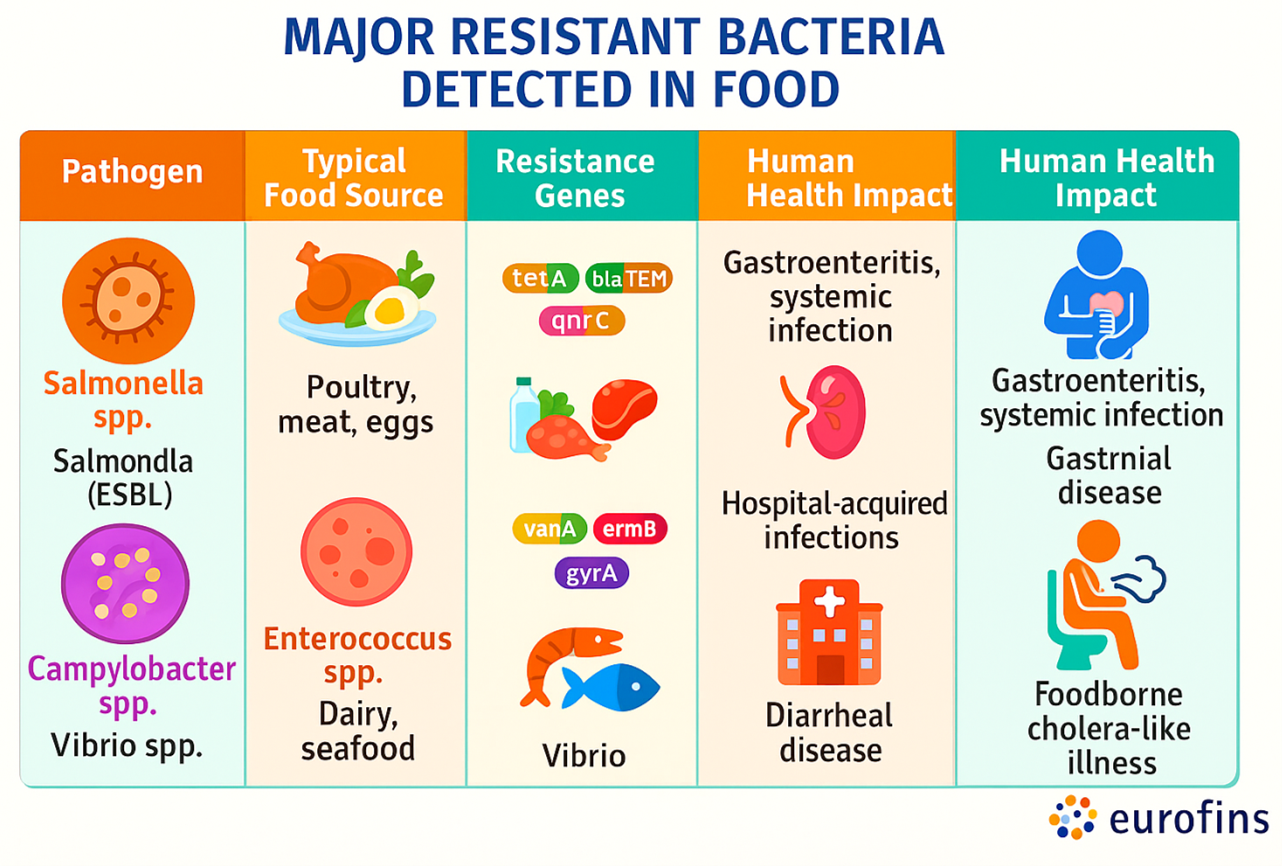
|
Pathogen |
Typical Food Source |
Resistance Genes |
Human Health Impact |
|
Salmonella spp. |
Poultry, meat, eggs |
tetA, blaTEM, qnr |
Gastroenteritis, systemic infection |
|
E. coli (ESBL) |
Meat, milk, vegetables |
blaCTX-M, ampC |
Urinary and bloodstream infections |
|
Enterococcus spp. |
Dairy, seafood |
vanA, ermB |
Hospital-acquired infections |
|
Campylobacter spp. |
Poultry, dairy |
gyrA, cmeABC |
Diarrheal disease |
|
Vibrio spp. |
Shrimp, fish |
blaOXA, sul1 |
Foodborne cholera-like illness |
Eurofins’ Advanced AMR Detection and Monitoring Framework
- Antibiotic Residue Testing
- Eurofins uses LC-MS/MS, GC-MS/MS, and UHPLC to detect antibiotic residues with precision at ppb/ppt levels.
- Monitors over 120 veterinary drug classes, including sulfonamides, fluoroquinolones, macrolides, tetracyclines, β-lactams, and aminoglycosides.
- Compliance with FSSAI, EU 37/2010, Codex, and FDA MRLs.
- Applied in dairy, meat, seafood, and honey sectors.
- Molecular Detection of Resistance Genes
- PCR and multiplex PCR detect key resistance genes such as mecA, tet, blaCTX-M, vanA, and qnr.
- qPCR quantification measures gene abundance and monitors reduction after mitigation steps.
- Whole Genome Sequencing (WGS) identifies mutations, mobile elements, and new resistance pathways.
- Eurofins uses bioinformatics pipelines to interpret genomic data and correlate it with antimicrobial usage patterns.
- Metagenomics and Resistome Profiling
- Eurofins is pioneering shotgun metagenomics for resistome mapping in food, feed, and environment samples.
- Detects both culturable and non-culturable resistant bacteria.
- Predicts risk trends based on climate, region, and production type.
- Enables early warning models for emerging resistance in agriculture and aquaculture.
- Environmental and Feed Surveillance
- Monitors antibiotic residues in water, soil, and animal feed.
- Detects resistant microorganisms in effluent and biofilms.
- Supports farm-level AMR audits for exporters and integrators.
- Rapid Detection and On-Site Tools (RAFT™)
- Eurofins’ Rapid Analytical Food Testing (RAFT™) kits allow screening of antibiotics and AMR indicators within hours at the point of sampling.
- Portable and validated under FSSAI Clause 2.4 of Laboratory & Sample Analysis Regulations.
- Used by Food Safety Officers, field labs, and processing facilities.
Global and Indian Regulations on AMR
The Food Safety and Standards (Contaminants, Toxins and Residues) Regulations, 2011, Version VIII (effective 01.04.2025), issued by the Food Safety and Standards Authority of India (FSSAI), establishes stringent limits on antibiotics and pharmacologically active substances in food to address antimicrobial resistance (AMR).
Section 2.3.2 sets maximum residue limits for antibiotics in seafood (e.g., Tetracycline at 0.1 mg/kg), bans specific antimicrobials like Chloramphenicol (EMRL 0.0003 mg/kg) in meat, milk, poultry, eggs, and aquaculture, and prohibits antibiotic use in honey production with Minimum Required Performance Limits (MRPLs, e.g., 0.3 µg/kg for Chloramphenicol) to detect misuse. It also specifies tolerance limits for antimicrobials in various foods to ensure safety and minimize AMR risks, aligning with global health standards. Below are the key tables summarizing these regulations:
Table 1: Antibiotics in Seafood
|
S.No. |
Name of Antibiotics |
Tolerance Limit (mg/kg or ppm) |
|
1. |
Tetracycline |
0.1 |
|
2. |
Oxytetracycline |
0.1 |
|
3. |
Trimethoprim |
0.05 |
|
4. |
Oxolinic acid |
0.3 |
Table 2: Prohibited Antimicrobials and Drugs in Veterinary Practices
|
S.No. |
Prohibited Substances |
|
1. |
Carbadox |
|
2. |
Chloramphenicol (EMRL: 0.0003 mg/kg) |
|
3. |
Chlorpromazine |
|
4. |
Clenbuterol |
|
5. |
Colistin |
|
6. |
Crystal Violet (Sum of Crystal Violet and Leucocrystal Violet) |
|
7. |
Glycopeptides |
|
8. |
Malachite Green (Sum of Malachite Green and Leucomalachite Green) |
|
9. |
Nitrofurans and its metabolites (furazolidone (AOZ), nitrofurazone (SEM), furaltadone (AMOZ), nitrofurantoin (AHD)) |
|
10. |
Streptomycin and its metabolite dihydrostreptomycin |
|
11. |
Nitroimidazoles (including Dimetridazole, Ronidazole, Ipronidazole, Metronidazole, and their metabolites) |
|
12. |
Steroids |
|
13. |
Stilbenes |
|
14. |
Sulphamethoxazole |
|
EMRL: 0.001 mg/kg for all except Chloramphenicol (0.0003 mg/kg). |
Table 3: Antibiotics in Honey
|
Serial No. |
Name of Antibiotics |
Maximum Residue Performance Limit (MRPL) (µg/kg) |
|
1. |
Chloramphenicol |
0.3 |
|
2. |
Nitrofurans and its metabolites |
1 |
|
3. |
Sulphonamides and its metabolites |
10 (individually or collectively) |
|
4. |
Streptomycin |
10 (individually or collectively) |
|
5. |
Tetracycline |
10 |
|
6(a). |
Oxytetracycline |
10 |
|
6(b). |
Chlortetracycline |
10 |
|
7. |
Ampicillin |
10 |
|
8. |
Enrofloxacin |
10 |
|
9. |
Ciprofloxacin |
10 |
|
10. |
Erythromycin |
10 |
|
11. |
Tylosin |
10 |
Table 4: Antimicrobials and Drugs in Various Foods
|
Serial No. |
Antimicrobials and Drugs |
Food |
Tolerance Limit (mg/kg) |
|
1. |
Ampicillin |
All edible animal tissues, Fats, Milk |
0.01 |
|
Finfish |
0.05 |
||
|
2. |
Amprolium |
Cattle (Kidney, Liver, Muscle) |
0.5 |
|
Cattle (Fat) |
2.0 |
||
|
Poultry (Kidney, Liver) |
1.0 |
||
|
Poultry (Egg) |
7.0 |
||
|
Poultry (Muscle) |
0.5 |
||
|
3. |
Apramycin |
All edible animal tissues except fish, Fats, Milk |
0.01 |
|
4. |
Albendazole |
Species not specified (Muscle, Fat, Milk, Fish) |
0.1 |
|
Species not specified (Liver, Kidney) |
5.0 |
||
|
5. |
Amoxicillin |
Cattle, Pig, Sheep (Muscle, Liver, Kidney, Fat) |
0.05 |
|
Cattle, Sheep (Milk) |
0.004 |
||
|
Finfish (Fillet, Muscle) |
0.05 |
||
|
6. |
Cloxacillin |
All edible animal tissues, Fats |
0.01 |
|
Milk |
0.03 |
||
|
7. |
Chlortetracycline/Oxytetracycline/Tetracycline |
Cattle, Pig, Poultry, Sheep (Muscle) |
0.2 |
|
Cattle, Pig, Poultry, Sheep (Liver) |
0.6 |
||
|
Cattle, Pig, Poultry, Sheep (Kidney) |
1.2 |
||
|
Cattle, Sheep (Milk) |
0.1 |
||
|
Poultry (Eggs) |
0.4 |
||
|
Giant prawn (muscle), Fish |
0.2 |
||
|
8. |
Ceftiofur |
Cattle, Pig, Sheep (Muscle) |
1.0 |
|
Cattle, Pig, Sheep (Liver) |
2.0 |
||
|
Cattle, Pig, Sheep (Kidney) |
6.0 |
||
|
Cattle, Pig, Sheep (Fat) |
2.0 |
||
|
Cattle (Milk) |
0.1 mg/l |
||
|
9. |
Cephapirine |
All edible animal tissues except fish, Fats |
0.01 |
|
Milk |
0.06 |
||
|
10. |
Clopidol |
All edible animal tissues except fish, Fats |
0.01 |
|
11. |
Closantel |
Cattle (Muscle, Liver) |
1.0 |
|
Cattle (Kidney) |
3.0 |
||
|
Cattle (Fat) |
3.0 |
||
|
Sheep (Muscle, Liver) |
1.5 |
||
|
Sheep (Kidney) |
5.0 |
||
|
Sheep (Fat) |
2.0 |
||
|
Milk (Bovine) |
0.045 |
||
|
12. |
Cefphacetrile |
All edible animal tissues except fish, Fats |
0.01 |
|
Milk |
0.125 |
||
|
13. |
Cephalexin |
All edible animal tissues except fish, Fats |
0.01 |
|
Milk |
0.1 |
||
|
14. |
Danofloxacin |
Cattle, Pig, Chicken (Muscle) |
0.2 (Cattle, Chicken), 0.1 (Pig) |
|
Cattle, Chicken (Liver, Kidney) |
0.4 |
||
|
Pig (Liver) |
0.05 |
||
|
Pig, Chicken (Kidney) |
0.2 |
||
|
Cattle, Pig, Chicken (Fat) |
0.1 |
||
|
15. |
Doramectin |
Cattle (Muscle) |
0.01 |
|
Cattle (Liver, Kidney) |
0.1, 0.03 |
||
|
Cattle (Fat) |
0.15 |
||
|
Cattle (Milk) |
0.015 |
||
|
Pig (Muscle) |
0.005 |
||
|
Pig (Liver, Kidney, Fat) |
0.1, 0.03, 0.15 |
||
|
16. |
Diminazene |
Cattle (Muscle) |
0.5 |
|
Cattle (Liver) |
12.0 |
||
|
Cattle (Kidney) |
6.0 |
||
|
Cattle (Milk) |
0.15 |
||
|
17. |
Erythromycin |
Chicken, Turkey (Muscle, Liver, Kidney, Fat) |
0.1 |
|
Chicken (Eggs) |
0.05 |
||
|
18. |
Flumequine |
Cattle, Chicken, Pig, Sheep, Trout (Muscle) |
0.5 |
|
Cattle, Chicken, Pig, Sheep (Liver) |
0.5 |
||
|
Cattle, Chicken, Pig, Sheep (Kidney) |
3.0 |
||
|
Cattle, Chicken, Pig, Sheep (Fat) |
1.0 |
||
|
19. |
Flunixin |
All edible animal tissues except fish, Fats, Milk |
0.01 |
|
20. |
Febantel/Fenbendazole/Oxyfendazole |
Cattle, Pig, Sheep, Goat (Muscle, Liver, Kidney, Fat, Milk) |
0.1 (Muscle, Fat, Milk), 0.5 (Liver, Kidney) |
|
21. |
Gentamicin |
Cattle, Pig (Muscle, Fat) |
0.1 |
|
Cattle, Pig (Liver) |
2.0 |
||
|
Cattle, Pig (Kidney) |
5.0 |
||
|
Cattle (Milk) |
0.2 mg/l |
||
|
22. |
Ivermectin |
Cattle (Milk) |
0.01 |
|
Cattle (Liver, Fat, Muscle, Kidney) |
0.8, 0.4, 0.03, 0.1 |
||
|
Pig, Sheep (Liver) |
0.015 |
||
|
Pig, Sheep (Fat) |
0.02 |
||
|
23. |
Lincomycin |
Cattle (Milk) |
0.15 |
|
Chicken, Pig (Muscle) |
0.2 |
||
|
Chicken, Pig (Liver) |
0.5 |
||
|
Chicken (Kidney) |
0.5 |
||
|
Pig (Kidney) |
1.5 |
||
|
Chicken, Pig (Fat) |
0.1 |
||
|
24. |
Levamisole |
Cattle, Pig, Sheep, Poultry (Muscle, Liver, Kidney, Fat) |
0.01 (Muscle, Kidney, Fat), 0.1 (Liver) |
|
25. |
Monensin |
Cattle, Sheep, Goat, Chicken, Turkey, Quail (Muscle, Kidney) |
0.01 |
|
Cattle, Sheep, Goat (Liver) |
0.1 (Cattle), 0.02 (Sheep, Goat) |
||
|
Cattle, Sheep, Goat, Chicken, Turkey, Quail (Fat) |
0.1 |
||
|
Cattle (Milk) |
0.002 |
||
|
26. |
Moxidectin |
Cattle (Muscle) |
0.02 |
|
Cattle, Sheep (Liver, Kidney) |
0.1, 0.05 |
||
|
Cattle, Sheep (Fat) |
0.5 |
||
|
27. |
Meloxicam |
Bovines (Muscle) |
0.02 |
|
Bovines (Kidney, Liver) |
0.065 |
||
|
Bovines (Milk) |
0.015 |
||
|
28. |
Neomycin |
Cattle, Chicken, Duck, Goat, Pig, Sheep, Turkey (Muscle, Liver, Fat) |
0.5 |
|
Cattle, Chicken, Duck, Goat, Pig, Sheep, Turkey (Kidney) |
10 |
||
|
Cattle (Milk) |
1.5 |
||
|
Chicken (Eggs) |
0.5 |
||
|
29. |
Nicarbazin |
Chicken (Kidney, Fat or skin, Liver, Muscle) |
0.2 |
|
30. |
Oxybendazole |
All edible animal tissues except fish, Fats |
0.01 |
|
31. |
Oxyclozanide |
All edible animal tissues except fish, Fats, Milk |
0.01 |
|
32. |
Parbendazole |
All edible animal tissues except fish, Fats, Milk |
0.01 |
|
33. |
Praziquantel |
Pig (All edible tissues) |
0.01 |
|
Sheep (All edible tissues) |
0.05 |
||
|
34. |
Penicillin G/Benzylpenicillin |
Pig, Chicken, Cattle (Muscle, Liver, Kidney) |
0.05 |
|
Cattle (Milk) |
0.004 |
||
|
35. |
Spectinomycin |
Cattle, Chicken, Pig, Sheep (Muscle, Liver, Fat) |
0.5, 2.0 (Liver), 2.0 (Fat) |
|
Cattle, Chicken, Pig, Sheep (Kidney) |
5.0 |
||
|
Cattle (Milk) |
0.2 mg/l |
||
|
Chicken (Eggs) |
2.0 |
||
|
36. |
Sulfadiazine |
All edible animal tissues, Fats, Milk |
0.01 |
|
37. |
Sulfanilamide |
All edible animal tissues, Fats, Milk |
0.01 |
|
38. |
Sulfaquinoxaline |
All edible animal tissues except fish, Fats, Milk |
0.01 |
|
39. |
Sulfadimidine |
Cattle (Milk) |
0.025 |
|
No Specified (Muscle, Fat, Kidney, Liver) |
0.1 |
||
|
40. |
SulfaChloropyrazine |
All edible animal tissues except fish, Fats, Milk |
0.01 |
|
41. |
Sulfamethazine |
All edible animal tissues except fish, Fats |
0.01 |
|
42. |
Sulfadimethoxine |
All edible animal tissues except fish, Fats, Milk |
0.01 |
|
43. |
Thiabendazole |
Cattle, Pig, Sheep, Goat (Muscle, Liver, Kidney, Fat, Milk) |
0.1 |
|
44. |
Triclabendazole |
Cattle (Muscle) |
0.25 |
|
Cattle (Liver, Kidney, Fat or skin) |
0.85, 0.4, 0.1 |
||
|
Sheep (Muscle, Liver, Kidney, Fat or skin) |
0.2, 0.3, 0.2, 0.1 |
||
|
Milk (All ruminants) |
0.01 |
||
|
45. |
Trimethoprim |
All edible animal tissues except fish, Fats |
0.01 |
|
Milk |
0.05 |
||
|
46. |
Tylosin |
Cattle, Pig, Sheep, Chicken (Muscle, Liver, Kidney, Fat or skin) |
0.1 |
|
Chicken (Eggs) |
0.3 |
||
|
47. |
Virginiamycin |
Poultry and egg |
0.01 |
|
48. |
Xylazine |
All edible animal tissues except fish, Fats |
0.01 |
|
49. |
Zinc Bacitracin |
All edible animal tissues except fish, Fats |
0.01 |
|
Milk |
0.1 |
https://www.fssai.gov.in/upload/uploadfiles/files/Comp_Contaminants_Regulations_2_4_2025_VIII.pdf
Global and National AMR Regulations
|
Jurisdiction |
Regulation / Standard |
Key Requirements / Objectives |
|
FSSAI (India) |
Food Safety and Standards (Contaminants, Toxins and Residues) First Amendment Regulations, 2024 (Effective April 1, 2025) |
Bans 14 antibiotics (e.g., chloramphenicol, colistin) in meat, milk, poultry, aquaculture, and honey. Sets residue limits (≤0.001 mg/kg) and aligns with Muscat Manifesto to reduce antimicrobial use by 30–50% by 2030. |
|
MoHFW (India) |
National Action Plan on AMR (NAP-AMR II, 2024–2029) |
Enforces One Health surveillance, regulates antibiotic sales, and aligns with FSSAI’s antibiotic limits. |
|
EU |
Council Recommendation on AMR (2023) and Regulation (EU) 2024/580 |
Limits livestock antibiotic use, bans growth-promoter antibiotics, and requires residue reporting to EFSA. |
|
USFDA |
Five-Year Antimicrobial Stewardship Plan (2024–2028) |
Promotes careful antimicrobial use in food animals, bans medically important antibiotics for growth, and enhances dairy/meat residue monitoring. |
|
WHO (Global) |
WHO Global Action Plan on AMR (Updated 2024) |
Targets 30–50% reduction in agrifood antimicrobial use by 2030, strengthens surveillance, and supports Muscat commitments. |
|
Muscat Ministerial Manifesto (2022) |
Third Global High-Level Ministerial Conference on AMR |
Aims for 30–50% antimicrobial use reduction, bans medically important antibiotics for growth, and ensures 60% of human antibiotic use from WHO “Access Group” by 2030. |
Eurofins’ Contribution to AMR Mitigation
|
Area |
Eurofins Initiative |
Outcome |
|
Surveillance Programs |
Partnered with national AMR task forces & WHO initiatives |
Harmonized monitoring in food and feed |
|
Technology Innovation |
Deployed WGS and AI-based resistome analytics |
Early detection of emerging resistance |
|
Training & Awareness |
Workshops for FBOs, FSOs, and QA managers |
Strengthened industry capacity |
|
Digital Integration |
SmartLIMS™ platform for AMR data capture and trend visualization |
Real-time compliance tracking |
|
Sustainability Support |
Farm-to-fork antibiotic stewardship audits |
Reduced misuse and environmental discharge |
Case Study 1: AMR Management in Poultry Exports
A large poultry processor faced export rejections due to antibiotic residues and resistant E. coli.
Eurofins intervention:
- Performed LC-MS/MS residue profiling and resistance gene screening.
- Implemented withdrawal compliance verification and hygiene audits.
Outcome: Rejection rates dropped by 75% within 3 months, with zero AMR detections in export batches.
Case Study 2: Aquaculture AMR Surveillance in Shrimp
Shrimp ponds showed recurring oxytetracycline resistance in Vibrio spp.
Eurofins approach:
- Water and feed analysis for antibiotic residues.
- Metagenomic analysis of pond microbiota to identify resistance sources.
- Implementation of probiotics and feed reformulation.
Result: AMR levels in export samples reduced below detectable limits, restoring EU market access.
Capacity Building and Knowledge Transfer
Eurofins actively supports government and industry through:
- AMR training modules for food safety officers and lab analysts.
- Technical workshops on LC-MS/MS method validation and PCR-based AMR detection.
- Joint studies with FSSAI, NCDC, and ICAR to map resistance in Indian agri-food systems.
Future of AMR Testing at Eurofins
|
Innovation |
Description |
|
AI-Based AMR Prediction |
Machine learning models forecast risk based on climate, antimicrobial usage, and supply chain data. |
|
Blockchain Traceability |
Integration with SmartLIMS™ for transparent farm-to-export audit trails. |
|
Resistome Data Sharing |
Global AMR data exchange with WHO & EFSA partners for policy alignment. |
|
Eco-toxicological Studies |
Assess the impact of antibiotic discharge on soil and aquatic biodiversity. |
Why Choose Eurofins
- Global AMR expertise with harmonized methods across 900+ labs.
- ISO/IEC 17025 and NABL accredited testing network.
- Proprietary technologies like RAFT™, SmartLIMS™, and AI-based surveillance tools.
- Integrated multi-matrix testing—food, water, feed, and environment.
- Expert advisory services for exporters, regulators, and policymakers.
Antimicrobial resistance is not just a clinical problem it’s a food safety, trade, and sustainability challenge. Eurofins provides scientific, data-driven solutions that empower industries to detect, monitor, and mitigate AMR effectively.
Safeguard your supply chain from AMR risks Partner with Eurofins for world-class testing, compliance, and insight.
Enquire now: https://www.eurofins.in/food-testing/enquire-now/

