


ETO Testing In Spices and Herbs

Introduction
Ethylene oxide (EtO) is a gaseous sterilizing agent occasionally used to control microbial contamination in herbs, spices, and other dried food ingredients. While effective in reducing microbial load, residues of EtO and its by-product, 2-chloroethanol (2-CE), are toxic and pose serious health concerns.
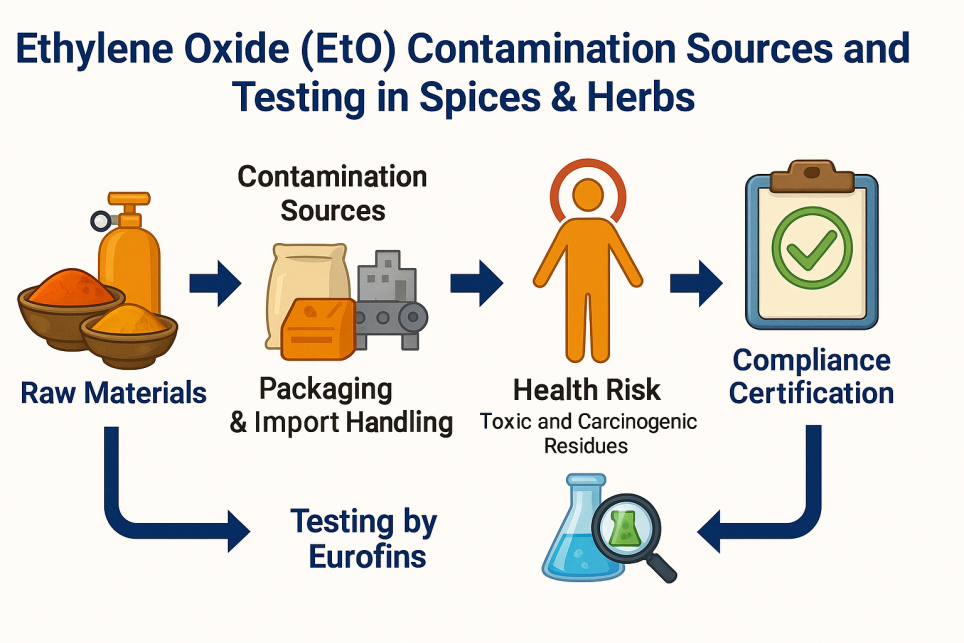
Due to its classification as a Group 1 human carcinogen by the International Agency for Research on Cancer (IARC), the presence of EtO and 2-CE in food products is highly regulated. Many countries, including the European Union and India, have adopted a zero-tolerance approach toward EtO residues in food ingredients.
Eurofins Food Testing Laboratories offer comprehensive testing services for ethylene oxide in spices, herbs, and seasoning blends. Using advanced analytical platforms and internationally accredited methods, Eurofins helps manufacturers and exporters ensure that their products meet global safety and regulatory requirements.
Importance of Ethylene Oxide Testing
|
Purpose |
Key Benefit |
|
Consumer Safety |
Detects toxic EtO and 2-CE residues that may pose carcinogenic and neurological risks |
|
Regulatory Compliance |
Meets the strict residue limits or bans imposed by the EU, FSSAI, and Codex Alimentarius |
|
Export Readiness |
Prevents shipment rejection and border detention due to non-compliance |
|
Brand Protection |
Avoids recalls and strengthens consumer confidence |
Regular testing protects consumers, maintains compliance, and ensures smooth global trade in high-risk categories such as spices and herbs.
Common Sources of Eto Contamination
|
Source |
Description |
Risk Level |
|
Sterilization Chambers |
Direct use of EtO gas for microbial control |
Very high |
|
Cross-Contamination |
Contact with EtO-treated raw materials or packaging |
Moderate |
|
Improper Aeration |
Incomplete removal of EtO residues post-treatment |
High |
|
Imported Ingredients |
Use of EtO-sterilized materials from certain regions |
Variable |
Regulatory Framework
The Food Safety and Standards Authority of India (FSSAI) has set a default maximum residue limit (MRL) of 0.1 mg/kg for ethylene oxide in herbs and spices, including herbal teas, when no specific Codex Alimentarius limit is available for a particular pesticide or chemical. This aligns with international standards, including those of the European Union, which also sets a limit of 0.1 mg/kg for EtO in food products
https://www.fssai.gov.in/upload/advisories/2024/04/6616351c775b5Order%20MRL%20Spices%20and%20culinary%20herbs.pdf
Spices Board of India – ETO Prevention Guidelines for Exporters
- Prohibit ETO use for sterilization or fumigation.
- Identify ETO & metabolites as hazards in HACCP/FSP/FSMS; establish critical control points.
- Mandatory testing of raw materials, packaging, and finished goods for ETO; conduct root cause analysis and corrective actions upon detection.
- Supply chain compliance: Transporters, storage, and packaging suppliers must ensure ETO is not used.
European Union
Maximum Residue Limits (MRLs) of Ethylene Oxide in Spices & Herbs (EU Regulation 2015/868)
|
Code Number |
Category / Product |
MRL (mg/kg) |
|
0800000 |
Spices (General Category) |
- |
|
0810000 |
(i) Seeds: Anise, Black caraway, Celery seed, Coriander seed, Cumin seed, Dill seed, Fennel seed |
0.10 |
|
0820000 |
(ii) Fruits and Berries: Allspice, Sichuan pepper, Caraway, Cardamom, Juniper berries, Pepper (all types), Vanilla pods, Tamarind |
0.10 |
|
0830000 |
(iii) Bark: Cinnamon (Cassia), Others |
0.10 |
|
0840000 |
(iv) Roots or Rhizome: Liquorice, Ginger, Turmeric (Curcuma), Horseradish |
0.10 |
|
0850000 |
(v) Buds: Cloves, Capers |
0.10 |
|
0860000 |
(vi) Flower Stigma: Saffron |
0.10 |
|
0870000 |
(vii) Aril: Mace |
0.10 |
|
0231020 |
Peppers (Chilli peppers) |
0.02 |
|
0220010 |
Garlic |
0.02 |
|
0256030 |
Celery leaves |
0.05 |
|
0256040 |
Parsley |
0.05 |
|
0256050 |
Sage |
0.05 |
|
0256060 |
Rosemary |
0.05 |
|
0256070 |
Thyme, Marjoram, Oregano |
0.05 |
|
0256080 |
Basil, Mint, Peppermint, Holy basil, Sweet basil, Hairy basil, Edible flowers, Curry leaves, Pennywort, Wild betel leaf |
0.05 |
|
0256090 |
Bay leaves |
0.05 |
|
0256100 |
Tarragon (Hyssop) |
0.05 |
|
0401080 |
Mustard seed |
0.05 |
|
0163050 |
Pomegranate |
0.02 |
https://eur-lex.europa.eu/legal-content/EN/TXT/?uri=CELEX:32015R0868
Eurofins Testing Capabilities
Eurofins laboratories are equipped with modern instrumentation and validated methods for trace-level detection of EtO and 2-CE in complex matrices such as spices, herbs, and seasonings.
Analytical Techniques
- Gas Chromatography–Mass Spectrometry (GC-MS/MS) for quantification of EtO and 2-CE
- Headspace Gas Chromatography for volatile compound analysis
- Isotope Dilution to enhance recovery accuracy and trace quantification
- Multi-matrix validation for a variety of spice and herb types
Eurofins Eto Testing Workflow
|
Step |
Objective |
Eurofins Solution |
|
1. Sample Collection |
Representative sampling of spice lots |
Guidance on handling and secure logistics |
|
2. Screening and Detection |
Rapid identification of EtO and 2-CE residues |
GC-MS/MS-based screening |
|
3. Quantification |
Confirmed residue analysis |
Isotope dilution validation for accuracy |
|
4. Root Cause Assessment |
Identify contamination origin |
Process and supply chain evaluation |
|
5. Compliance Certification |
Verify conformance with standards |
Certificate of Analysis (CoA) and digital reporting |
Health and Safety Implications
Ethylene oxide is known to interact with DNA, leading to genetic mutations and long-term carcinogenic effects. Prolonged exposure may also cause neurological symptoms, respiratory irritation, and reproductive toxicity.
Routine laboratory testing for Eto residues helps manufacturers and exporters reduce consumer risk and meet food safety obligations under international trade requirements.
Digital Traceability and Client Support
|
Platform |
Function |
|
SmartLIMS™ |
Manages sample registration, analysis workflow, and certificate generation |
|
SmartView™ |
Online dashboard for result tracking and residue trends |
|
AI-Based Predictive Analytics |
Identifies contamination risk zones and source trends |
|
Blockchain Integration |
Provides secure and traceable digital documentation for regulatory audits |
Case Study: Eto Detection in Chili Powder Export
Challenge
An exporter faced EU shipment detention due to ethylene oxide detection above the permissible limit in chili powder.
Eurofins Intervention
- Conducted GC-MS/MS analysis to quantify EtO and 2-CE residues
- Identified contamination linked to sterilized raw materials used in blending
- Recommended supplier screening and sterilization process improvements
Outcome
Post-intervention batches achieved non-detectable EtO levels (<0.01 mg/kg), restored export clearance, and met compliance under EU standards.
Why Choose Eurofins
- Network of ISO/IEC 17025-accredited laboratories across major spice-exporting regions
- Expertise in multi-matrix spice, herb, and botanical testing
- Advanced analytical capability for trace residue detection
- End-to-end service covering sampling, analysis, certification, and consultancy
- Fast turnaround time (48–72 hours) with secure digital result access
- Technical support for preventive risk management and export compliance
Ensure your spices and herbs meet international safety and compliance standards.
Partner with Eurofins Food Testing Laboratories to:
- Detect and quantify Ethylene Oxide and 2-CE residues with accuracy
- Achieve compliance with EU, FSSAI, and Codex requirements
- Maintain traceability and protect your brand in global markets
Enquire now: www.eurofins.in/food-testing/enquire-now/

