


From Lab to Fork: The Future of Rapid Food Testing Technologies

Food safety assurance is evolving rapidly as the global food industry demands faster, more accurate, and traceable testing. The traditional laboratory model—while accurate often results in long turnaround times, delaying critical safety and trade decisions.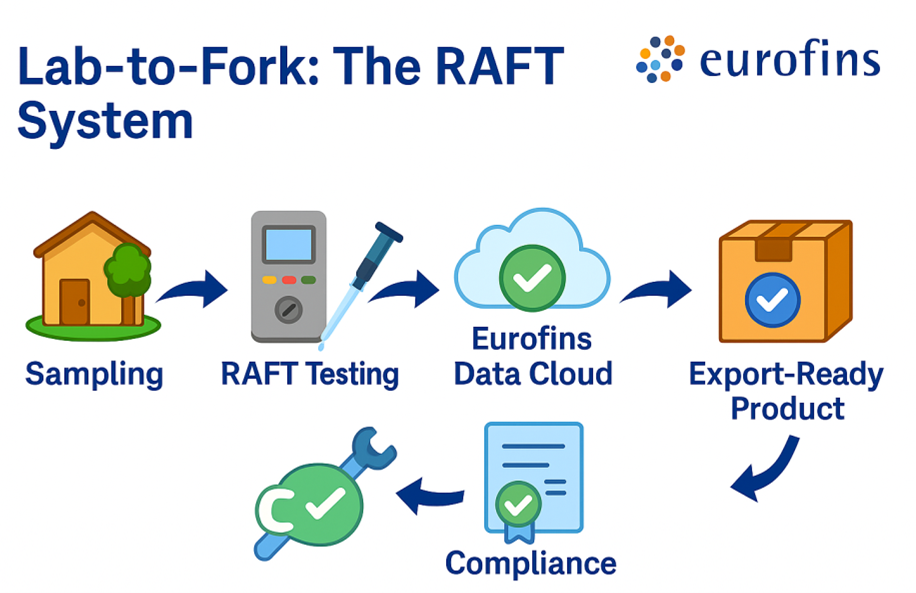
To meet this need, rapid analytical testing technologies are transforming how food is monitored, tested, and certified. At Eurofins, we have been leading this transformation by integrating Rapid Analytical Food Testing (RAFT) systems, AI-driven interpretation, and portable diagnostic tools into our workflows. Our mission: deliver faster, smarter, and more reliable food testing solutions “from lab to fork.
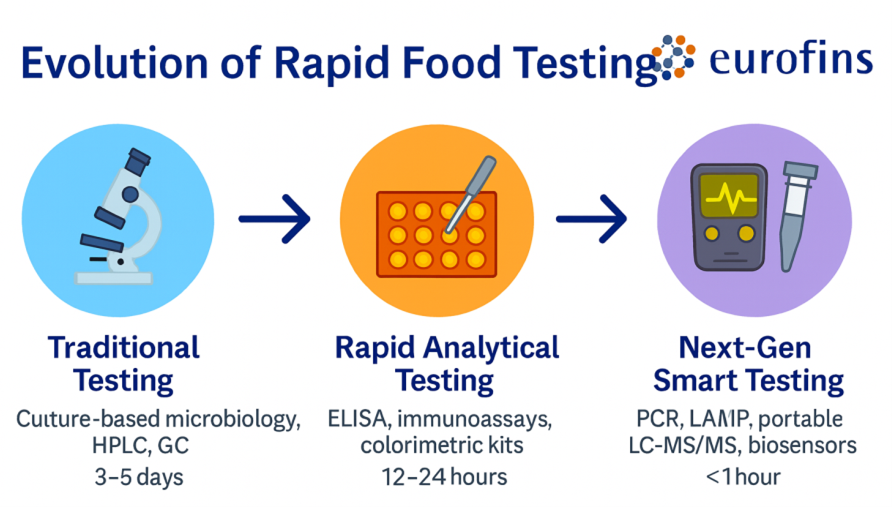
Evolution of Rapid Food Testing
|
Phase |
Key Methods |
Turnaround Time |
Eurofins Contribution |
|
Traditional Testing |
Culture-based microbiology, HPLC, GC |
3–5 days |
ISO/IEC 17025-accredited reference labs for confirmatory testing |
|
Rapid Analytical Testing |
ELISA, immunoassays, colorimetric kits |
12–24 hours |
High-throughput screening for allergens, pesticides, and mycotoxins |
|
Next-Gen Smart Testing |
PCR, LAMP, portable LC-MS/MS, biosensors |
<1 hour |
Deployment of Eurofins RAFT™ and SmartLIMS™ for real-time analytics |
Technology Landscape: Next-Generation Tools
1. Molecular and Immunoassay Platforms
- Advanced PCR, qPCR, and LAMP-based systems now detect pathogens like coli, Listeria monocytogenes, and Salmonella within 30–90 minutes.
- Eurofins’ multiplex PCR kits allow simultaneous identification of multiple targets, minimizing human error and enhancing speed.
2. Portable Spectroscopy and Mass Spectrometry
- Handheld Raman, FTIR, and mini LC-MS/MS units have made on-site testing feasible.
- Eurofins integrates these instruments into mobile labs equipped with cloud connectivity for direct result upload and expert review.
3. Biosensors and Lab-on-a-Chip Devices
- These ultra-compact tools enable near-instant field detection of chemical contaminants.
- Eurofins partners with technology providers to validate biosensor systems under ISO 16140 for official control programs.
4. AI, Machine Learning, and Predictive Analytics
- Through Eurofins SmartLIMS™ and Predictive Food Risk Dashboard, real-time data from RAFT kits, weather models, and supply chains are analyzed to predict potential contamination zones, guiding preventive action.
5. Blockchain-Enabled Data Integration
- Eurofins’ FoodChainConnect™ links laboratory results to supplier databases, providing tamper-proof, digital traceability for exporters and regulators.
Regulatory Framework for Rapid Food Testing
India: FSSAI RAFT System
The Rapid Analytical Food Testing (RAFT) system introduced by the Food Safety and Standards Authority of India (FSSAI) underpins India’s modern food safety surveillance. RAFT supports quick, reliable, and cost-effective food screening using portable kits, field devices, and mobile laboratories.
|
Aspect |
Details |
|
Regulation |
Food Safety and Standards (Laboratory and Sample Analysis) Regulations, 2011 (Amendment 2019) |
|
Authority |
Food Safety and Standards Authority of India (FSSAI) |
|
Clause |
2.4 – Approval of RAFT Kit/Equipment/Method |
|
Approval Basis |
Validation against AOAC, ISO, and Codex international standards |
|
Purpose |
On-site, rapid, and cost-effective food testing |
|
Primary Users |
Food Safety Officers (FSOs), mobile labs, and field surveillance agencies |
|
Key Features |
Portable, validated, cost-efficient, quick screening |
|
Application |
Field surveillance, import control, and safety certification |
|
Reference |
https://www.fssai.gov.in/cms/raft.php |
Eurofins laboratories work closely with FSSAI to validate and benchmark RAFT-approved methods, ensuring their equivalence with ISO 17025-certified confirmatory procedures.
European Union: Recognition of Rapid Methods
The European Union recognizes the role of rapid analytical testing under Commission Regulation (EC) No. 2073/2005, which permits validated rapid methods as alternatives to standard reference methods if equivalency in reliability and sensitivity is demonstrated.
|
Aspect |
Details |
|
Regulation |
Commission Regulation (EC) No. 2073/2005 on microbiological criteria for foodstuffs |
|
Objective |
Acceptance of validated rapid or alternative methods |
|
Validation Reference |
ISO 16140 (Microbiology of Food and Animal Feeding Stuffs) |
|
Key Impact |
Facilitates faster pathogen monitoring and batch release |
Eurofins’ European laboratories actively contribute to the development of these validation protocols through participation in CEN/ISO committees and EU reference laboratory collaborations.
Eurofins RAFT™ in Action
Key Functionalities
- Portable Analytical Platforms: Handheld spectrometers and LAMP analyzers validated for field use.
- AI Integration: Automated data logging and cloud transmission via SmartLIMS™.
- Interoperability: Compatible with regulatory data systems like INFOSAN and RASFF.
- Custom Modules: Adaptable for sectors such as dairy, seafood, beverages, and grains.
|
Sector |
Key Contaminants |
Rapid Testing Applied |
Typical Turnaround |
|
Dairy & Infant Nutrition |
Aflatoxin M1, antibiotics |
RAFT-LC-MS/MS |
30 mins |
|
Meat & Poultry |
Salmonella, residues |
LAMP-PCR + ELISA |
1 hour |
|
Spices & Herbs |
Pesticides, mycotoxins |
RAFT + HRMS |
45 mins |
|
Beverages |
Additives, preservatives |
FTIR + Chemometrics |
20 mins |
Global Harmonization: Eurofins’ Contribution
|
Area |
Eurofins’ Role |
|
Regulatory Benchmarking |
Collaborates with FSSAI, EFSA, FDA for RAFT validation and harmonization. |
|
Technology Development |
Co-develops handheld analytical kits with equipment manufacturers. |
|
Training and Capacity Building |
Provides hands-on training for FSOs, QA managers, and lab technicians. |
|
Data Intelligence |
Integrates AI dashboards for predictive contamination mapping. |
Case Study: On-Site Pesticide Screening in Tea Estates
A leading Indian tea producer faced export delays due to pesticide residue monitoring bottlenecks. Eurofins deployed a RAFT–LC-MS/MS hybrid unit directly at the plantation.
- Test turnaround time reduced from 72 hours to under 4 hours.
- Enabled real-time release of export consignments.
- Saved over ₹25 lakh in demurrage costs per quarter.
The Future: Lab-to-Fork Digital Connectivity
Eurofins envisions a fully connected testing ecosystem integrating field diagnostics, cloud-based analytics, and real-time traceability. Our digital RAFT™ model merges AI, IoT, and blockchain to create a continuous chain of assurance from raw material sampling to end-product verification.
Why Choose Eurofins
- Global network of 900+ laboratories across 60+ countries.
- ISO/IEC 17025, FSSAI, and EU accredited analytical excellence.
- End-to-end testing—from on-site RAFT screening to confirmatory LC-MS/MS validation.
- Integration with predictive risk assessment and contamination mapping tools.
- Expert teams in analytical chemistry, toxicology, and regulatory compliance.
Accelerate your food safety assurance with Eurofins’ Rapid Analytical Food Testing solutions. Ensure faster release, stronger compliance, and global market readiness—powered by science, data, and innovation.
Enquire now: www.eurofins.in/food-testing/enquire-now/

