


Heavy Metals in Plant-Based and Functional Foods

Plant-based, herbal, nutraceutical, and functional food products are experiencing rapid global demand. However, they are under increasing scrutiny for heavy metal contamination. Crops readily absorb metals from soil, water, fertilizers, and the environment, leading to accumulation in powders, extracts, beverages, and supplements.
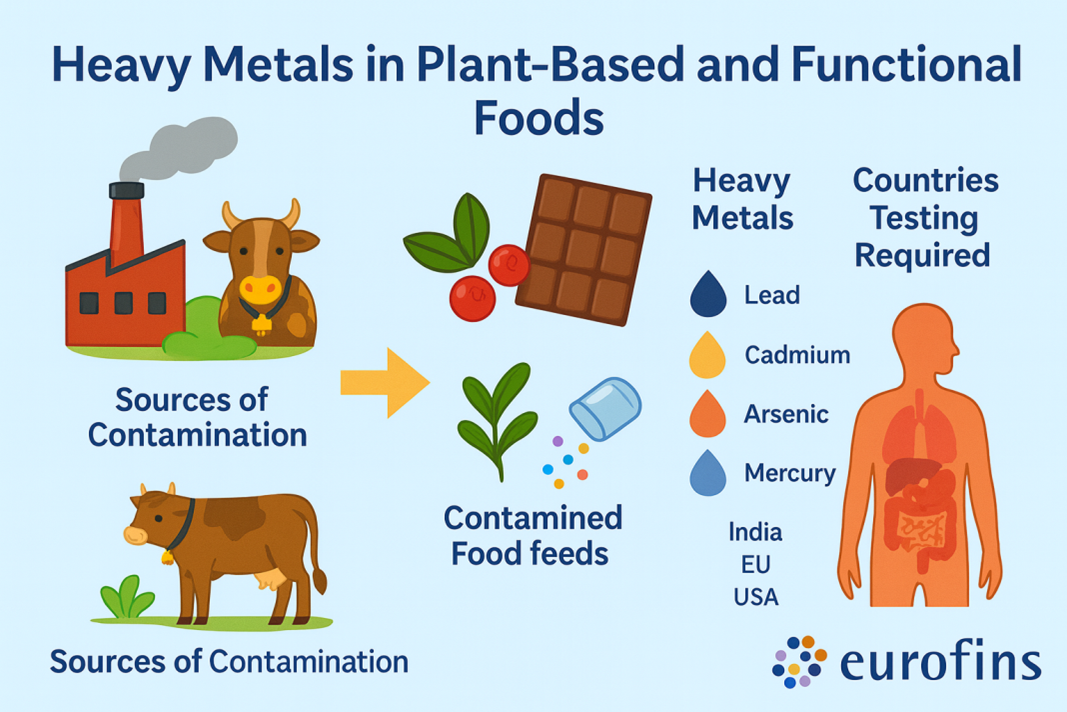
Ensuring heavy metal levels remain within safe regulatory limits is critical for consumer safety, brand reputation, export approvals, and regulatory compliance.
Eurofins offers comprehensive, accredited testing solutions using cutting-edge instrumentation and a global laboratory network to evaluate heavy metals in raw materials, processed foods, herbal ingredients, spices, botanicals, supplements, and ready-to-drink formulations.
Why Heavy Metal Testing Matters
|
Benefit |
Purpose |
|
Consumer Safety |
Prevents chronic exposure to toxic metals |
|
Export Compliance |
Meets EU, USFDA, FSSAI, Codex, and other international standards |
|
Brand Protection |
Avoids recalls and market rejection |
|
Quality Assurance |
Ensures purity of functional & plant-based foods |
|
Supply Chain Transparency |
Detects contamination from soil, processing, or packaging |
|
Regulatory Documentation |
Supports label claims, certifications, and audits |
Key Heavy Metals of Concern
|
Metal |
Primary Sources |
Health Impact |
|
Lead (Pb) |
Soil, dust, fertilizers, irrigation water |
Neurological damage, cognitive impairment |
|
Cadmium (Cd) |
Phosphate fertilizers, leafy vegetables |
Kidney damage, bone demineralization |
|
Arsenic (As) |
Groundwater, rice, spices |
Skin lesions, increased cancer risk |
|
Mercury (Hg) |
Industrial emissions, fish-based ingredients |
Nervous system toxicity, enzyme inhibition |
|
Chromium, Nickel, Aluminium |
Water, machinery, processing aids |
Allergic reactions, cellular toxicity |
Sources of Heavy Metal Contamination
|
Source |
Examples |
Typical Risk |
|
Soil & Water |
Contaminated irrigation, industrial zones |
Pb, As, Cd uptake by plants |
|
Agricultural Inputs |
Fertilizers, pesticides, manure |
Cd, Cr, Ni accumulation |
|
Processing & Equipment |
Metal grinders, dryers, extractors |
Fe, Al, Ni leaching |
|
Packaging Materials |
Printed films, recycled plastics |
Migration of metals |
|
Environmental Deposition |
Dust, emissions, smoke |
Pb, Hg fallout on crops |
High-Risk Food Categories
- Herbal & Botanical Ingredients (Ashwagandha, turmeric, moringa)
- Plant Protein Powders (Pea, soy, hemp, rice protein blends)
- Functional Foods & Beverages (RTD wellness drinks, fortified smoothies)
- Spices & Tea (Curry powders, cinnamon, green/black tea)
- Nutraceuticals & Extracts (Capsules, tablets, concentrated botanicals)
Global Regulatory Standards (Examples)
FSSAI regulates under the Food Safety and Standards (Contaminants, Toxins and Residues) Regulations, 2011 (with amendments as of 2020; no major 2025 updates noted). The EU framework is now Commission Regulation (EU) 2023/915 (repealing (EC) No 1881/2006 effective May 2023, with 2024–2025 amendments for nickel and refinements).
Key limits for select heavy metals in high-risk categories (e.g., beverages, spices, infant foods). Limits apply to total metal content unless specified.
|
Metal Contaminant |
Food Category |
Maximum Limit (mg/kg or ppm) |
|
Lead (Pb) |
Concentrated soft drinks |
0.5 |
|
Fruit and vegetable juice |
1.0 |
|
|
Soft drink concentrates (e.g., lime, lemon) |
2.0 |
|
|
Baking powder |
10.0 |
|
|
Edible oils and fats |
0.5 |
|
|
Infant milk substitutes and infant foods |
0.2 |
|
|
Turmeric (whole and powder) |
10.0 |
|
|
Copper (Cu) |
Soft drinks excluding concentrates and carbonated water |
7.0 |
|
Carbonated water |
1.5 |
|
|
Toddy |
5.0 |
|
|
Soft drink concentrates |
20.0 |
|
|
Arsenic (As) |
Milk |
0.1 |
|
Soft drinks except carbonated water |
0.5 |
|
|
Carbonated water |
0.25 |
|
|
Infant milk substitutes and infant foods |
0.05 |
|
|
Turmeric (whole and powder) |
0.1 |
|
|
Juice (orange, grape, apple, tomato, pineapple, lemon) |
0.2 |
|
|
Pulp and pulp products of any fruit |
0.2 |
|
|
Preservatives, anti-oxidants, emulsifying agents, synthetic food colours (dry matter) |
3.0 |
|
|
Ice-cream, iced lollies, similar frozen confections |
0.5 |
|
|
Dehydrated onions, edible gelatin, liquid pectin |
2.0 |
|
|
Chicory (dried or roasted) |
4.0 |
|
|
Dried herbs, spices, finings, solid pectin |
5.0 |
|
|
Food coloring other than synthetic colouring |
5.0 (dry colouring matter) |
|
|
Hard boiled sugar confectionery |
1.0 |
|
|
Iron fortified common salt |
1.0 |
|
|
Brewed vinegar and synthetic vinegar |
0.1 |
|
|
Other foods not specified |
1.1 |
|
|
Tin (Sn) |
Processed and canned products |
250.0 |
|
Hard boiled sugar confectionery |
5.0 |
|
|
Jam, jellies, marmalade |
250.0 |
|
|
Juice (orange, apple, tomato, pineapple, lemon) |
250.0 |
|
|
Infant milk substitutes and infant foods |
5.0 |
|
|
Turmeric (whole and powder) |
Nil |
|
|
Corned beef, luncheon meat, cooked ham, canned meats |
250.0 |
|
|
Other foods not specified |
250.0 |
|
|
Zinc (Zn) |
Ready-to-drink beverages |
5.0 |
|
Juice (orange, grape, tomato, pineapple, lemon) |
5.0 |
|
|
Pulp and pulp products of any fruit |
5.0 |
|
|
Infant milk substitutes and infant foods |
50.0 (not less than 25.0) |
|
|
Edible gelatin |
100.0 |
|
|
Turmeric (whole and powder) |
25.0 |
|
|
Fruit and vegetable products |
50.0 |
|
|
Hard boiled sugar confectionery |
5.0 |
|
|
Other foods not specified |
50.0 |
|
|
Cadmium (Cd) |
Infant milk substitutes and infant foods |
0.1 |
|
Turmeric (whole and powder) |
0.1 |
|
|
Other foods |
1.5 |
|
|
Mercury (Hg) |
Fish |
0.5 |
|
Chromium (Cr) |
Refined sugar |
0.02 (20 ppb) |
|
Nickel (Ni) |
Hydrogenated, partially hydrogenated oils and fats (e.g., vanaspati, margarine) |
1.5 |
https://fssai.gov.in/upload/uploadfiles/files/Comp_Contaminants_Regulations_2_4_2025_VIII.pdf
EU : Governed by Regulation (EU) 2023/915 (Annex I, Section 3), with updates via (EU) 2024/1987 for nickel (effective July 2025) and prior amendments for lead/cadmium (2021). EFSA provides risk assessments; limits are ALARA-based.
|
Metal Contaminant |
Food Category |
Maximum Limit (mg/kg) |
|
Lead (Pb) |
Processed cereal-based foods, baby foods |
0.02 – 0.05 |
|
Cadmium (Cd) |
Vegetables, cereals, baby foods |
0.05 – 0.2 |
|
Arsenic (iAs) |
Rice and rice products |
0.2 – 0.3 |
|
Mercury (Hg) |
Fish and fish products |
0.5 |
|
Nickel (Ni) |
Various foods, nuts |
0.05 – 1.5 |
https://heavymetaltested.com/eu-heavy-metal-limits-in-food-2025/
Eurofins Analytical Testing Capabilities
Core Instrumentation
|
Instrument |
Purpose |
|
ICP-MS |
Ultra-trace detection (ppt–ppb) of Pb, Cd, As, Hg |
|
ICP-OES |
Rapid multi-element screening |
|
AAS |
Confirmatory analysis |
|
CV-AFS / HG-AAS |
Specialized mercury & arsenic speciation |
|
Ion Chromatography |
Related anions and metal salts |
Eurofins Heavy Metal Compliance Framework
|
Step |
Objective |
Eurofins Solution |
|
1. Raw Material Screening |
Detect metals at source |
ICP-MS multi-element scan |
|
2. Process Audit |
Identify contamination points |
On-site assessment & equipment testing |
|
3. Product Testing |
Ensure final compliance |
Batch-wise heavy metal profiling |
|
4. Label Verification |
Support export & claims |
Technical documentation & CoA |
|
5. Trending & Monitoring |
Prevent future issues |
SmartLIMS™ digital analytics |
Case Study: Heavy Metal Reduction in Herbal Powders
- Challenge A leading global nutraceutical brand faced repeated EU border rejections due to elevated lead in herbal powders.
- Eurofins Approach Multi-stage contamination tracing: soil mapping, water analysis, supplier lot comparison.
- Root Cause One supplier stored raw herbs outdoors near highways, leading to lead-rich dust deposition.
- Solution Implemented Switched to indoor controlled drying facilities and validated supplier protocols.
- Outcome Lead levels reduced by 70% within four production cycles → Full EU compliance restored and customer trust regained.
Emerging Trends
- Rising focus on chromium & nickel in plant-based proteins
- AI-driven prediction of contamination hotspots
- Microbial and phytoremediation research for cleaner soils
- Growing demand for full mineral transparency on clean-label products
Why Choose Eurofins
- ISO/IEC 17025 accredited global laboratory network
- Expertise in herbal, functional, and plant-based foods
- Ultra-trace detection down to parts-per-trillion (ppt)
- Fast 48–72 hour turnaround time
- Dedicated regulatory and export support team
Partner with Eurofins Food Testing Laboratories to:
- Accurately evaluate heavy metals in plant-based and functional foods
- Safeguard consumer health and brand reputation
- Achieve global regulatory compliance and export readiness
- Build transparent, clean-label supply chains
Enquire now: www.eurofins.in/food-testing/enquire-now/

