


Importance of Nutritional Label Accuracy & Claim Validation

Accurate nutritional labeling and scientifically validated claims are fundamental to food safety, regulatory compliance, and consumer trust. Nutrition information guides purchasing decisions, supports public health objectives, and ensures transparency across the food supply chain. Errors or unsupported claims can mislead consumers, pose health risks, and expose manufacturers to regulatory action, recalls, and export rejections.
Eurofins provides end-to-end nutritional analysis and claim validation services through its global network of ISO/IEC 17025-accredited laboratories. By combining advanced analytical testing, regulatory expertise, and robust data interpretation, Eurofins helps food businesses ensure accurate labels, compliant claims, and confidence in global markets.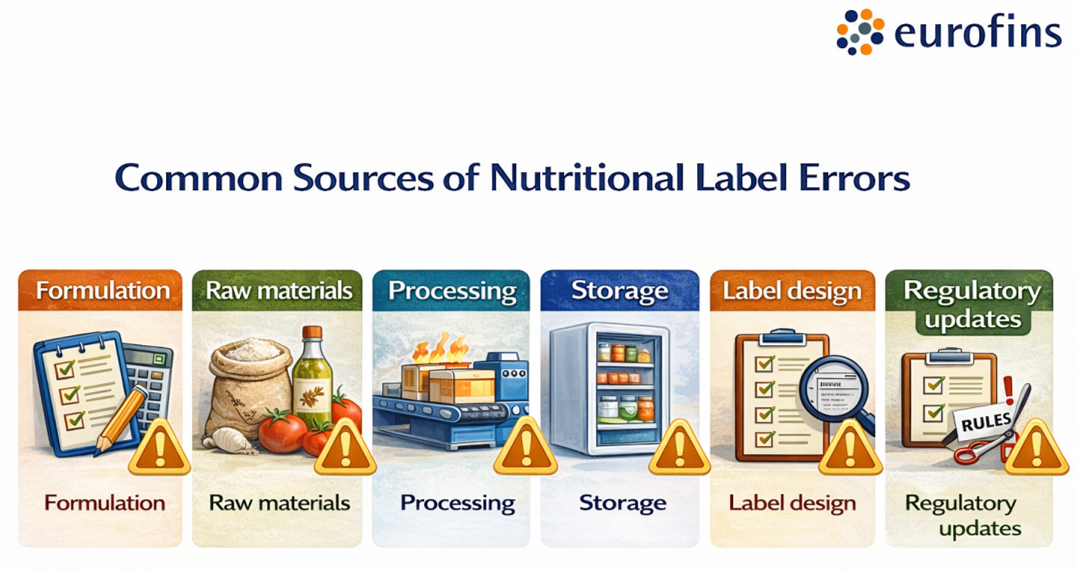
Why Nutritional Label Accuracy & Claim Validation Are Essential
Nutrient values and nutrition or health claims must accurately reflect the true composition of a food product throughout its shelf life. Variability in raw materials, processing losses, formulation changes, and storage conditions can all impact declared values.
Accurate testing and validation help manufacturers protect consumers, meet legal obligations, and maintain brand integrity.
|
Key Benefit |
Purpose |
|
Consumer transparency |
Enables informed dietary choices |
|
Regulatory compliance |
Meets FSSAI, EU, FDA, Codex requirements |
|
Claim credibility |
Prevents misleading or false claims |
|
Risk reduction |
Avoids recalls, penalties, and litigation |
|
Export readiness |
Ensures acceptance in international markets |
What Is Nutritional Label Accuracy?
Nutritional label accuracy refers to the correctness of declared energy and nutrient values within permitted regulatory tolerances. Labels must represent the product “as sold” and remain valid over its declared shelf life.
Key nutritional parameters include:
- Energy (kcal / kJ)
- Protein
- Carbohydrates and sugars
- Total fat and saturated fat
- Sodium / salt
- Vitamins and minerals (where declared)
- Added nutrients or fortificants
Deviation beyond allowable limits can result in non-compliance, even if unintentional.
What Are Nutrition & Health Claims?
Nutrition and health claims highlight specific nutritional properties or physiological benefits of food products. These claims must be scientifically substantiated, analytically verified, and compliant with applicable regulations.
Types of Claims
|
Claim Type |
Examples |
|
Nutrition claims |
“Low fat”, “High protein”, “Source of fibre”, “No added sugar” |
|
Health claims |
“Calcium supports bone health” |
|
Function claims |
“Supports immunity”, “Helps maintain energy levels” |
|
Comparative claims |
“Reduced sugar”, “Lower sodium” |
Claims must meet defined nutrient thresholds and must not be misleading.
Products Commonly Requiring Nutritional Validation
Nutritional accuracy and claim substantiation are especially critical for:
- Packaged and processed foods
- Bakery and confectionery products
- Dairy and plant-based alternatives
- Beverages and functional drinks
- Infant foods and baby cereals
- Nutraceuticals and supplements
- Sports and performance nutrition
- Fortified and enriched foods
Common Sources of Nutritional Label Errors
|
Stage |
Typical Risk Factors |
|
Formulation |
Incorrect calculations or recipe changes |
|
Raw materials |
Ingredient variability |
|
Processing |
Nutrient loss due to heat or extrusion |
|
Storage |
Nutrient degradation over shelf life |
|
Label design |
Incorrect claim wording or thresholds |
|
Regulatory updates |
Outdated compliance assumptions |
Eurofins supports root-cause analysis and corrective strategies to mitigate these risks.
Parameters Tested in Nutritional Analysis
|
Parameter |
Description |
|
Energy value |
Calorific value calculation and verification |
|
Macronutrients |
Protein, fat, carbohydrates, sugars |
|
Fatty acid profile |
Saturated, trans, mono- and polyunsaturated fats |
|
Vitamins |
Water- and fat-soluble vitamin analysis |
|
Minerals |
Sodium, calcium, iron, zinc, etc. |
|
Added nutrients |
Fortification level verification |
|
Shelf-life stability |
Nutrient retention over time |
Eurofins Nutritional Testing & Claim Validation Capabilities
Analytical Methods
- AOAC / ISO validated chemical methods
- HPLC and UPLC for vitamins
- ICP-MS / ICP-OES for mineral analysis
- Enzymatic and gravimetric methods for macronutrients
Testing Scope
- Raw materials, in-process samples, finished products
- Single nutrient testing or full nutritional panels
- Shelf-life and stability studies
- Market-specific claim validation
All analyses are conducted in ISO/IEC 17025-accredited laboratories.
Nutritional Compliance Workflow
|
Step |
Objective |
Eurofins Solution |
|
Product assessment |
Identify labeling requirements |
Recipe and claim review |
|
Sampling |
Representative analysis |
Standardized sampling protocols |
|
Laboratory testing |
Accurate nutrient data |
Validated analytical methods |
|
Claim evaluation |
Verify claim eligibility |
Threshold and wording assessment |
|
Reporting |
Audit and launch readiness |
Label-ready documentation |
Regulations & Standards for Nutritional Labeling
Food Safety and Standards (Labelling and Display) Regulations, 2020 (as amended up to 2025)
|
Parameter |
Requirement (FSSAI Regulation) |
|
Name of the food |
Clearly labeled and descriptive name |
|
List of ingredients |
All ingredients in descending order by weight/volume; allergens must be highlighted |
|
Nutritional information (per 100 g/ml or per serving) |
Mandatory declaration of: Energy (kcal), Protein (g), Carbohydrate (g) [with sugar specified], Total Fat (g), Saturated Fat (g), Trans Fat (g), Sodium (mg) |
|
Energy value |
Declared in kilocalories (kcal) per 100 g/ml or per serving |
|
Protein, Carbohydrates, Fat |
Amount in grams (g) per 100 g/ml; Carbohydrates must specify quantity of sugar |
|
Saturated fat, Trans fat, Sodium |
Declared in grams (g) or milligrams (mg) per 100 g/ml |
|
Added Sugars |
Amount in grams (g) per 100 g/ml (to be declared separately if present) |
|
Other nutrients (vitamins, minerals) |
Declare only if a nutrition/health claim is made or specifically required |
|
Net quantity |
Display weight or volume in metric units (g/ml/L) |
|
Date marking |
“Date of manufacture” and “Best Before” or “Use By” date clearly mentioned |
|
Vegetarian / Non-Vegetarian symbol |
Mandatory green dot (veg) or brown/red dot (non-veg) |
|
FSSAI Logo & License Number |
Must be displayed prominently on the principal display panel |
|
Name & complete address of manufacturer/packer/importer |
Full address required |
|
Batch / Lot number |
Clearly displayed |
|
Country of origin |
Mandatory for imported foods |
|
Storage conditions & Allergen information |
Required wherever applicable (e.g., “Store in cool & dry place”, “Contains allergen: …”) |
https://fssai.gov.in/upload/uploadfiles/files/Guidance_Note_Labelling_23_02_2022.pdf
EU Food Labeling Requirements
Regulation (EU) No 1169/2011 on the provision of food information to consumers
|
Parameter |
Requirement (EU Regulation) |
|
Name of the food |
Clearly labeled with the legal or customary name of the food |
|
List of ingredients |
All ingredients in descending order by weight; allergens must be highlighted (Annex II) |
|
Nutritional declaration (per 100 g/ml) |
Mandatory: energy (kJ and kcal), fat, saturates, carbohydrates, sugars, protein, salt – in tabular or linear format |
|
Energy value |
Declared in both kilojoules (kJ) and kilocalories (kcal) per 100 g or 100 ml |
|
Fat, saturates, carbohydrates, sugars |
Declared in grams (g) per 100 g/ml as part of nutrition declaration |
|
Protein, salt |
Declared in grams (g) per 100 g/ml |
|
Optional vitamins and minerals |
Must be declared only when a nutrition or health claim is made, or if the food is fortified |
|
Net quantity |
Displayed in metric units (g, kg, ml, L, cl) |
|
Date marking |
“Best before” or “Use by” date mandatory |
|
Allergen information |
14 major allergens must be clearly indicated (as per Annex II of the regulation) |
|
Name and address of food business operator |
Must be present (including importer if applicable) |
|
Country of origin |
Required if omission might mislead the consumer or when specifically required by law |
|
Font and legibility |
Minimum x-height 1.2 mm (or 0.9 mm for packages with largest surface < 80 cm²) |
|
Vegetarian / Vegan labeling |
No mandatory symbol, but voluntary “suitable for vegetarians/vegans” statements allowed if accurate |
https://food.ec.europa.eu/food-safety/labelling-and-nutrition/food-information-consumers-legislation/nutrition-labelling_en
Case Study: Preventing Label Non-Compliance in a Functional Beverage
A functional beverage manufacturer planned to launch a product with “high protein” and “low sugar” claims. Eurofins conducted full nutritional profiling and found that protein content narrowly missed regulatory thresholds and sugar levels varied due to processing conditions.
Based on Eurofins’ findings, the formulation was optimized and claim wording revised before market launch. This prevented regulatory non-compliance, protected brand credibility, and ensured a successful product introduction.
Integration with Food Safety & Quality Systems
Nutritional label accuracy supports:
- HACCP – Control of nutritional hazards
- Product development – Claim feasibility assessment
- Supplier management – Ingredient consistency verification
- Regulatory audits – Label and claim validation
- Export compliance – Market-specific labeling requirements
Why Choose Eurofins
- Global network of ISO/IEC 17025-accredited laboratories
- Comprehensive nutritional and claim expertise
- Advanced analytical capabilities
- Strong knowledge of Indian and global regulations
- Fast turnaround with defensible, audit-ready data
- Ensure 100% accurate nutritional labeling
• Validate nutrient and health claims with scientific precision
• Achieve regulatory-compliant labels for domestic and export markets
Partner with Eurofins your trusted pathway to compliant, export-ready food
Enquire now: www.eurofins.in/food-testing/enquire-now/

