


Indoor Air Monitoring

Indoor air quality has emerged as a critical public health and occupational safety concern as people spend a significant portion of their time inside enclosed environments such as offices, homes, hospitals, laboratories, schools, and manufacturing facilities. Unlike outdoor air, indoor air can accumulate pollutants from multiple sources, often reaching concentrations that pose serious health and comfort risks.
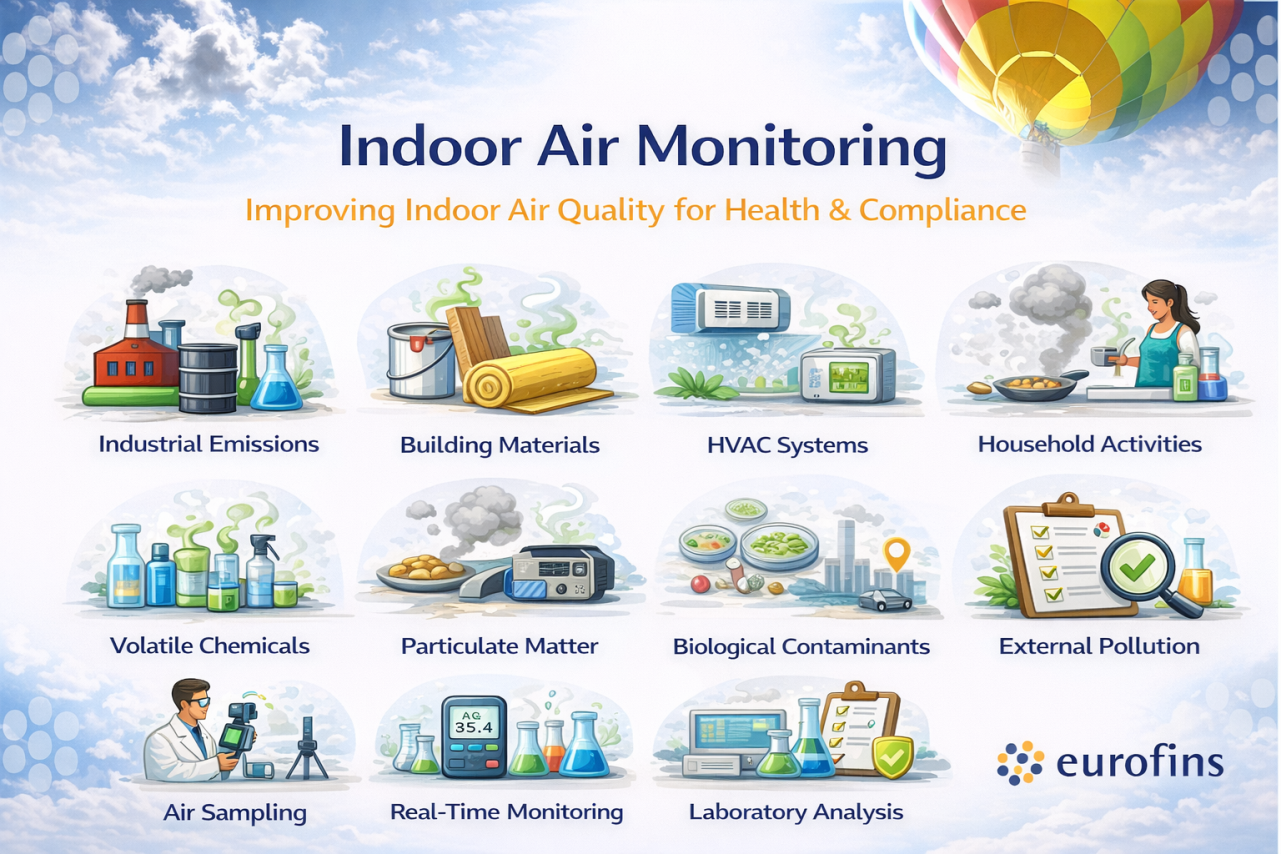
Indoor air monitoring involves the systematic assessment of physical, chemical, and biological components of indoor air to evaluate exposure risks, verify compliance with guidelines, and support corrective actions. Eurofins delivers comprehensive indoor air monitoring solutions that help organizations maintain safe, compliant, and healthy indoor environments.
What Is Indoor Air and What Does It Contain?
Indoor air is a complex mixture of gases, particles, vapors, and biological materials. Its composition is influenced by building design, ventilation, materials used, occupant activities, and external environmental conditions.
Major Components of Indoor Air
|
Category |
Examples |
|
Gases |
Oxygen, nitrogen, carbon dioxide |
|
Chemical vapors |
VOCs, formaldehyde, solvents |
|
Particulates |
PM10, PM2.5, dust, fibers |
|
Combustion by-products |
Carbon monoxide, nitrogen dioxide |
|
Biological agents |
Bacteria, fungi, mold spores, allergens |
Understanding these components is essential for selecting the right monitoring strategy and analytical methods.
Common Indoor Air Pollutants and Their Sources
Chemical Pollutants
- Volatile Organic Compounds from paints, adhesives, cleaning agents, furniture, and office equipment
- Formaldehyde from pressed wood products and insulation materials
- Carbon monoxide from fuel-burning appliances and generators
Particulate Matter
- Fine dust particles from outdoor air infiltration
- Smoke, fumes, and aerosols from cooking or industrial activities
Biological Contaminants
- Mold growth due to high humidity
- Bacteria from HVAC systems
- Allergens from dust mites, pollen, and pets
Why Indoor Air Monitoring Is Critical
Indoor air monitoring helps organizations to:
- Identify pollutant sources and exposure levels
- Prevent health complaints and Sick Building Syndrome
- Meet occupational health and safety requirements
- Improve ventilation effectiveness
- Support sustainability and wellness initiatives
Health Effects of Poor Indoor Air Quality
|
Exposure Type |
Potential Health Effects |
|
Short-term exposure |
Eye irritation, headaches, dizziness |
|
Long-term exposure |
Asthma, respiratory disease, cardiovascular effects |
|
Biological exposure |
Allergies, infections, mold-related illnesses |
|
Chemical exposure |
Neurological symptoms, cancer risks |
Vulnerable populations such as children, elderly individuals, and patients are particularly at risk.
Indoor Air Quality Standards and Guidelines
Indoor air monitoring is guided by several regulatory and advisory frameworks:
- World Health Organization indoor air quality guidelines
- OSHA occupational exposure limits
- ASHRAE standards for ventilation and thermal comfort
- National environmental and occupational health regulations
Eurofins aligns monitoring programs with applicable regulatory and client-specific requirements.
Key Parameters Tested in Indoor Air Monitoring
Physical Parameters
- Temperature
- Relative humidity
- Air velocity and ventilation rate
Chemical Parameters
- Carbon dioxide (CO₂)
- Carbon monoxide (CO)
- Volatile Organic Compounds (VOCs)
- Formaldehyde
- Ozone
Particulate Matter
- PM10
- PM2.5
- PM1
Biological Parameters
- Total bacterial count
- Fungal spores and molds
- Pathogenic microorganisms (where applicable)
Indoor Air Sampling and Testing Approaches
Eurofins applies scientifically validated sampling and analytical methodologies, including:
- Area air sampling for general exposure assessment
- Personal air sampling for occupational exposure evaluation
- Active and passive sampling techniques
- Short-term diagnostic and long-term trend monitoring
Laboratory analysis is conducted using advanced techniques such as GC-MS, HPLC, gravimetric analysis, and microbiological culturing.
Regulations and standards
In India, the regulation of ambient air and workspace monitoring standards involves several key entities. The Central Pollution Control Board (CPCB) sets national ambient air quality standards and oversees pollution control measures, while State Pollution Control Boards (SPCBs) enforce environmental regulations at the state level. The Ministry of Environment, Forest and Climate Change (MoEFCC) formulates policies and collaborates with the CPCB and SPCBs. Occupational safety and health authorities, such as the Directorate General Factory Advice Service and Labour Institutes (DGFASLI), oversee workspace conditions. The Bureau of Indian Standards (BIS) sets standards for indoor air quality, and the Indian Green Building Council (IGBC) promotes sustainable buildings with healthy indoor environments.
National ambient air quality standards (NAAQS) are established by governments to regulate and maintain acceptable levels of air quality in a country. These standards define the maximum allowable concentrations of specific air pollutants in the ambient air.
|
Pollutants |
Time- weighted average |
Concentration in ambient air |
Method of measurement |
||
|
|
|
Sensitive of Area |
Industrial Area |
Residential, Rural & Other areas |
|
|
Sulphur |
Annual Average* |
15 µg/m3 |
80 µg/m3 |
60 µg/m3 |
Improved West and Greek Method |
|
Dioxide (SO2) |
24 hours** |
30 µg/m3 |
120 µg/m3 |
80 µg/m3 |
Ultraviolet Fluorescence |
|
Oxide of Nitrogen as NO2 |
Annual* |
15 µg/m3 |
80 µg/m3 |
60 µg/m3 |
Jacob & Ochheiser modified (Na- Arsenite) Method |
|
|
24 hours** |
30 µg/m3 |
120 µg/m3 |
80 µg/m3 |
Gas Phase Chemilumloescence |
|
Suspended Particulate Matter (SPM) |
Annual 24 hours** |
70 µg/m3 100 µg/m3 |
360 µg/m3 500 µg/m3 |
140 µg/m3 200 µg/m3 |
High volume sampling. (Average flow rate not less than 1.1m3/minute) |
|
Respirable Particulate matter (RPM), (size less than 10 µm) |
Annual 24 hours** |
50 µg/m3 75 µg/m3 |
120 µg/m3 150 µg/m3 |
60 µg/m3 100 µg/m3 |
Respirable particulate matter sampler |
|
Lead (Pb) |
Annual 24 hours** |
0.50 µg/m3 0.75 µg/m3 |
1.0 µg/m3 1.5 µg/m3 |
0.75 µg/m3 1.00 µg/m3 |
ASS Method after sampling using EPM 2000 or equivalent Filter paper |
|
Carbon Monoxide (CO) |
8 hours** 1 hour |
1.0 µg/m3 2.0 µg/m3 |
5.0 µg/m3 10.0 µg/m3 |
2.0 µg/m3 4.0 µg/m3 |
Non dispersive infra red Spectroscopy |
Eurofins Indoor Air Monitoring Services
Eurofins offers end-to-end indoor air monitoring services, including:
- Baseline indoor air quality assessments
- HVAC system performance evaluation
- Post-renovation and post-construction air testing
- Indoor air audits for regulatory compliance
- Investigation of indoor air complaints
Industries and Facilities Served
- Corporate offices and IT parks
- Healthcare and pharmaceutical facilities
- Educational institutions
- Manufacturing and industrial units
- Laboratories and cleanrooms
- Residential and commercial buildings
Risk-Based Indoor Air Quality Management
Eurofins adopts a preventive, risk-based approach by:
- Identifying pollution hotspots
- Assessing ventilation adequacy
- Tracking trends and seasonal variations
- Supporting corrective and preventive action plans
This approach helps organizations maintain consistent air quality rather than reacting to complaints.
Case Study: Comprehensive Indoor Air Quality Assessment in a Corporate Office
A large corporate office complex experienced an increase in employee complaints related to headaches, fatigue, and discomfort, particularly in densely occupied areas. The facility management team initiated an indoor air quality assessment to identify the root cause and ensure compliance with workplace health guidelines.
Eurofins conducted a comprehensive indoor air monitoring program covering carbon dioxide levels, VOCs, particulate matter, temperature, humidity, and microbial contamination. Sampling locations were selected based on occupancy density, ventilation layout, and complaint zones. Analytical results revealed elevated carbon dioxide levels and localized increases in VOCs, indicating insufficient ventilation and off-gassing from interior furnishings.
Based on the findings, Eurofins provided data-driven recommendations, including improving fresh air intake, optimizing HVAC operation, and implementing routine monitoring. Following corrective actions, indoor air quality parameters returned to acceptable levels, resulting in improved occupant comfort, reduced complaints, and enhanced workplace productivity.
Benefits of Eurofins Indoor Air Monitoring
|
Benefit |
Outcome |
|
Health protection |
Reduced exposure risks |
|
Regulatory compliance |
Audit-ready documentation |
|
Operational efficiency |
Improved productivity |
|
Early risk detection |
Preventive action |
|
Scientific credibility |
Reliable, validated results |
Why Choose Eurofins
- Global network of accredited laboratories
- Expertise in environmental and occupational testing
- Advanced analytical technologies
- Customized monitoring programs
- Clear, actionable reporting and recommendations
Partner with Eurofins your trusted pathway to compliant, export-ready food
Enquire now: www.eurofins.in/food-testing/enquire-now/

