


Infant Formula Complete Label Claims Testing

Infant formula is one of the most strictly regulated food categories because it serves as the primary or sole nutrition source for newborns and infants. Every component listed on an infant formula label must be scientifically verified to ensure that the product delivers accurate nutrition, meets regulatory requirements, and protects infant health.
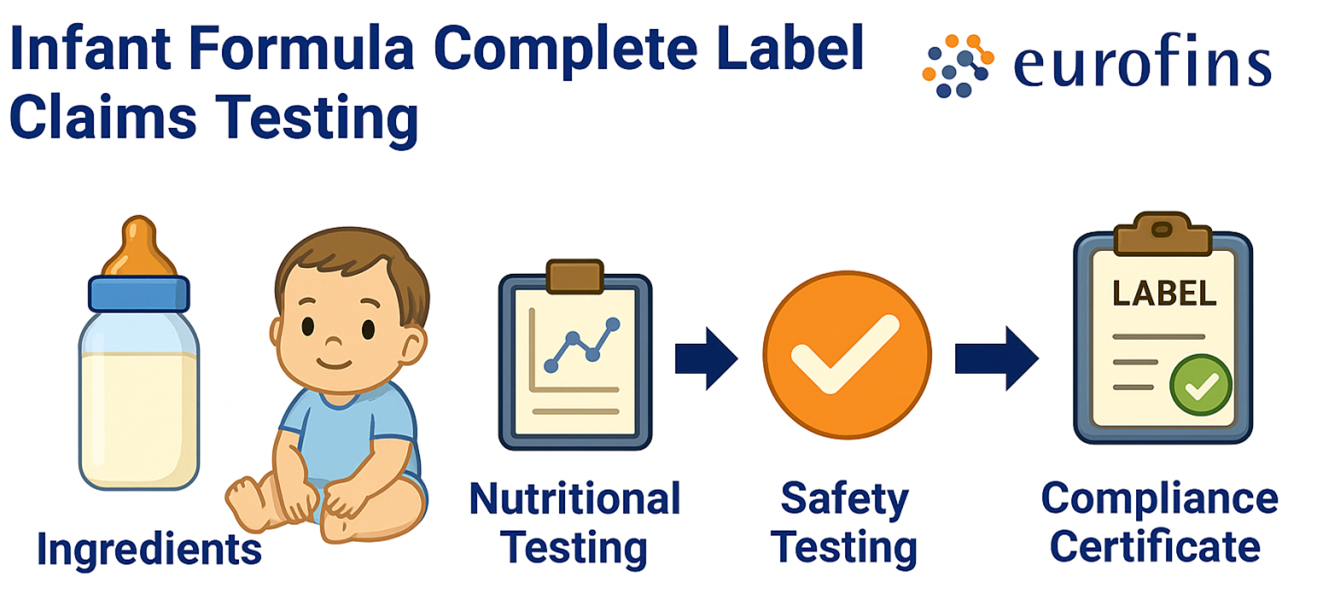
Complete label claims testing ensures that the declared nutrients, ingredients, and safety attributes match the actual composition of the product. Eurofins Food Testing Laboratories provide comprehensive analytical services to validate infant formula formulation, nutritional adequacy, microbiological safety, and compliance with international standards.
Why Complete Label Claims Testing Is Important
|
Reason |
Importance |
|
Regulatory Compliance |
Aligns with strict standards set by FSSAI, Codex, FDA, and EU for infant food |
|
Nutritional Accuracy |
Confirms that formula provides essential nutrients for healthy infant growth |
|
Safety Assurance |
Detects contaminants, allergens, and undeclared ingredients |
|
Brand Credibility |
Ensures transparency and prevents product recalls |
|
Export Approval |
Required documentation for global infant formula trade |
Key Label Claims for Infant Formula
Infant formula labels typically include claims related to nutrition, composition, and product suitability. These require laboratory verification.
- Macronutrients
- Protein quantity and profile
• Fat content and fatty acid composition (including DHA/ARA)
• Carbohydrates including lactose
- Micronutrients
- Vitamins (A, D, E, K, C, B-complex)
• Minerals (calcium, iron, zinc, selenium, iodine, magnesium)
- Specialized Ingredients
- Prebiotics and probiotics
• Nucleotides
• Lactoferrin
• Amino acids (taurine, choline, carnitine)
- Functional Claims
- Gut health support
• Brain and vision development
• Immune support
- Allergen-Free or Special Diet Claims
- Lactose-free
• Hypoallergenic
• Soy-free
• Hydrolyzed protein formula
• Suitable for premature or low-birth-weight infants
Why Contamination or Mislabeling Happens in Infant Formula
|
Source |
Description |
|
Cross-contact during production |
Shared manufacturing equipment for different formula types |
|
Ingredient variability |
Inconsistent nutrient content in raw materials |
|
Incorrect formulation |
Errors in pre-mixing or dosing |
|
Packaging mistakes |
Mixing up batches or outdated labels |
|
Supply chain issues |
Non-compliant or adulterated imported ingredients |
|
Manufacturing process losses |
Nutrient degradation due to heat, storage, or shelf life |
Parameters That Should be Tested
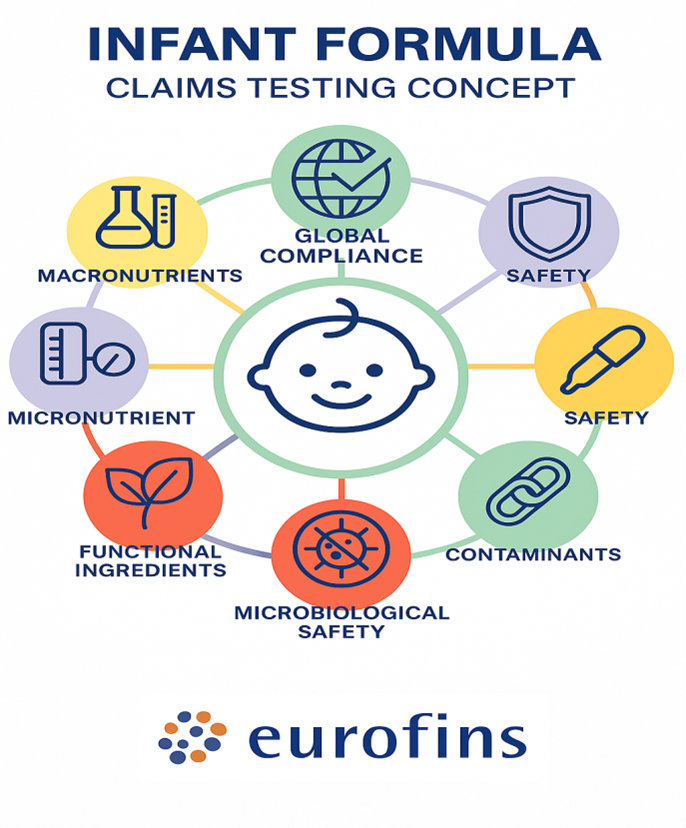 Nutritional Composition
- Protein, fat, carbohydrates
• Essential amino acids
• Omega-3 and Omega-6 profile
• Vitamins and minerals
• Energy value per 100 g or 100 ml
Microbiological Safety
- Salmonella
• Cronobacter sakazakii
• Staphylococcus aureus
• Total plate count
• Yeast and mold
Contaminants and Residues
- Heavy metals (lead, arsenic, cadmium)
• Mycotoxins
• Pesticide residues
• Acrylamide
• Packaging migrants
Allergen Verification
- Milk proteins
• Soy
• Gluten contamination (must be zero)
Authenticity and Adulteration Checks
- Added sugars
• Dilution with non-permitted ingredients
• Protein source authenticity
Regulatory Standards
FSSAI Labeling Requirements for Infant Formula in India
The following table outlines the key labeling requirements for infant formula products in India as mandated by the Food Safety and Standards (Packaging and Labelling) Regulations, 2011, along with specific requirements for different types of infant formulas.
|
Category |
Requirement |
Details |
|
Mother’s Milk Statement |
- Statement: “IMPORTANT NOTICE: MOTHER’S MILK IS BEST FOR YOUR BABY” in capital letters. |
|
|
Use and Preparation Instructions |
- Statement: Product should be used only on the advice of a health worker. |
|
|
Nutritional Information |
- Approximate composition of nutrients per 100 g or 100 ml, including energy value. |
|
|
Storage Instructions |
- Example: “Store in a cool and dry place in an airtight container.” |
|
|
Feeding Chart and Directions |
- Instructions for using a measuring scoop and quantity per scoop. |
|
|
Product Identification and Safety |
- Batch number, manufacturing date, expiry date, or recommended last consumption date. |
|
|
Restrictions on Imagery and Claims |
- No images of infants or women allowed. |
|
|
Milk Content Declaration |
- Products without milk or milk derivatives must be labeled: “Contains no milk or milk products or milk derivatives.” |
|
|
Lactose-Free Infant Milk Substitutes |
||
|
Lactose-Free Label |
- Prominently display “LACTOSE-FREE” in capital and bold letters. |
|
|
Medical Advisory Warning |
- Statement: “RECOMMENDED TO BE USED UNDER MEDICAL ADVICE ONLY” in capital and bold letters. |
|
|
Hypoallergenic Infant Milk Substitutes |
||
|
No Milk Declaration |
- Label: “CONTAINS NO MILK OR MILK PRODUCTS” conspicuously. |
|
|
Hypoallergenic Formula Label |
- Indicate “HYPOALLERGENIC FORMULA” with the statement “RECOMMENDED TO BE TAKEN UNDER MEDICAL ADVICE ONLY” in capital and bold letters. |
|
|
Foods for Infants with Inborn Errors of Metabolism (IEM) |
||
|
Special Medical Purpose Declaration |
- Words: “FOOD FOR SPECIAL MEDICAL PURPOSE” in capital and bold letters next to the product name or brand. |
|
|
Medical Advisory Warning |
- Statement: “RECOMMENDED TO BE USED UNDER MEDICAL ADVICE ONLY” in capital and bold letters, separate from other information. |
|
|
Infant Milk Substitute for Preterm Babies |
||
|
Preterm Baby Statement |
- Statement: “FOR THE PRETERM BABY (BORN BEFORE 37 WEEKS)” in capital and bold letters along with the product name. |
|
|
Medical Advisory Warning |
- Statement: “RECOMMENDED TO BE TAKEN UNDER MEDICAL ADVICE ONLY” in capital and bold letters. |
European Union
Commission Implementing Regulation (EU) 2025/1537 of 29 July 2025
This regulation amends Implementing Regulation (EU) 2017/2470 and includes provisions for infant formula, follow-on formula, and foods for special medical purposes for infants and young children. It specifies maximum levels for novel food ingredients, such as 3-Fucosyllactose (3-FL).
The following table outlines the key points related to infant formula under this EU regulation:
|
Category |
Requirement |
Details |
|
General Compliance |
||
|
Nutrient Composition and Labeling |
- Infant formula and follow-on formula must comply with requirements under Regulation (EU) No 609/2013. |
|
|
Labeling Requirements |
||
|
Promotion of Breastfeeding |
- Labeling must promote breastfeeding. |
|
|
Safe Preparation Instructions |
- Provide clear and safe instructions for preparation. |
|
|
Restrictions on Claims |
- Restrict health or nutrition claims. |
|
|
Novel Ingredients Labeling |
- Mandates specific labeling for novel ingredients like 3-Fucosyllactose (3-FL). |
|
|
Maximum Levels for Novel Ingredients |
||
|
3-Fucosyllactose (3-FL) |
- Maximum authorized level: 1.75 g/L in the final prepared product. |
|
|
Overall Standards |
||
|
Compositional, Safety, and Labeling Standards |
- Requires full compliance with these standards for all products. |
|
|
Applicability |
||
|
Binding Nature |
- Binding and directly applicable across all EU member states. |
Eurofins Analytical Testing Capabilities
Eurofins laboratories use advanced, accredited testing methods designed for complex infant formula matrices.
Technologies Used
- LC-MS/MS for vitamin and amino acid profiling
• ICP-OES/ICP-MS for mineral and heavy metal analysis
• GC-FID/MS for fatty acid profiling
• HPLC for sugars and nutrient stability
• Microbiological platforms for infant pathogens
• ELISA/PCR for allergen detection
Sample Types
- Infant milk formula
• Follow-up formula
• Hypoallergenic formula
• Plant-based infant nutrition
• Premature infant formula
• Ready-to-feed formulas
Eurofins Label Claims Validation Workflow
|
Step |
Objective |
Eurofins Service |
|
1. Review of Label Claims |
Understand formulation and regulatory needs |
Technical team assessment |
|
2. Sampling |
Representative sample collection |
Controlled, secure sample intake |
|
3. Analytical Testing |
Verify nutrients, contaminants, and safety |
Multi-parameter laboratory testing |
|
4. Compliance Comparison |
Match results with regulatory limits |
Expert interpretation |
|
5. Reporting & Certification |
Provide export-ready documentation |
Digital CoA via SmartLIMS |
Case Example
A leading infant nutrition brand required verification of DHA, iron, and vitamin D levels for new export markets. Eurofins performed comprehensive label claim testing across multiple batches and identified minor formulation variability. After correction, the product achieved full compliance and cleared all export checks with consistent batch reporting.
Why Choose Eurofins
- Global network of accredited infant formula testing laboratories
• Expertise in nutritional chemistry, safety testing, and regulatory compliance
• Highly sensitive detection methods tailored for infant products
• Fast turnaround with traceable digital reporting
• Support for formulation optimization and clean-label development
Ensure your infant formula products meet the highest global standards for safety, nutrition, and regulatory compliance.
Partner with Eurofins Food Testing Laboratories for complete label claim verification and trusted certification.
Enquire now: www.eurofins.in/food-testing/enquire-now/

