


Microplastic Testing in Drinking Water and Salt

Microplastics have emerged as a major global contaminant affecting drinking water, table salt, marine ecosystems, and the food chain. These tiny plastic particles (typically <5 mm) originate from packaging waste, industrial processes, synthetic textiles, degraded plastics, and environmental pollution.
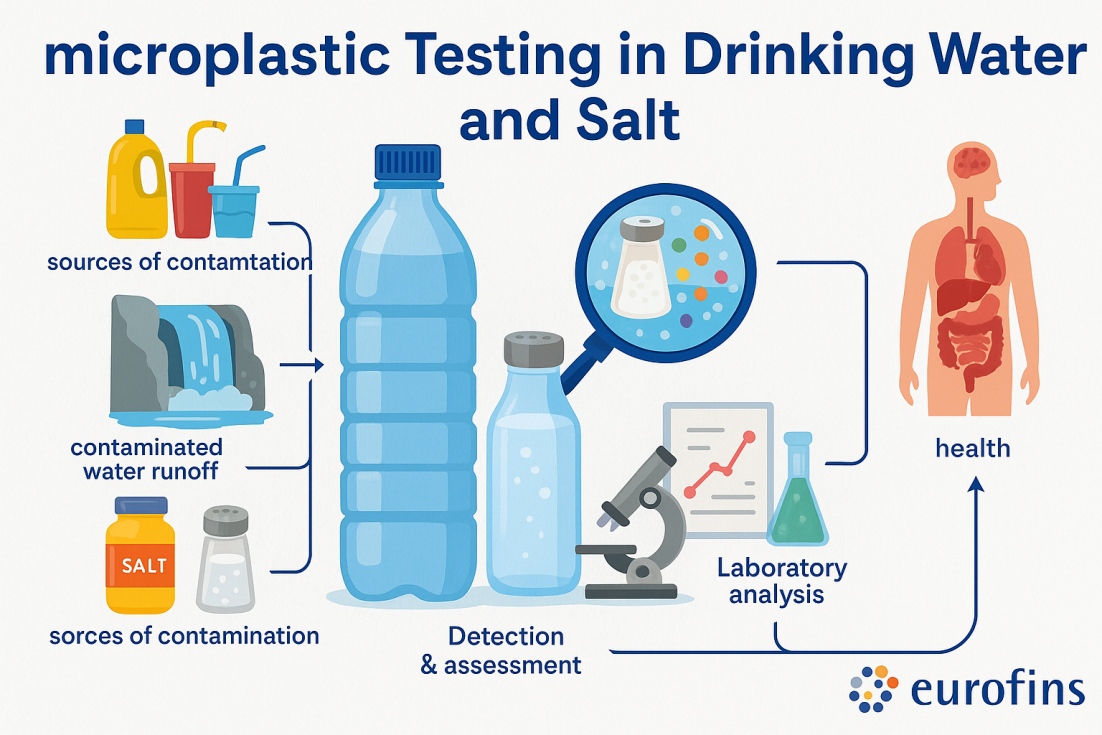
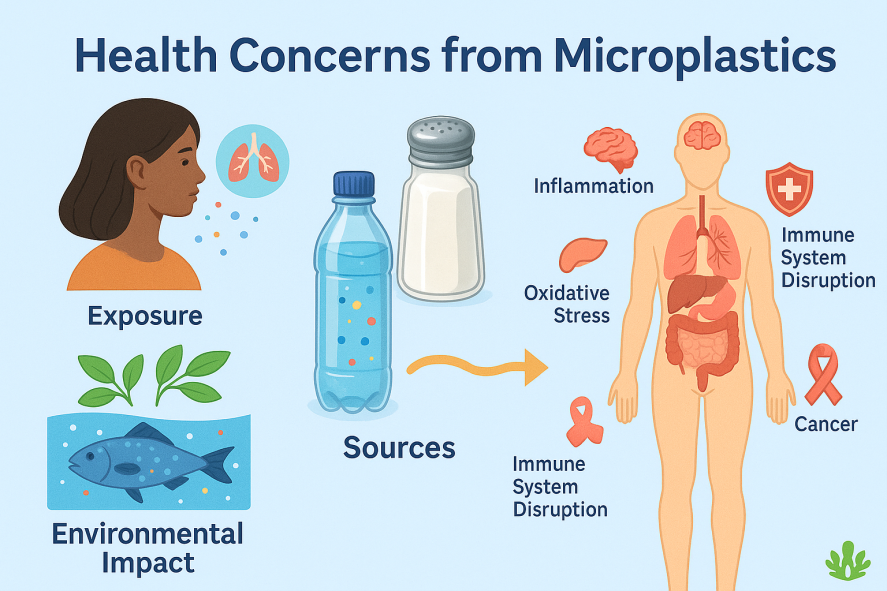
Studies show that microplastics can be present in bottled water, tap water, sea salt, rock salt, and processed foods. Continuous consumption may pose potential health risks including inflammation, oxidative stress, gastrointestinal disruption, and chemical exposure from plastic additives.
Eurofins provides advanced microplastic testing using state-of-the-art instrumentation and validated global methodologies to help water producers, salt manufacturers, food industries, regulators, and exporters ensure product safety and regulatory compliance.
Why Microplastic Testing Matters
|
Benefit |
Purpose |
|
Consumer protection |
Ensures drinking water and salt are free from harmful particulates |
|
Regulatory compliance |
Aligns with emerging global microplastic monitoring guidelines |
|
Brand trust |
Demonstrates transparency and quality assurance |
|
Export acceptance |
Required by several international buyers & food safety authorities |
|
Environmental responsibility |
Supports reduction of plastic contamination |
|
Risk management |
Early identification of pollution sources |
Sources of Microplastic Contamination
|
Source |
Description |
|
Environmental degradation |
Breakdown of plastic waste in oceans & rivers |
|
Packaging materials |
Leaching from plastic bottles, pouches, and caps |
|
Industrial processes |
Microbeads, fibers, polymer residues |
|
Household laundry |
Release of synthetic textile fibers |
|
Water treatment inefficiencies |
Incomplete filtration of microplastic particles |
|
Salt harvesting |
Marine and lake salts exposed to plastic-polluted water |
Types of Microplastics Detected
By Size
- Macroplastics (>5 mm)
- Microplastics (1 µm – 5 mm)
- Nanoplastics (<1 µm)
By Polymer Type
- Polyethylene (PE)
- Polypropylene (PP)
- Polystyrene (PS)
- PET (Polyethylene Terephthalate)
- PVC (Polyvinyl Chloride)
- Nylon & polyester fibers
By Shape
- Fragments
- Fibers
- Films
- Beads / pellets
- Foams
Products Commonly Tested
|
Product Category |
Examples |
|
Drinking water |
Bottled water, tap water, RO water |
|
Table salt |
Sea salt, rock salt, iodized salt |
|
Food-grade ice |
Cubes, craft ice, processed ice |
|
Beverages |
Soft drinks, juices, mineral water |
|
Marine products |
Seaweed, dried foods, shellfish |
|
Processed foods |
Ready-to-cook & packaged items |
Health Risks from Microplastic Exposure
|
Health Effect |
Description |
|
Inflammation |
Irritation to digestive lining |
|
Chemical exposure |
Additives like BPA, phthalates, heavy metals |
|
Oxidative stress |
Cellular damage from ingested particles |
|
Hormonal disruption |
Endocrine-interfering plasticizers |
|
Microbial carriage |
Pathogens attached to plastic particles |
Standards and Regulations
Microplastic Regulations: India (FSSAI)
- Current Status
- No mandatory limits or routine regulatory testing for microplastics/nanoplastics in food, packaged drinking water, or salt
- Microplastics not explicitly covered under existing standards
- Ongoing FSSAI Initiatives
- Multi-institution projects with CSIR-IITR, ICAR-CIFT, BITS Pilani, and others
- Focus: Develop India-specific validated testing protocols for microplastics and nanoplastics
- Prevalence studies in various food matrices including packaged drinking water and salt
- Exposure assessment and risk evaluation
- Related Existing Regulation
- Food Safety and Standards (Packaging) Regulations, 2018 → Sets specific migration limits for substances (e.g., additives, monomers) from plastic packaging into food/water → Does NOT specifically address physical microplastic particles
https://www.business-standard.com/article/news-ani/microplastics-in-packaged-water-within-safe-limits-health-minister-119070401454_1.html
https://fssai.gov.in/upload/uploadfiles/files/Compendium_Packaging_V_%2002-04-2025.pdf
Microplastic Regulations: European Union
- Drinking Water
- Revised Drinking Water Directive (EU) 2020/2184: Mandates monitoring of microplastics
- Commission Delegated Decision (EU) 2024/1441: → Harmonized technical methods for sampling, analysis, and reporting → Applies to particles 20 µm – 5 mm
- Intentionally Added Microplastics
- Commission Regulation (EU) 2023/2055 (REACH Annex XVII, Entry 78): → Bans or restricts sale of products containing intentionally added synthetic polymer microparticles (e.g., cosmetics, detergents, infill material)
Eurofins Microplastic Testing Capabilities
Analytical Techniques
Eurofins uses globally recognized tools to detect, identify, and quantify microplastics at ultra-trace levels.
|
Instrument / Platform |
Purpose |
|
FTIR Microscopy (µFTIR) |
Polymer identification and particle counting |
|
Raman Microscopy |
Nanoplastic and fiber detection |
|
SEM–EDS |
Morphology and elemental composition |
|
Pyr-GC/MS |
Polymer fingerprinting and quantification |
|
Optical & Fluorescence Microscopy |
Rapid screening and particle visualization |
|
Filtration & Digestion Methods |
Concentration and isolation of microplastics |
Complementary Testing Solutions
- Heavy metal analysis in water/salt
- Additive & plasticizer detection (phthalates, BPA)
- Salt purity & mineral analysis
- Water quality parameters (pH, TDS, turbidity, hardness)
- Packaging material migration testing
Eurofins Microplastic Compliance Framework
|
Stage |
Objective |
Eurofins Solution |
|
Sample Preparation |
Remove organic matter |
Chemical digestion & filtration |
|
Particle Isolation |
Concentrate microplastics |
Density separation & sieving |
|
Identification |
Determine polymer composition |
µFTIR / Raman spectroscopy |
|
Quantification |
Count & size distribution |
Automated image analysis |
|
Reporting |
Compliance and risk evaluation |
Digital CoA & regulatory review |
Global Regulations & Guidelines
- European Union: EU Drinking Water Directive mandates microplastic monitoring; EFSA actively evaluating risk assessment
- WHO: Guidelines for microplastic presence in drinking water; risk-based assessment recommended
- India: BIS standards evolving toward microplastic testing in packaged water; FSSAI encouraging monitoring in salt & marine products
- USA: EPA microplastic monitoring programs; FDA oversees plastic contamination in foods & bottled water
Case Study: Eliminating Microplastic Contamination in Packaged Drinking Water
Challenge A premium bottled-water manufacturer faced export rejections and customer complaints due to microplastic fibers in multiple batches.
Eurofins Assessment Full contamination-mapping study including bottle polymer analysis, cap-shedding evaluations, and filtration efficiency checks.
Findings Micro-FTIR and Raman microscopy confirmed polypropylene and PET fragments originating from the high-speed capping unit.
Eurofins Solution Upgraded filtration membranes, improved pressure control, and adoption of low-shedding closure materials.
Outcome Microplastic levels reduced by 85% within three production cycles, restoring compliance with EU and Middle East import standards and rebuilding brand trust.
Why Choose Eurofins
- Global leader in microplastic and polymer analysis
- Advanced spectral libraries for accurate polymer identification
- ISO/IEC 17025 accredited laboratories
- Expertise in water, salt, marine, and packaged food testing
- Fast turnaround and high-sensitivity detection
- Trusted partner for bottling plants, salt manufacturers, exporters, and regulators
- Detect microplastics with scientific accuracy
- Ensure drinking water and salt safety
- Meet emerging global standards for microplastic control
- Strengthen consumer trust with transparent quality reporting
Enquire now: www.eurofins.in/food-testing/enquire-now/

