


Nitrosamines in Food and Packaging

Nitrosamines are chemical compounds formed by the reaction of secondary amines with nitrites under conditions such as heat, acidity, or oxidation. Recognized as potent carcinogens and mutagens even at low concentrations, nitrosamines pose a significant concern in the food and packaging industries due to their potential formation during processing, storage, or migration from packaging materials.
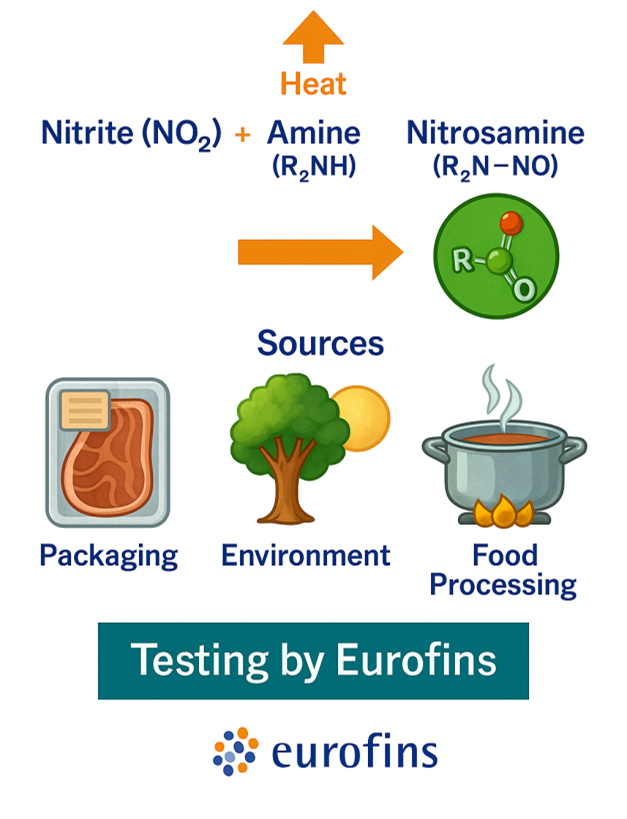
At Eurofins, we specialize in identifying, quantifying, and mitigating nitrosamine risks across food, packaging, and related sectors. Our global network of ISO/IEC 17025-accredited laboratories employs advanced analytical platforms to deliver precise, trace-level results. Through comprehensive testing, risk assessment, and regulatory consulting, we ensure compliance and consumer safety.
Understanding Nitrosamine Formation and Occurrence
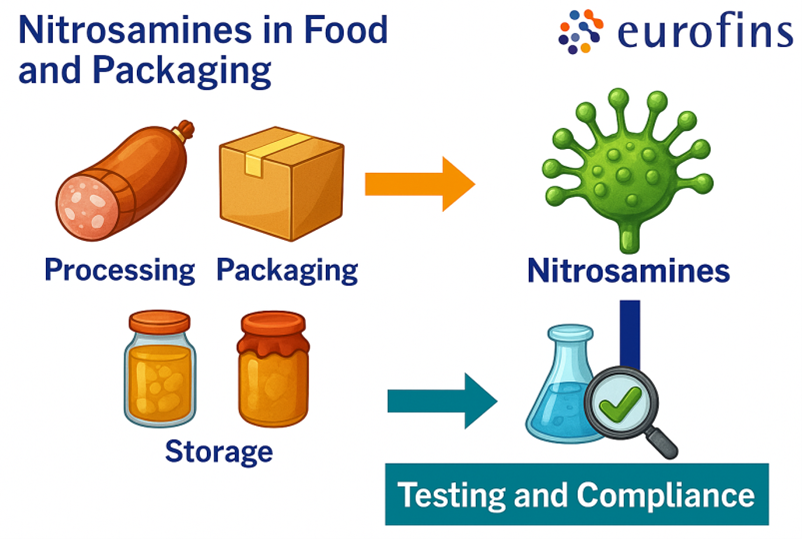
Nitrosamines may form naturally or through human activities at various stages of production and supply.
Key Formation Pathways
- Reaction of Nitrites and Secondary Amines: Occurs during curing, fermentation, or thermal processing.
- Migration from Packaging: Originates from amine-based accelerators, adhesives, or printing inks.
- Environmental Exposure: Nitrogen oxides from fertilizers or air pollution contribute to contamination.
- Storage Interactions: Chemical reactions during long-term storage of high-protein or high-fat foods.
Commonly Detected Nitrosamines
|
Nitrosamine Compound |
Typical Source |
Associated Products |
Health Concern |
|
NDMA (N-Nitrosodimethylamine) |
Nitrite in cured meat, packaging adhesives |
Meat, milk, beverages |
Carcinogenic; liver toxicity |
|
NDEA (N-Nitrosodiethylamine) |
Amines in flavor precursors |
Alcoholic drinks, dairy |
Genotoxic; reproductive impact |
|
NPYR (N-Nitrosopyrrolidine) |
Thermal degradation of amines |
Spices, fried foods |
Carcinogenic |
|
NPIP (N-Nitrosopiperidine) |
Piperidine-containing additives |
Seasonings, cured meats |
Neurotoxic potential |
Why Nitrosamine Testing is Essential
Nitrosamine monitoring ensures compliance and protects brand reputation by:
- Detecting formation points during manufacturing and storage.
- Validating raw materials and additives for precursor amines.
- Identifying and eliminating nitrosating conditions in packaging and processing.
- Meeting international Maximum Residue Limits (MRLs) and safety regulations.
- Supporting “nitrosamine-free” product claims through independent validation.
Sources and Pathways of Contamination
|
Stage |
Possible Source |
Example |
Control Strategy |
|
Raw Material |
Nitrite salts, fertilizers, amine additives |
Cured meat ingredients, dairy culture starters |
Source verification, incoming inspection |
|
Processing |
Heat, acidic conditions, protein degradation |
Smoking, roasting, frying |
Controlled temperature, pH optimization |
|
Packaging |
Rubber seals, adhesives, plasticizers, inks |
Bottle caps, sachets, foil laminates |
Migration testing, material replacement |
|
Storage |
Oxidative and thermal reactions |
Long-term storage at high humidity |
Controlled atmosphere, shelf-life testing |
|
Environment |
Industrial air emissions, cleaning residues |
NOx, residual sanitizers |
Environmental monitoring, cleaning validation |
Eurofins Analytical Testing Capabilities
Eurofins offers ultra-sensitive, validated analytical techniques for nitrosamine detection in food, water, packaging, and process materials.
Instrumental Platforms
- Gas Chromatography–Mass Spectrometry (GC-MS, GC-MS/MS): For volatile nitrosamines.
- Liquid Chromatography–High-Resolution Mass Spectrometry (LC-HRMS): For non-volatile compounds.
- Headspace GC-MS: For packaging migration analysis.
- Isotope Dilution Mass Spectrometry: For quantitative trace confirmation.
Analytical Features
- Detection limits down to parts-per-trillion (ppt).
- Matrix-specific extraction and cleanup methods.
- Identification of nitrosamine precursors and nitrosating agents.
- Data validation per AOAC, ISO, and EN standards.
Regulatory Framework and Compliance Standards
FSSAI Regulations on Printing Inks and Nitrosamine Control
- In 2019, the Food Safety and Standards Authority of India (FSSAI) revised the packaging norms under the Food Safety and Standards (Packaging) Regulations, 2018, making it mandatory to comply with the Bureau of Indian Standards (BIS) specification IS 15495: “Printing Ink for Food Packaging — Code of Practice.” This standard ensures that printing inks used in food packaging are safe, non-toxic, and free from harmful substances that could migrate into food.
- IS 15495 includes a negative list of chemicals that are prohibited in ink formulations. Section A-5 of Annexure A specifically restricts compounds such as nitrosamines including NDMA, NDEA, NPYR, and NPIP, due to their carcinogenic nature. The regulations require that printing inks used on food packaging conform to IS 15495 and that the printed surface should not come into direct contact with food.
https://foodsafetystandard.in/wp-content/uploads/2020/01/Printing-Ink-for-food-packaging.pdf
European union
Commission Regulation (EU) 2023/2108, adopted on October 6, 2023, updates existing food additive laws related to nitrites (E 249–250) and nitrates (E 251–252). The amendment reduces the maximum levels of these additives used in meat, fish, and dairy products. The regulation expresses limits in terms of nitrite (NO₂) and nitrate (NO₃) ions for better alignment with EFSA’s acceptable daily intake standards. Its goal is to lower the formation of nitrosamines, which can be harmful, while still maintaining the necessary preservative and antimicrobial functions of nitrites and nitrates—particularly their role in preventing Clostridium botulinum growth.
https://eur-lex.europa.eu/legal-content/EN/TXT/PDF/?uri=OJ%3AL_202302108
Packaging Interaction and Migration Studies
Packaging materials are a significant secondary source of nitrosamine contamination. Eurofins conducts:
- Extraction and migration analysis of rubber gaskets, closures, and laminated films.
- Simulation studies with food simulants (aqueous, fatty, acidic).
- Shelf-life and accelerated aging assessments.
- Compliance evaluation under EU Regulation (EU) No. 10/2011 and FDA 21 CFR 175–178.
These studies enable manufacturers to replace non-compliant materials and validate safer alternatives.
Advanced Interpretation and Data Reporting
Eurofins provides comprehensive data interpretation to support actionable outcomes:
- Correlation of nitrosamine levels with process conditions and material chemistry.
- Identification of root causes through precursor mapping and reaction mechanisms.
- Comparison with historical data and regulatory thresholds.
- Corrective recommendations to eliminate recurring contamination sources.
Case Study: Migration Control in Snack Packaging
A leading snack manufacturer faced export challenges due to nitrosamine contamination detected in flavored potato chips. Eurofins’ analytical team identified N-nitrosodimethylamine (NDMA) migrating from the ink layer of the product’s packaging film. Through targeted GC-MS/MS analysis and accelerated migration studies, the source was traced to nitrosatable curing agents used in the laminate layer. Eurofins recommended material reformulation and validated alternative packaging solutions through controlled migration testing. Follow-up analyses confirmed that nitrosamine presence was successfully mitigated, enabling the manufacturer to resume exports confidently and maintain global safety standards.
Eurofins Comprehensive Service Portfolio
- Nitrosamine and precursor screening in food, water, and packaging.
- Migration, interaction, and stability studies.
- Method validation for specific product lines.
- Toxicological risk and exposure assessment.
- Global regulatory testing and certification.
- Technical training for R&D and QA teams.
Why Partner with Eurofins
- ISO/IEC 17025-accredited global laboratory network.
- Multi-matrix testing across food, packaging, and pharmaceutical sectors.
- Analytical sensitivity at ppb to ppt levels.
- In-depth regulatory knowledge for FSSAI, EU, FDA, and Codex compliance.
- Integrated data interpretation and risk communication.
- Rapid turnaround and end-to-end customer support.
Safeguard your food and packaging integrity with Eurofins’ advanced nitrosamine testing and risk assessment services. Our experts help you identify sources, evaluate exposure, and ensure global compliance through scientific accuracy and quality assurance.
Enquire now: www.eurofins.in/food-testing/enquire-now/

