


Perchlorate and Chlorate Residues in Bottled Water & Produce

Perchlorates and chlorates are chemical residues that can enter bottled water, fresh produce, and processed foods through disinfection processes, fertilizers, and environmental contamination. Although they are not intentionally added, their presence has become a growing concern due to their potential to interfere with thyroid function, especially in infants, pregnant women, and sensitive individuals.
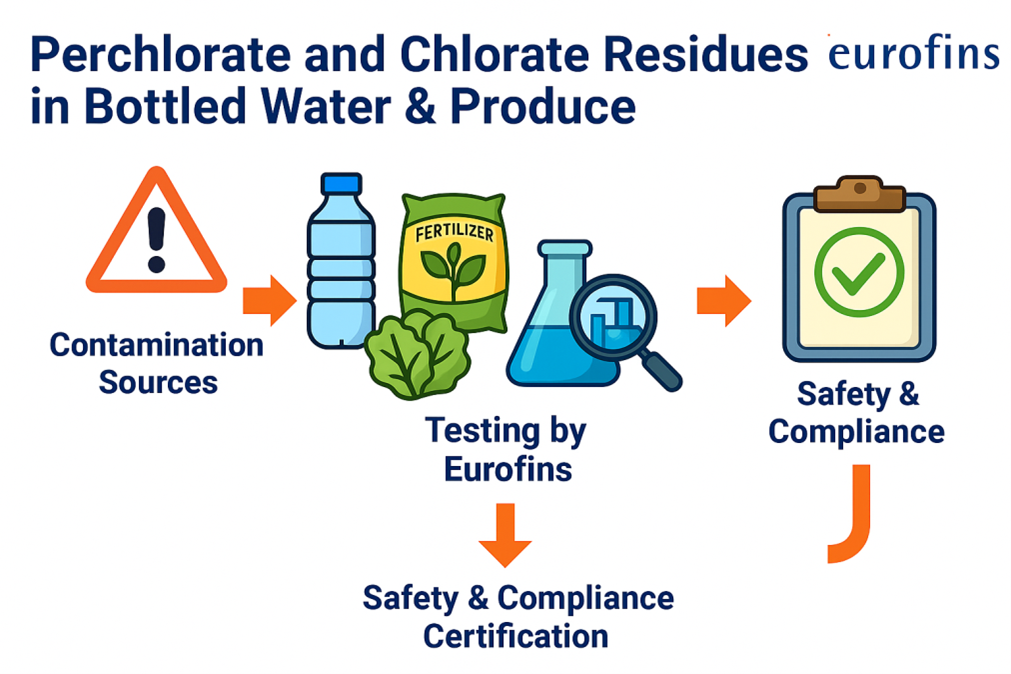
Food safety authorities have established strict limits and monitoring requirements to control these residues. Eurofins Food Testing Laboratories offer comprehensive analytical services for detecting perchlorates and chlorates across a wide range of food, water, and agricultural products to ensure compliance and consumer safety.
Why Perchlorates and Chlorates Enter Food & Water
|
Source |
Description |
|
Water Disinfection |
Chlorine-based sanitizers used in water treatment or food processing generate chlorates and perchlorates |
|
Agricultural Practices |
Use of nitrate fertilizers, irrigation with contaminated water, and soil accumulation |
|
Food Processing |
Washing, peeling, and cutting produce using chlorinated water |
|
Packaging Contact |
Active packaging materials containing chlorine compounds |
|
Environmental Contamination |
Industrial discharge, atmospheric deposition, and contaminated groundwater |
|
Storage & Distribution |
Breakdown of disinfectants during long storage times |
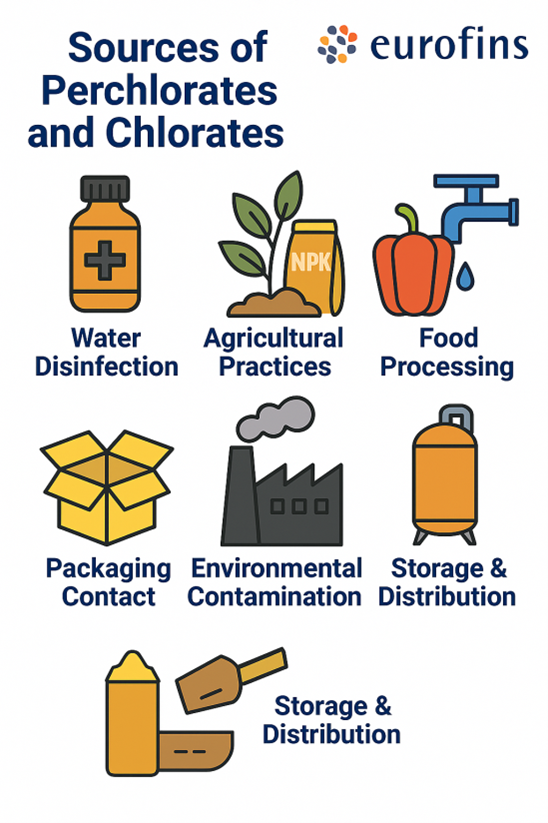
These residues often originate unintentionally from sanitation and agricultural systems, making routine monitoring essential.
Health Impacts
Perchlorates and chlorates affect the thyroid gland by disrupting iodine uptake. Long-term or high exposure may result in:
- Reduced thyroid hormone production
- Impaired neurological development in infants
- Growth delays in children
- Hormonal imbalance
- Increased vulnerability in pregnant and breastfeeding women
- Regular testing helps protect vulnerable populations and ensures safe consumption.
Regulatory Overview
European union
Chlorate: COMMISSION REGULATION (EU) 2020/749
This regulation amends Annex III of Regulation (EC) No 396/2005 and sets MRLs for chlorate in various food categories. Chlorate residues mainly arise from the use of chlorine-based disinfectants in food processing and water treatment, not from pesticide use.
Perchlorate: COMMISSION REGULATION (EU) 2023/915
This regulation sets maximum levels for perchlorate in food, with a focus on protecting infants and children due to perchlorate's impact on thyroid function. The regulation was amended in 2024 (via Commission Regulation (EU) 2024/1002) to reflect new data and practical considerations for certain foods, such as adjusting levels in beans (Phaseolus vulgaris) with pods.
Summary Table: EU MRLs for Chlorate and Perchlorate
|
Food Category |
Chlorate MRL (mg/kg) |
Perchlorate MRL (mg/kg) |
|
Most fruits and vegetables |
0.05 |
0.05 |
|
Pome/stone fruits, berries |
0.05 |
0.05 |
|
Spices |
0.07 |
0.05 |
|
Edible nuts |
0.1 |
0.05 |
|
Dates and figs |
0.3 |
0.05 |
|
Table olives |
0.7 |
0.05 |
|
Cucurbitaceae, kale |
0.05 |
0.10 |
|
Leaf vegetables, herbs |
0.05 |
0.50 |
|
Beans with pods |
0.05 |
0.15 |
|
Tea, herbal infusions |
0.05 |
0.75 |
|
Infant formula |
0.05 |
0.01 |
|
Drinking water |
0.7 mg/L |
Not specified |
https://eur-lex.europa.eu/legal-content/EN/TXT/PDF/?uri=CELEX:32020R0749&qid=1591623683652&from=EN
https://measurlabs.com/blog/eu-regulations-on-food-contaminants/#perchlorate
Parameters That Should Be Tested
- Perchlorate Residues
Quantification in bottled water, produce, juices, vegetables, and baby foods.
- Chlorate Residues
Assessment of chlorate contamination from food processing and sanitation.
- Source Investigation
Identifying if contamination is from water treatment, fertilizers, or processing.
- Raw Material vs Finished Product
Ensures ingredients, water sources, and end products all meet safety limits.
- Multi-matrix Screening
Testing across fruits, leafy greens, herbs, root vegetables, bottled water, ice, and beverages.
Eurofins Analytical Capabilities
Eurofins laboratories use advanced analytical methods to detect perchlorates and chlorates at trace levels in complex food and water matrices.
Technologies Used
- LC-MS/MS for sensitive and selective detection
• Ion chromatography for confirmatory analysis
• Multi-residue screening for large sample batches
• Matrix-specific validation across water, produce, and processed foods
Sample Types Covered
- Bottled water (mineral, packaged drinking water)
• Fresh produce (leafy greens, berries, herbs, vegetables)
• Baby foods and infant nutrition
• Juices, beverages, and syrups
• Frozen produce and ready-to-eat items
Eurofins Testing Workflow
|
Step |
Objective |
Eurofins Service |
|
Sample Collection |
Traceable and representative sample intake |
Secure logistics & SmartLIMS |
|
Screening |
Initial detection of perchlorates and chlorates |
LC-MS/MS screening |
|
Quantification |
Confirmed concentration analysis |
High-resolution instruments |
|
Interpretation |
Identify contamination sources |
Expert evaluation |
|
Reporting |
Export-ready, regulatory-compliant documentation |
Digital CoA and dashboards |
Case Study
A European exporter of leafy vegetables faced repeated shipment detentions due to perchlorate levels exceeding EU limits. Eurofins conducted source tracing, identified the contamination as arising from chlorinated wash water, and recommended process adjustments. Updated water treatment reduced perchlorate levels significantly, restoring compliance.
Why Partner with Eurofins
- Accredited global laboratory network
- Expertise in chemical residue and environmental contaminant testing
- High-sensitivity methods suitable for water, produce, and baby foods
- Fast reporting for export-driven supply chains
- Support for root cause analysis and preventive measures
- Digital traceability through SmartLIMS and SmartView
Ensure your bottled water and produce products comply with global contaminant standards and remain safe for every consumer.
Partner with Eurofins Food Testing Laboratories for reliable perchlorate and chlorate residue testing, full regulatory support, and precise certification.
Enquire now: www.eurofins.in/food-testing/enquire-now/

