


Phthalates Testing Services

Phthalates are a group of chemical plasticizers widely used to enhance the flexibility, durability, and performance of plastics and consumer materials. Commonly found in food packaging, processing equipment, printing inks, coatings, tubing, cosmetics, medical devices, and household products, these compounds can migrate into food, water, and biological systems, raising significant food safety and public health concerns.
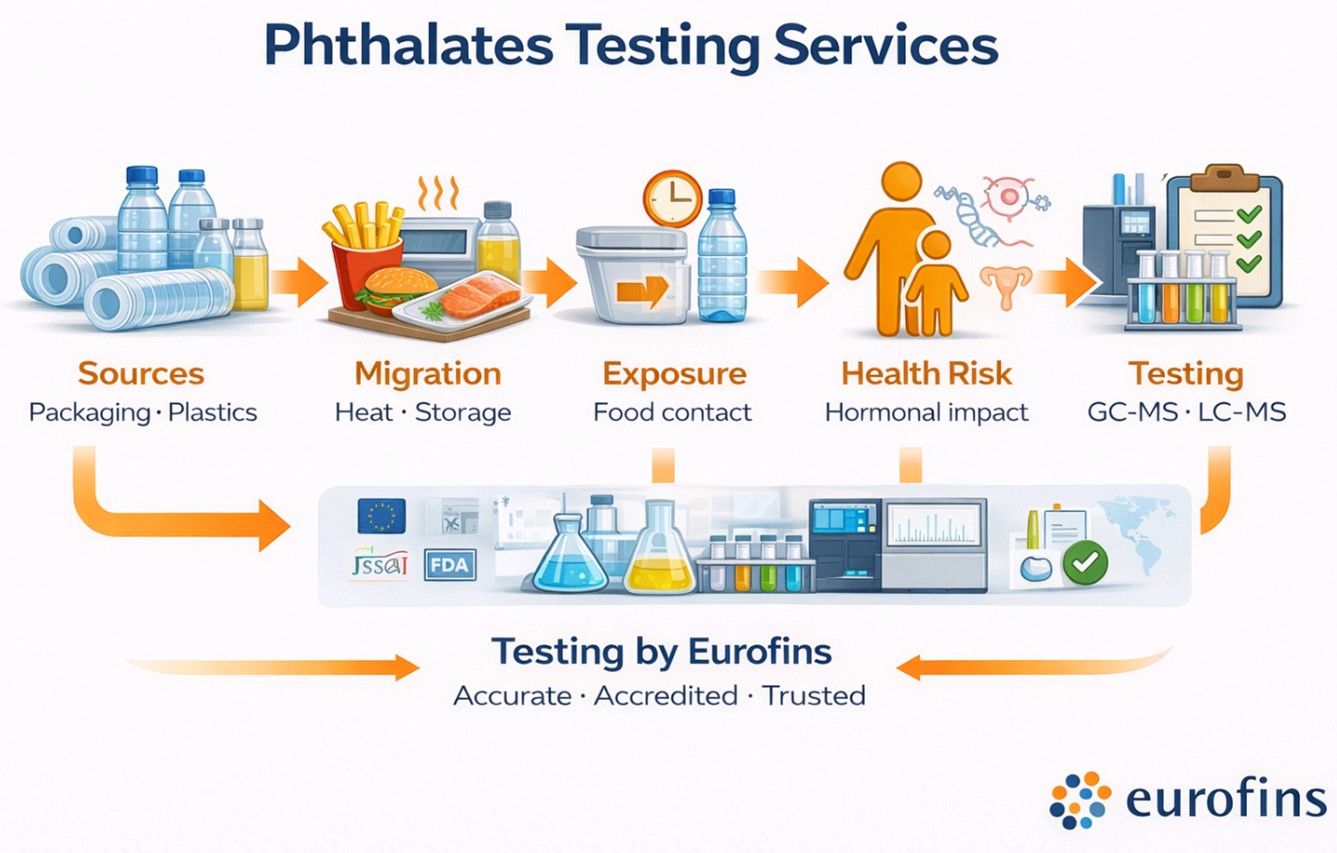
Exposure to phthalates is linked to endocrine disruption, reproductive toxicity, developmental effects, and long-term health risks especially in infants and vulnerable populations. Strict global regulations now control phthalate levels in food-contact materials, drinking water, functional foods, nutraceuticals, and consumer products.
Eurofins delivers comprehensive phthalates testing services through accredited laboratories and advanced analytical platforms, helping manufacturers, exporters, brand owners, and regulators achieve safety and compliance.
Why Phthalates Testing Matters
|
Benefit |
Purpose |
|
Consumer safety |
Prevents exposure to endocrine-disrupting chemicals |
|
Regulatory compliance |
Meets EU, FSSAI, FDA, REACH, and RoHS standards |
|
Product integrity |
Confirms safety of packaging and raw materials |
|
Export readiness |
Avoids rejection in regulated global markets |
|
Brand protection |
Reduces recall and reputational risks |
|
Supply chain control |
Identifies contamination sources early |
Common Phthalates and Their Applications
Understanding applications helps pinpoint contamination risks.
|
Phthalate |
Typical Applications |
Risk of Occurrence |
|
DEHP (Di(2-ethylhexyl) phthalate) |
PVC packaging, tubing, conveyor belts, printing inks |
High migration into fatty foods |
|
DBP (Dibutyl phthalate) |
Adhesives, coatings, inks, cosmetics |
Common in packaging and labels |
|
BBP (Benzyl butyl phthalate) |
Flooring materials, sealants, food wraps |
Migration from food-contact surfaces |
|
DINP (Diisononyl phthalate) |
Flexible plastics, films, lids |
Present in plastic containers |
|
DIDP (Diisodecyl phthalate) |
Heavy-duty plastics, cables |
Long-term migration risk |
|
DEP (Diethyl phthalate) |
Fragrances, personal care products |
Indirect contamination |
|
DMP (Dimethyl phthalate) |
Industrial solvents, coatings |
Low but detectable exposure |
These compounds can migrate into food, beverages, drinking water, supplements, and more during processing, packaging, or storage.
Products Commonly Tested for Phthalates
|
Category |
Examples |
|
Food & beverages |
Oils, dairy, bottled water, soft drinks |
|
Packaging materials |
Plastic films, containers, caps, seals |
|
Functional foods |
Protein powders, fortified drinks |
|
Nutraceuticals |
Capsules, tablets, liquid supplements |
|
Infant & baby products |
Formula packaging, feeding accessories |
|
Medical & pharma products |
Tubing, containers, devices |
|
Drinking water |
Bottled and packaged water |
Health Risks Associated with Phthalates
|
Health Impact |
Description |
|
Endocrine disruption |
Interferes with hormone function |
|
Reproductive toxicity |
Affects fertility and development |
|
Developmental effects |
Risk to infants and children |
|
Metabolic disorders |
Linked to obesity and insulin resistance |
|
Chronic exposure risk |
Bioaccumulation over time |
Regulations & Standards
|
Region |
Regulatory Body |
Key Regulation/Update |
Limit/Restriction |
|
India |
FSSAI |
Food Safety and Standards (Packaging) Amendment Regulations, 2021 (further amended 2022) |
DEHP migration limit: ≤ 1.5 mg/kg in food contact plastics |
|
USA |
FDA |
As of May 2022, approval for 23 phthalates revoked; only 9 allowed in packaging |
Use restricted to a reduced list of permitted phthalates |
|
EPA |
National Primary Drinking Water Regulations |
DEHP in drinking water limited to 6 ppb |
|
|
European Union |
European Commission (EU) |
EU Regulation 10/2011 (amended in 2023) |
DEHP allowed only in repeated-use materials for non-fatty foods, limit: 0.6 mg/kg |
|
EFSA |
Tolerable Daily Intake (TDI) values set for consumer protection |
TDI values vary by phthalate type to limit long-term exposure |
https://www.fssai.gov.in/upload/advisories/2020/02/5e3d4cdfba1ebDirection_Antinomy_limits_Packaged_Drinking_Water_07_02_2020.pdf
https://www.fda.gov/food/food-additives-and-gras-ingredients-information-consumers/phthalates-food-packaging-and-food-contact-applications
Eurofins Phthalates Testing Capabilities
Analytical Platforms
Eurofins employs state-of-the-art instrumentation for precise detection.
|
Instrument |
Purpose |
|
GC-MS / GC-MS/MS |
Primary method for phthalate identification |
|
LC-MS/MS |
Confirmatory analysis in complex matrices |
|
Headspace GC |
Migration and packaging studies |
|
FTIR Screening |
Rapid plastic composition checks |
Migration testing under simulated food-contact conditions using standardized simulants
Key Testing Parameters and Services
Eurofins offers targeted panels for regulated phthalates with low detection limits (down to ppb levels):
- Standard Phthalate Panel: DEHP, DBP, BBP, DINP, DIDP, DEP, DMP, DIBP, DPENP, DHEXP, DCHP (expanded to cover recent prohibitions).
- Detection Methods: GC-MS/MS for primary quantification; LC-MS/MS for trace levels in complex samples.
- Migration Testing: Specific Migration Limits (SML) and Overall Migration assessment using food simulants.
- Screening for Alternatives: Testing for non-phthalate plasticizers (e.g., DINCH, DEHT, ATBC, citrates) to support transition to safer options.
- Additional Services: NIAS (Non-Intentionally Added Substances) screening, sensory evaluation, Declaration of Compliance (DoC), and compliance for toys/childcare products.
Eurofins Phthalates Compliance Framework
|
Step |
Objective |
Eurofins Solution |
|
Material screening |
Detect phthalates at source |
GC-MS profiling |
|
Migration assessment |
Evaluate leaching into food |
Simulant studies |
|
Product testing |
Verify finished product safety |
Targeted phthalate panels |
|
Regulatory review |
Compare with legal limits |
Compliance reporting |
|
Monitoring |
Ongoing risk management |
Digital trend analysis |
Case Study: Phthalate Reduction in Bottled Water Packaging
A bottled water manufacturer faced EU compliance failure due to elevated DEHP migration from plastic caps. Eurofins performed GC-MS-based migration studies, pinpointed the cap material as the source, and suggested low-migration alternatives. Post-modification, phthalate levels fell below limits, restoring EU export approval in two production cycles.
Why Choose Eurofins
- ISO/IEC 17025 accredited laboratories
- Advanced GC-MS and migration testing expertise
- Global regulatory knowledge and export support
- Fast turnaround with digital reporting
- Trusted partner for food, packaging, and nutraceutical industries
- Detect and control phthalates with scientific precision
- Ensure packaging and product compliance
- Protect consumer health and brand reputation
- Meet global food-contact and safety regulations
Partner with Eurofins your trusted pathway to compliant, export-ready food
Enquire now: www.eurofins.in/food-testing/enquire-now/

