


Pyrrolizidine Alkaloids (PA) Testing: Ensuring Safety in Herbal and Food Products

Pyrrolizidine alkaloids (PAs) are naturally occurring plant toxins found in more than 6,000 plant species worldwide. These compounds can unintentionally enter the food chain when PA-producing weeds grow alongside crops, contaminate herbal ingredients, or mix with plant materials during harvesting.
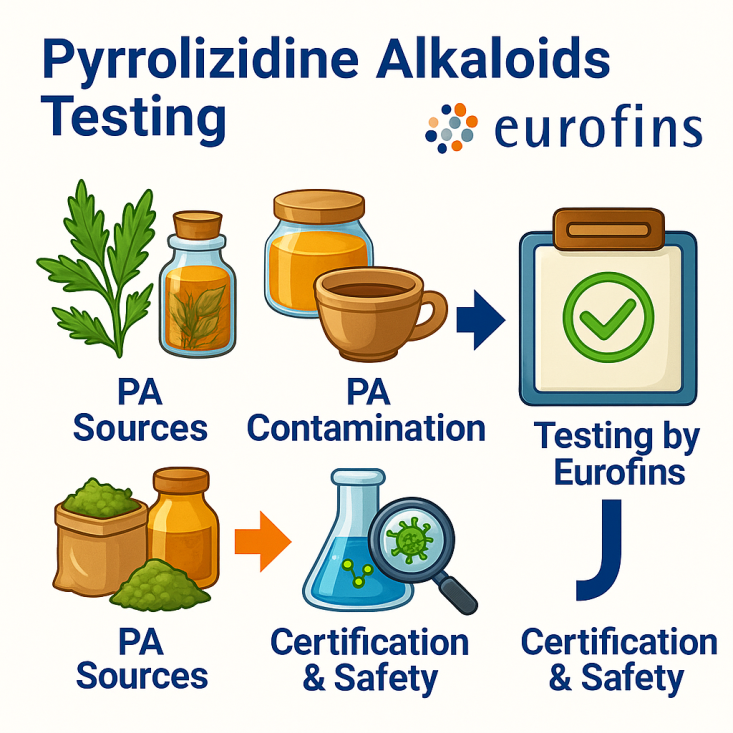
Due to their potential to cause liver toxicity, genotoxic damage, and long-term carcinogenic effects, global authorities consider PAs a major contaminant in herbal teas, honey, spices, dietary supplements, and botanical extracts.
Eurofins Food Testing Laboratories provide advanced testing solutions for the detection and profiling of pyrrolizidine alkaloids, helping manufacturers, processors, and exporters maintain product safety and regulatory compliance.
Why Pyrrolizidine Alkaloids Enter Food Products
|
Cause |
Description |
|
Weed Infestation |
PA-producing weeds grow near crops such as chamomile, buckwheat, cinnamon, mint, or green leafy herbs |
|
Cross-Contamination During Harvest |
Mixing of PA-containing weeds with edible plant material during cutting or bundling |
|
Contaminated Herbal Raw Materials |
Certain medicinal plants naturally contain PAs and may transfer them to blended herbal products |
|
Bee Foraging Patterns |
Bees collect nectar from PA-containing flowers, leading to residues in honey |
|
Poor Sorting or Cleaning |
Insufficient removal of contaminated leaves, stems, or flowers |
|
Global Sourcing Variability |
Ingredients sourced from high-risk regions without adequate screening |
PAs frequently enter food unintentionally, making routine laboratory surveillance essential for supply chain safety.
Health Risks Associated with Pas
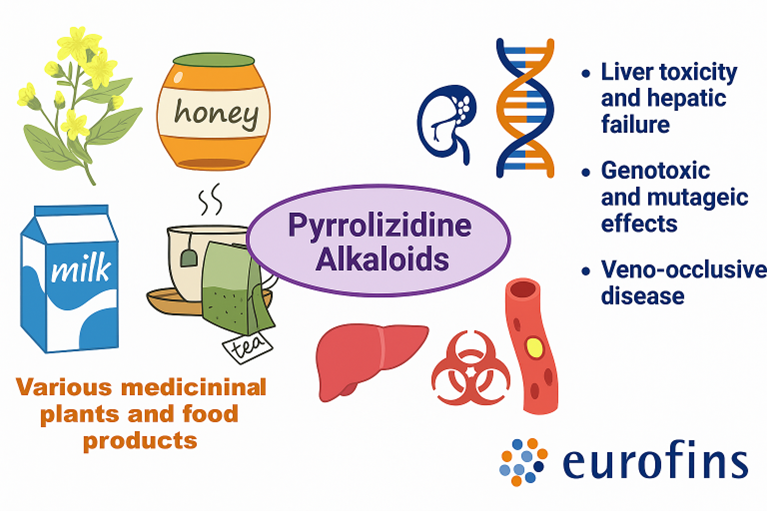
Pyrrolizidine alkaloids are metabolized in the liver into reactive compounds that bind to DNA and proteins. This may lead to:
- Liver toxicity and hepatic failure
- Genotoxic and mutagenic effects
- Long-term carcinogenic risk
- Veno-occlusive disease (blood vessel blockage)
- Reduced safety of herbal and traditional medicines
Regular monitoring allows manufacturers to detect contamination early and prevent exposure in sensitive populations.
Regulatory Overview
- Fssai
India, through FSSAI, actively participates and contributes in the Codex Committee on Contaminants in Foods (CCCF) work, particularly in five Electronic Working Groups (EWGs). One key focus area is the review of the Code of Practice for the prevention and reduction of pyrrolizidine alkaloid contamination in food and feed, as outlined in Codex CXC 74-2014.
- EU
Commission Regulation (EU) 2023/915, adopted on April 25, 2023, sets maximum levels for certain contaminants in food, including pyrrolizidine alkaloids (PAs). It repeals the previous Regulation (EC) No 1881/2006 and came into effect on May 25, 2023, with the purpose of enhancing food safety by establishing more stringent contaminant limits to protect public health.
Key points about Regulation (EU) 2023/915:
- It introduces maximum allowable limits for pyrrolizidine alkaloids in foods like tea, herbal infusions, honey, dried herbs, cumin, botanical supplements, and borage leaves.
- For borage, specifically, the maximum levels for the sum of PAs are set at 750 µg/kg for fresh and frozen leaves and 1000 µg/kg for dried leaves.
- The regulation also sets updated limits for heavy metals like lead, cadmium, mercury, arsenic, and nickel in various food products.
- It aims to protect vulnerable populations including children and pregnant women from the risks associated with PAs and other contaminants.
- This regulation consolidates previous amendments and updates for contaminant levels, streamlining the regulatory framework to improve clarity and safety compliance in the EU food market.
Parameters That Should Be Tested
Testing PAs involves screening multiple compounds simultaneously because each plant species produces different alkaloids. A comprehensive analytical program should include:
Total PA Content
Covers the full group of toxic pyrrolizidine alkaloids present in the sample.
Individual PA Profiling
Specific alkaloids such as senecionine, retrorsine, jacobine, heliotrine, lasiocarpine, and their N-oxides.
PA N-Oxides
Important because these derivatives convert to toxic forms during digestion.
Botanical Source Identification
Determines whether contamination originated from specific PA-producing weed species.
Raw Material vs Finished Product Testing
Ensures both ingredients and final packaged items meet regulatory expectations.
Seasonal and Batch Variability Testing
PAs vary with harvest time and region; periodic monitoring prevents supply chain risks.
Eurofins Analytical Capabilities
Eurofins laboratories use advanced analytical platforms to accurately detect and quantify PAs in complex herbal and food matrices.
Technologies Used
- LC-MS/MS multi-residue analysis for targeted PA detection
- High-resolution mass spectrometry for confirmation
- Isotope dilution techniques for consistent accuracy
- Multi-matrix validation for teas, herbs, spices, honey, botanicals, and supplements
Sample Types Covered
- Herbal teas and infusions
- Medicinal plant extracts
- Spices and dried herbs
- Honey and bee products
- Nutraceuticals and dietary supplements
- Botanical blends and seasonings
Why PA Testing Is Important for Your Business
|
Benefit |
Impact |
|
Compliance with International Standards |
Avoids border rejections and market withdrawal |
|
Protection of Brand Reputation |
Demonstrates commitment to product safety |
|
Quality Control in Sourcing |
Detects contaminated ingredients early |
|
Consumer Safety Assurance |
Reduces risk of chronic toxicity |
|
Support for Export Documentation |
Meets regulatory requirements of EU, UK, USA, and Asia |
Eurofins PA Testing Workflow
|
Step |
Objective |
Service Provided |
|
Sample Receipt |
Ensure integrity and traceability |
Controlled sample handling through SmartLIMS |
|
Screening |
Detect presence of PA residues |
LC-MS/MS multi-panel scanning |
|
Confirmation |
Verify identity of alkaloids |
High-resolution MS confirmation |
|
Interpretation |
Understand contamination pattern |
Expert scientific assessment |
|
Reporting |
Provide export-ready documentation |
Clear digital CoA and compliance summary |
Case Study: PA Reduction in Herbal Infusions
Challenge
A European herbal tea blender detected excessive PA levels in a mixed-flower product targeted for export.
Eurofins Intervention
- Performed batch-wise PA profiling
- Identified contamination from Senecio weed fragments
- Recommended supplier change and enhanced cleaning process
Outcome
PA levels dropped to acceptable limits, enabling successful EU market release.
Why Choose Eurofins
- Extensive experience in botanical and herbal contaminant testing
- Globally accredited laboratories
- Advanced instrumentation for accurate PA profiling
- Rapid sample processing and digital reporting
- Expert advisory for supplier management and corrective actions
Ensure your herbal and food products are safe, compliant, and export-ready through accurate pyrrolizidine alkaloid testing.
Partner with Eurofins today to:
- Detect PAs with high precision
- Improve raw material quality
- Protect consumers and your brand
Enquire now: www.eurofins.in/food-testing/enquire-now/

