


Rising Food Allergies in India: The Importance of Allergen Testing

Food allergies are emerging as a significant public health concern in India, driven by changing dietary patterns, increased consumption of processed and packaged foods, urbanization, and improved diagnostic awareness. While food allergies were once considered relatively uncommon in the Indian population, recent clinical data and consumer reports indicate a steady rise in allergy prevalence among both children and adults.
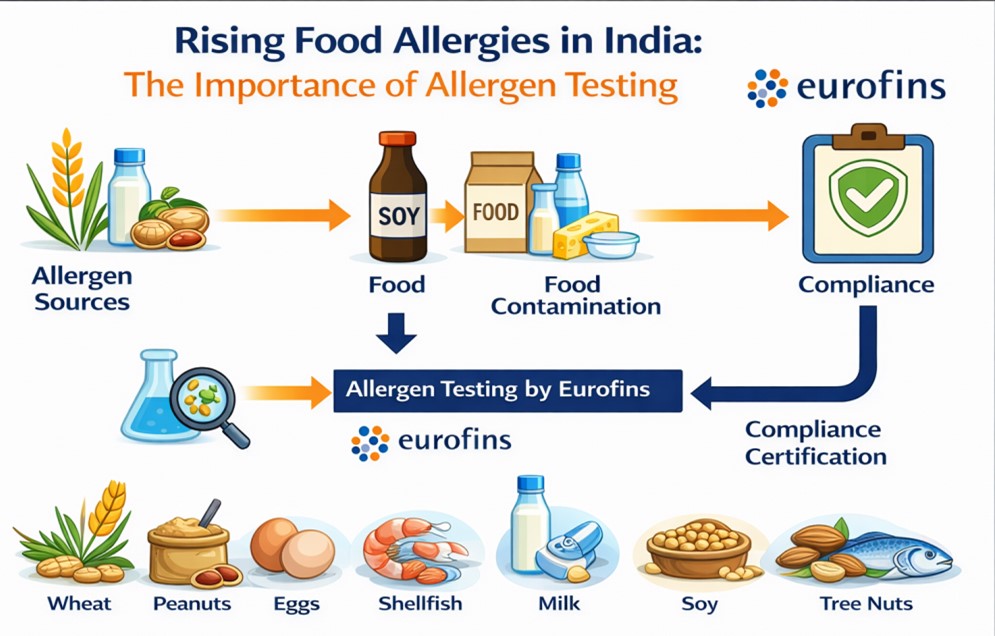
Food allergens can trigger adverse immune responses ranging from mild symptoms such as itching and rashes to severe, life-threatening reactions including anaphylaxis. Even trace levels of undeclared allergens can pose serious risks to sensitive individuals.
In this evolving landscape, allergen testing has become a critical component of food safety management, regulatory compliance, and consumer protection. Eurofins supports food manufacturers, processors, and brand owners with comprehensive allergen testing services designed to identify, control, and communicate allergen risks across the food supply chain.
Understanding Food Allergies and Their Impact
A food allergy occurs when the immune system mistakenly identifies a food protein as harmful and triggers an immune response. Unlike food intolerances, allergic reactions can be severe and unpredictable, often requiring immediate medical attention.
In India, the rising incidence of food allergies has been linked to:
- Increased consumption of processed and convenience foods
- Greater exposure to imported food ingredients
- Early-life dietary changes and urban lifestyles
- Improved awareness and clinical diagnosis
For food businesses, this trend translates into increased responsibility to prevent accidental allergen exposure and ensure accurate labeling.
Common Food Allergens of Concern in India
While global allergen lists provide a baseline, India presents unique allergen challenges due to regional diets and culinary practices.
|
Allergen Category |
Typical Food Sources |
|
Cereals containing gluten |
Wheat, barley, rye |
|
Milk and milk products |
Milk, cheese, butter, milk powders |
|
Eggs |
Bakery products, sauces, processed foods |
|
Peanuts |
Snacks, sauces, confectionery |
|
Tree nuts |
Cashew, almond, walnut, pistachio |
|
Soy |
Soy flour, textured protein, sauces |
|
Sesame seeds |
Traditional foods, bakery items |
|
Fish and crustaceans |
Seafood, sauces, flavorings |
|
Sulphites |
Dried fruits, beverages, processed foods |
Cross-contact during manufacturing is a major risk factor, even when allergens are not intentionally added.
Why Allergen Testing Is Critical for Food Safety
Allergen testing is not optional it is a core risk management tool that protects consumers and food businesses alike.
|
Key Aspect |
Why It Matters |
|
Consumer safety |
Prevents allergic reactions and medical emergencies |
|
Regulatory compliance |
Supports mandatory allergen declaration |
|
Brand trust |
Demonstrates commitment to transparency and safety |
|
Recall prevention |
Reduces risk of undeclared allergen incidents |
|
Export readiness |
Meets international market expectations |
Even microgram-level contamination can trigger reactions, making analytical sensitivity essential.
Regulatory Landscape for Allergen Control in India and Global Markets
Food Allergens – FSSAI Guidelines (India)
As per Food Safety and Standards (Labelling and Display) Regulations, 2020 and Direction dated 22nd October 2021 (effective from 1st July 2022), the following allergens must be clearly declared on pre-packaged food labels.
|
Allergen |
Declaration Requirement |
Specific Exemptions / Notes |
|
Cereals containing gluten |
Name of the cereal must be declared (e.g., wheat, rye, barley, oats, spelt or their hybridised strains) |
• Wheat-based glucose syrups including dextrose • Wheat-based maltodextrins • Barley glucose syrups • Cereals used for alcoholic distillates (gluten ≤ 20 mg/kg) |
|
Crustaceans and products thereof |
Declare as “Crustacean” |
None |
|
Eggs and egg products |
Declare as “Egg” |
None |
|
Fish and fish products |
Declare as “Fish” |
None |
|
Peanuts and products thereof |
Declare as “Peanut” or “Nut” |
None |
|
Tree nuts and products thereof |
Declare as “Nut” (specific name recommended) |
None |
|
Soybeans and products thereof |
Declare as “Soy” |
None |
|
Milk and milk products |
Declare as “Milk” |
None |
|
Sulphites |
Declare as “Sulphite” when ≥ 10 mg/kg |
None |
|
Cross-contamination (voluntary) |
“May contain [name of allergen]” |
Only when unavoidable |
|
Highly refined oils & distilled alcoholic beverages derived from allergens |
No declaration required |
Applies to fully refined oils and distillates |
|
Raw agricultural commodities |
Completely exempt |
— |
Food Allergens – European Union (EU) Law
Regulation (EU) No 1169/2011 (Food Information to Consumers Regulation) – Annex II lists 14 substances or
|
Cereals containing gluten |
Specific name of cereal (wheat, rye, barley, oats, spelt, kamut, etc.) |
• Wheat/barley glucose syrups & dextrose • Wheat maltodextrins • Distillates for spirits |
|
Crustaceans and products thereof |
“Crustaceans” |
None |
|
Eggs and products thereof |
“Eggs” |
None |
|
Fish and products thereof |
“Fish” |
• Fish gelatine/isinglass as fining agent or carrier |
|
Peanuts and products thereof |
“Peanuts” |
None |
|
Soybeans and products thereof |
“Soybeans” or “Soya” |
• Fully refined soybean oil & fat • Tocopherols, phytosterols from soy sources |
|
Milk and products thereof (incl. lactose) |
“Milk” |
• Whey/lactitol in distillates • Certain milk derivatives |
|
Nuts (tree nuts) |
“Nuts” + specific name (almond, hazelnut, walnut, cashew, pecan, Brazil nut, pistachio, macadamia/Queensland nut) |
• Nuts used in distillates & certain flavourings |
|
Celery and products thereof |
“Celery” |
None |
|
Mustard and products thereof |
“Mustard” |
None |
|
Sesame seeds and products thereof |
“Sesame seeds” or “Sesame” |
None |
|
Lupin and products thereof |
“Lupin” |
None |
|
Molluscs and products thereof |
“Molluscs” |
None |
|
Sulphur dioxide and sulphites |
“Sulphur dioxide and sulphites” when ≥ 10 mg/kg or 10 mg/L (expressed as SO₂) |
Threshold applies |
https://www.fssai.gov.in/upload/uploadfiles/files/Compendium_Labelling_Display_30_06_2022.pdf
https://www.wipo.int/wipolex/en/legislation/details/19862
Case Study: Preventing a Major Allergen Recall
A ready-to-eat food manufacturer detected trace peanut contamination in a non-nut product during export testing. Eurofins conducted targeted ELISA screening and environmental swab analysis, identifying cross-contact from shared packaging equipment. Corrective cleaning protocols and revised allergen zoning were implemented, preventing a large-scale recall and restoring export approvals.
Sources of Allergen Contamination in Food Manufacturing
Allergen presence may be intentional or accidental. Common contamination pathways include:
|
Stage |
Risk Factors |
|
Raw materials |
Shared suppliers, undeclared allergenic ingredients |
|
Processing |
Shared equipment, inadequate cleaning |
|
Packaging |
Label mix-ups, incorrect artwork |
|
Storage |
Poor segregation of allergen and non-allergen products |
|
Transport |
Cross-contact in bulk handling |
Without routine testing, these risks may go undetected until a consumer incident occurs.
Allergen Testing Methods Used by Eurofins
Eurofins applies validated, internationally recognized analytical techniques tailored to food matrices and risk profiles.
ELISA (Enzyme-Linked Immunosorbent Assay)
- Highly sensitive detection of specific allergenic proteins
- Suitable for routine monitoring and verification
PCR (Polymerase Chain Reaction)
- Detects allergen-specific DNA
- Useful for processed foods where proteins may be degraded
Lateral Flow Devices
- Rapid, on-site screening for hygiene verification
Mass Spectrometry (Advanced Applications)
- Confirmatory and multi-allergen detection in complex matrices
Eurofins Allergen Testing Workflow
|
Step |
Objective |
Eurofins Approach |
|
Ingredient assessment |
Identify allergen risks |
Raw material profiling |
|
Environmental monitoring |
Detect cross-contact |
Surface and rinse testing |
|
In-process testing |
Control contamination |
ELISA / PCR screening |
|
Finished product testing |
Verify label accuracy |
Regulatory-ready analysis |
|
Reporting |
Audit and recall readiness |
Digital certificates and interpretation |
Integration with Food Safety and Quality Systems
Allergen testing plays a vital role within broader food safety frameworks.
|
System |
Role of Allergen Testing |
|
HACCP |
Identification and validation of allergen CCPs |
|
GMP |
Verification of cleaning and segregation |
|
Supplier approval |
Ingredient risk assessment |
|
Internal audits |
Objective evidence of control |
|
Label verification |
Prevention of mislabeling |
Consumer Awareness and Market Expectations
Indian consumers are increasingly reading labels, asking questions, and demanding transparency regarding allergens. E-commerce platforms, hospitals, schools, and airlines now require documented allergen control, making testing a competitive differentiator rather than just a compliance activity.
Future Trends in Allergen Risk Management
Emerging trends shaping allergen testing include:
- Multi-allergen detection platforms
- Digital allergen risk mapping across facilities
- Integration of allergen testing with product lifecycle management
- Increased regulatory scrutiny and lower action thresholds
Proactive testing strategies will be essential as food systems become more complex.
Why Choose Eurofins for Allergen Testing
- ISO/IEC 17025-accredited laboratories
- Comprehensive coverage of regulated and emerging allergens
- Expertise across traditional, processed, and specialty foods
- Fast turnaround times and harmonized global reporting
- Strong regulatory and export compliance support
Eurofins helps food businesses identify allergen risks, validate controls, and ensure accurate labeling protecting allergic consumers while strengthening brand credibility and regulatory confidence.
Partner with Eurofins your trusted pathway to compliant, export-ready food
Enquire now: www.eurofins.in/food-testing/enquire-now/

