


Role of organochlorine pesticide residues in spices

Introduction
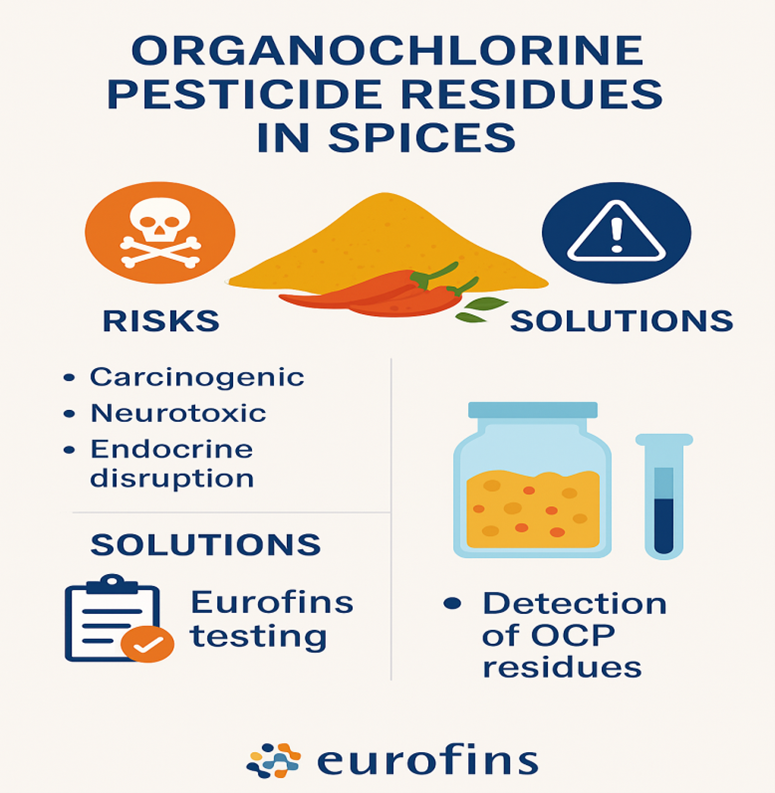
Spices are among the most globally traded food commodities, valued for their flavor, aroma, and therapeutic properties. However, due to intensive agricultural practices and storage challenges, they are at risk of pesticide contamination, particularly from organochlorine pesticides (OCPs).
These chemicals though largely banned or restricted may persist in the environment due to their high stability and bioaccumulative nature. Even trace residues in spices can pose risks to consumer safety, international trade, and regulatory compliance.
At Eurofins, we help spice producers, exporters, and regulators ensure that spices are free from harmful OCP residues, compliant with global safety standards, and market-ready.
Why OCP Testing in Spices is Important
At Eurofins, we recognize the importance of testing organochlorine pesticide residues in spices for:
- Protecting Consumer Health – Detecting and eliminating compounds linked to cancer, endocrine disruption, neurotoxicity, and immune suppression.
- Regulatory Compliance – Meeting Maximum Residue Limits (MRLs) as per Codex Alimentarius, FSSAI, EFSA, US FDA, and EU pesticide regulations.
- Trade Facilitation – Preventing export rejections of chili, turmeric, pepper, cumin, coriander, and other high-risk spices.
- Brand Trust & Reputation – Safeguarding consumer loyalty through transparent and residue-free products.
- Sustainability – Supporting safer farming practices and minimizing long-term soil and environmental contamination.
Common Organochlorine Pesticides of Concern in Spices
|
Compound |
Category |
Potential Risk |
Spices Commonly Affected |
|
DDT & metabolites |
Insecticide |
Carcinogenic, endocrine disruptor |
Chili, turmeric, coriander |
|
Lindane (γ-HCH) |
Insecticide |
Neurotoxic, persistent pollutant |
Black pepper, cumin, fennel |
|
Aldrin, Dieldrin |
Insecticides |
Liver toxicity, bioaccumulation risk |
Red chili, nutmeg, cardamom |
|
Endosulfan |
Organochlorine insecticide |
Developmental & reproductive toxicity |
Turmeric, dried ginger, coriander |
|
Heptachlor |
Termiticide |
Carcinogenic, immune system effects |
Chili powder, mixed spices |
Case study
Regulations and Standards: FSSAI, EU, and USFDA
Standards and Regulations
|
Organisation |
Standard |
Basis for Standard |
Regulation Number |
Specifications |
Where to Find Standards |
|
FSSAI |
Maximum Residue Limits (MRLs) |
Scientific risk assessment |
FSS (C, T & R) Regulations, 2011 |
Specific MRLs for various pesticides in different spices. If not defined, default limit of 0.01 mg/kg applies. |
https://www.fssai.gov.in/upload/uploadfiles/files/Guidance_Note_Pesticides_04_02_2020.pdf |
|
EU |
Maximum Residue Limits (MRLs) |
Scientific risk assessment by EFSA |
Regulation (EC) No 396/2005 |
Specific MRLs for various pesticides in different spices, based on risk assessments. |
https://eur-lex.europa.eu/homepage.html |
|
USFDA |
Tolerances |
Scientific data submitted by manufacturers |
Title 40 of the Code of Federal Regulations (CFR) Part 180 |
Specific tolerances for various pesticides in different spices, based on good agricultural practices (GAPs). |
https://www.accessdata.fda.gov/scripts/cdrh/cfdocs/cfcfr/CFRSearch.cfm?CFRPart=177 |
FSSAI recently circulated a list of 20 banned Pesticides in this context.
- Aldicarb-Aldrin, Dieldrin, Chlordane, Heptachlor, Lindane, Endosulfan, Carbofuran, Methomyl, Phosphamidon, Captafol, Ferbam, Formothion, Simazine, Diazinon, DDT, Fenitrothion, Fenthion, Methyl Parathion, Ethyl Parathion and Monocrotophos
Note : The Extraneous MRL of the above mentioned banned insecticides shall be 0.01mg/kg except for DDT for which it shall be 0.05 mg/kg.
Types of OCP Residue Tests We Offer
Eurofins provides one of the most comprehensive suites of pesticide residue testing for spices, supported by state-of-the-art facilities and validated methods. Our testing includes:
- Multi-Residue Screening for OCPs (DDT, lindane, aldrin, dieldrin, endosulfan, heptachlor, etc.)
- Single-Residue Confirmation for targeted pesticides at trace levels
- Analytical Platforms: GC-ECD, GC-MS/MS, LC-MS/MS, HRMS for high sensitivity and specificity
- Compliance Testing against EU, FSSAI, Codex, and importing country MRLs
How Our Testing Process Works
At Eurofins, we ensure efficiency, accuracy, and regulatory clarity:
- Sample Collection: Clear instructions for spice sampling, packaging, and logistics
- Testing: ISO/IEC 17025-accredited labs using globally harmonized residue methods
- Turnaround Time (TAT): Fast-track (48h) and standard (3–5 working days) options
- Reports: Detailed analysis with interpretation against MRLs and corrective guidance
Who Needs OCP Residue Testing?
Our services benefit a wide range of stakeholders, including:
- Spice exporters and traders targeting EU, US, Middle East, and Asian markets
- Food processors and FMCG companies using spices in blends, seasonings, or ready-to-eat foods
- Regulatory bodies and auditors ensuring compliance
- Retailers and clean-label brands promoting “pesticide-free” claims
- Research institutions studying pesticide persistence and risk assessment
Common Issues We Help Clients Solve
|
Issue |
How Eurofins Helps |
|
Detection of banned OCPs (e.g., DDT, Endosulfan) |
Confirmation, reporting, and corrective action support |
|
MRL exceedances in export consignments |
Advanced GC-MS/MS detection with reformulation/advice |
|
Import rejections due to residues |
Documentation, retesting, and technical regulatory support |
|
Brand risk due to contamination |
Rapid testing and supply-chain corrective measures |
Case Study: Supporting a Spice Exporter in Global Trade
A leading chili exporter faced repeated EU shipment rejections due to traces of lindane. Eurofins conducted comprehensive residue profiling using GC-MS/MS, identified contamination at the farm level, and guided the client in adopting safer pest control practices. The exporter successfully regained compliance, restoring market access and brand credibility.
Why Choose Eurofins for OCP Residue Testing in Spices?
- Global Network: Over 900 labs in 50+ countries with specialized expertise in spice testing
- Accreditations: NABL, ISO/IEC 17025, FSSAI-recognized
- Advanced Technologies: GC-MS/MS, LC-MS/MS, HRMS for ultra-trace analysis
- Regulatory Expertise: Guidance from chemists, toxicologists, and compliance specialists
- Logistics Support: Nationwide sample collection, secure transport, and fast turnaround
- Ensure your spices are safe, compliant, and globally accepted.
- Contact Eurofins today for pesticide residue testing.
- Book your testing slot now to safeguard exports and consumer trust.
Enquire now: www.eurofins.in/food-testing/enquire-now/

