


Seafood Testing - Shrimp and Fish

Seafood, encompassing shrimp, fish, mollusks, and crustaceans, is a cornerstone of global nutrition and trade. Due to their biological composition and aquatic environment, these products are prone to contamination from feed, water, chemicals, and post-harvest handling. Ensuring the safety, authenticity, and quality of seafood is essential for public health and international trade compliance.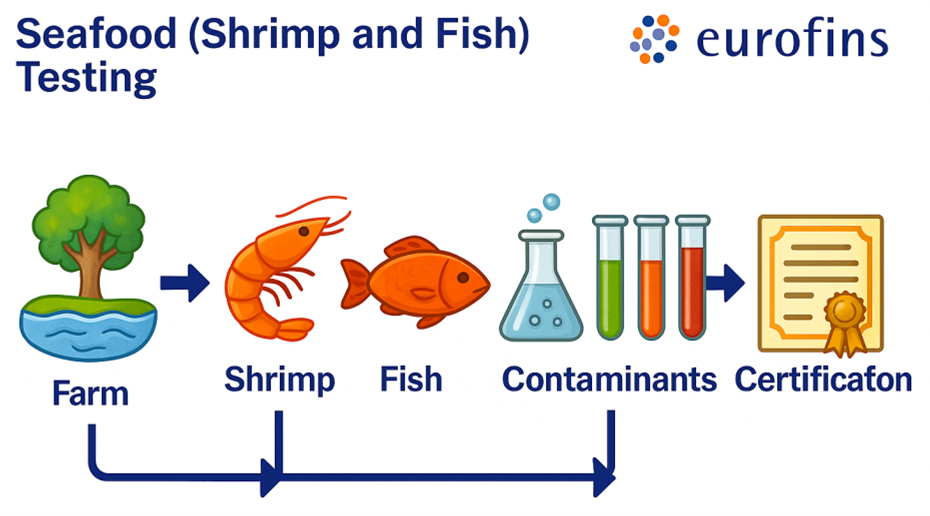
Eurofins provides a comprehensive suite of seafood testing services tailored for aquaculture farms, seafood processors, exporters, and regulatory bodies. Our ISO/IEC 17025-accredited laboratories utilize advanced analytical technologies and comply with FSSAI, EU, USFDA, and Codex Alimentarius standards to deliver precise, actionable results.
Why Seafood Testing is Critical
- Health Safety: Detect harmful residues and contaminants.
- Regulatory Compliance: Meet international food safety and residue standards.
- Trade Assurance: Prevent export rejections and financial losses.
- Sustainability: Support responsible aquaculture practices.
- Consumer Trust: Protect brand integrity and consumer confidence.
Key Seafood Testing Parameters
Antibiotic Residue Testing
Antibiotics are used in aquaculture to prevent infections, but improper use or insufficient withdrawal periods can lead to residues in edible tissue. Eurofins screens for:
- Chloramphenicol, Nitrofurans (AOZ, AMOZ, SEM, AHD)
- Tetracyclines, Quinolones, Sulfonamides, Macrolides, Beta-lactams
- Method: LC-MS/MS and UPLC with isotopic internal standards for ppt-level quantification.
Heavy Metals and Trace Elements
Marine and freshwater organisms can bioaccumulate heavy metals from sediments, feed, and polluted water. Eurofins tests for:
- Mercury (Hg), Arsenic (As), Cadmium (Cd), Lead (Pb), Tin (Sn)
- Technique: ICP-MS and Atomic Absorption Spectroscopy (AAS) to ensure compliance with MRLs set by FSSAI, EU, and Codex.
Pesticide Residues
Pesticides from agricultural runoff and aquaculture feed can contaminate aquatic ecosystems. Eurofins screens for:
- Organochlorines (DDT, Lindane)
- Organophosphates (Chlorpyrifos, Malathion)
- Pyrethroids and Carbamates
- Methodology: GC-MS/MS and LC-MS/MS multi-residue methods covering over 600 pesticides.
Mycotoxins and Marine Biotoxins
Contamination from feed or algal blooms can introduce toxins. Eurofins tests for:
- Aflatoxins (B1, B2, G1, G2), Ochratoxin A
- Paralytic Shellfish Poison (Saxitoxin)
- Amnesic Shellfish Poison (Domoic acid)
- Diarrhetic Shellfish Poison (Okadaic acid)
- Technique: LC-MS/MS, ELISA, and immunoaffinity column cleanup.
Microbiological Testing
Microbial contamination is a leading cause of seafood spoilage and illness. Eurofins tests for:
- Vibrio species (V. cholerae, V. parahaemolyticus, V. vulnificus)
- Salmonella spp., Listeria monocytogenes, E. coli, Staphylococcus aureus
- Total Plate Count, Yeast, and Mold counts
- Techniques: ISO standard culture methods, qPCR, and rapid molecular assays.
Histamine and Biogenic Amines
Improper storage of species like tuna and mackerel can lead to high histamine levels. Eurofins analyzes:
- Histamine, putrescine, and cadaverine
- Method: HPLC and LC-MS/MS, ensuring compliance with Codex and EU standards.
Allergens and Species Authentication
Mislabeling and undeclared allergens pose trade and safety risks. Eurofins provides:
- DNA-based species identification using PCR and DNA barcoding
- Allergen testing for crustacean, shellfish, and fish proteins using ELISA or LC-MS/MS
Environmental Contaminants
Aquaculture and coastal fisheries may be exposed to persistent pollutants. Eurofins tests for:
- Polychlorinated Biphenyls (PCBs)
- Dioxins and Furans
- Polycyclic Aromatic Hydrocarbons (PAHs)
- Per- and Polyfluoroalkyl Substances (PFAS)
- Method: GC-HRMS and LC-HRMS for trace-level detection.
Physical and Sensory Testing
Eurofins evaluates quality attributes impacting consumer acceptance and shelf life:
- pH, moisture, and water activity
- Texture profile and color analysis
- Odor and sensory profiling by trained panels
- Shelf-life testing under controlled conditions
Aquaculture Water and Feed Testing
Eurofins ensures holistic safety by analyzing aquaculture inputs:
- Water Quality: pH, ammonia, nitrite, nitrate, heavy metals, salinity
- Feed Testing: Mycotoxins, antibiotics, and nutritional composition
- Sediment Analysis: Pollutants and microbial load These insights promote biosecurity and environmental sustainability.
Regulatory Framework
FSSAI Regulations (India)
The Food Safety and Standards Authority of India (FSSAI) sets maximum limits for heavy metal contaminants in seafood as per the Contaminants, Toxins, and Residues Regulations, 2011 (updated August 20, 2020). Limits are expressed in mg/kg (wet weight).
|
Contaminant |
Seafood Category |
Maximum Limit (mg/kg) |
|
Methyl Mercury |
All foods (including seafood) |
0.25 |
|
Total Mercury (Hg) |
Non-predatory fish |
0.5 |
|
Predatory fish (tuna, swordfish, marlin, elasmobranchs) |
1.0 |
|
|
Crustaceans, cephalopods, bivalve molluscs |
0.5 |
|
|
Lead (Pb) |
Finfish |
0.3 |
|
Crustaceans |
0.5 |
|
|
Cephalopods (e.g., squid) |
1.0 |
|
|
Bivalve molluscs (e.g., clams) |
1.5 |
|
|
Canned fish |
5.0 |
|
|
Cadmium (Cd) |
Finfish |
0.3 |
|
Crustaceans |
0.5 |
|
|
Cephalopods, bivalve molluscs |
2.0 |
|
|
Arsenic (As) |
Finfish, crustaceans |
76.0 |
|
Molluscs |
86.0 |
|
|
Chromium (Cr) |
All fishery products |
12.0 |
Source: FSSAI Compendium of Contaminants Regulations, 2020 https://www.fssai.gov.in/upload/uploadfiles/files/Compendium_Contaminants_Regulations_20_08_2020.pdf
European Union Regulations
The European Union (EU) regulates heavy metal contaminants in seafood under Regulation (EU) 2023/915, which replaced Regulation (EC) No 1881/2006. Maximum levels are expressed in mg/kg (wet weight) and apply to fishery products offered for sale in the EU market.
|
Contaminant |
Seafood Category |
Maximum Level (mg/kg, wet weight) |
|
Methyl Mercury / Total Mercury (Hg) |
Non-predatory fish |
0.3 |
|
Predatory fish (tuna, swordfish, marlin, shark, pike) |
1.0 |
|
|
Other fishery products |
0.5 |
|
|
Lead (Pb) |
Muscle meat of fish and crustaceans |
0.3 |
|
Bivalve molluscs (e.g., clams, oysters) |
1.5 |
|
|
Cadmium (Cd) |
Fish (general) |
0.05–0.1 |
|
Crustaceans |
0.5 |
|
|
Cephalopods (excluding viscera) |
1.0 |
|
|
Bivalve molluscs |
1.0 |
|
|
Arsenic (inorganic As) |
Fish, crustaceans, molluscs |
0.5 |
|
Chromium (Cr) |
Not specifically listed for seafood; monitored under EFSA TDI 0.3 mg/kg bw/day for Cr(III) |
- |
Source: Regulation (EU) 2023/915 https://eur-lex.europa.eu/eli/reg/2023/915/oj/eng
Common Issues and Eurofins Solutions
|
Issue |
Eurofins Solution |
|
Antibiotic or chemical residues |
Multi-residue LC-MS/MS testing and supplier control programs |
|
Heavy metal contamination |
ICP-MS quantification and water source tracing |
|
Microbial spoilage or pathogens |
Root cause analysis and HACCP verification |
|
Export rejection due to non-compliance |
Pre-shipment certification and compliance documentation |
|
Mislabeling or fraud |
DNA-based species authentication and traceability reports |
Case Study: Ensuring Compliance for Shrimp Exports
A shrimp processing company faced export rejections due to antibiotic residues. Eurofins implemented a residue monitoring program, testing water, feed, and products using LC-MS/MS. The source was identified as contaminated pond feed supplements. After corrective action and regular screening, shipments passed EU and USFDA tests, restoring buyer confidence.
Eurofins Seafood Testing Portfolio
- Antibiotic and chemical residue analysis
- Heavy metals, pesticides, and mycotoxin testing
- Microbiological and pathogen detection
- Histamine and allergen analysis
- DNA-based species authentication
- Feed and water quality testing
- Export certification and HACCP validation
Emerging Trends in Seafood Safety
- Blockchain for traceability from pond to plate
- Predictive analytics for contamination risk assessment
- Eco-friendly aquaculture inputs and bio-remediation
- Testing for microplastics and PFAS in seafood
Why Partner with Eurofins
- Global expertise in food, environment, and aquaculture
- ISO/IEC 17025-accredited laboratories
- Rapid turnaround with validated methodologies
- Data-driven insights for process optimization
- Technical support for export and regulatory documentation
Enhance the quality, safety, and export competitiveness of your seafood products with Eurofins’ advanced analytical testing and compliance services. From farm to export container, we ensure every step of your seafood value chain meets international safety standards.
Enquire now: www.eurofins.in/food-testing/enquire-now/

