


The Impact of New EU Regulations on Food Exporters in India

The European Union (EU) has introduced a new generation of food safety regulations focusing on contaminants, pesticide residues, packaging migration, and transparency in supply chains. These reforms aim to safeguard consumers while maintaining fair trade practices and scientific traceability across borders.
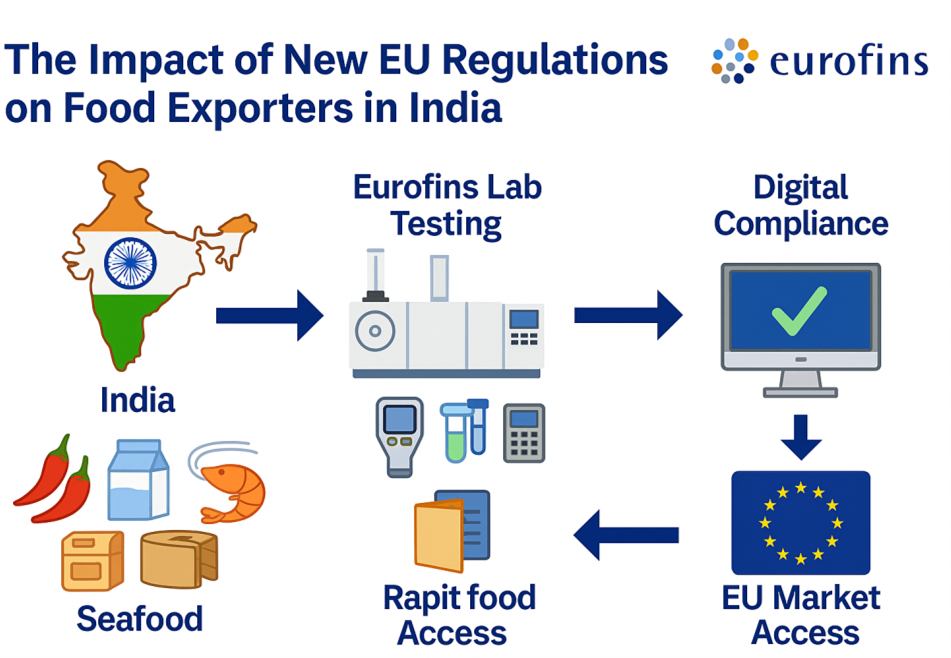
Over the past few months, several Indian food consignments including rice, peanuts, cumin, and herbal supplements have faced rejection at European Union (EU) entry points. These rejections are primarily due to the detection of banned pesticide residues, microbial contamination, use of non-compliant packaging materials, and lack of proper traceability or documentation.
Such incidents not only delay exports but also harm brand reputation and increase costs for Indian exporters. To address this challenge, Eurofins Food Testing Laboratories, a global leader in analytical testing and regulatory compliance, outlines the root causes, relevant EU laws, and scientifically proven solutions to help exporters meet EU standards confidently.
Why Are Shipments Being Rejected?
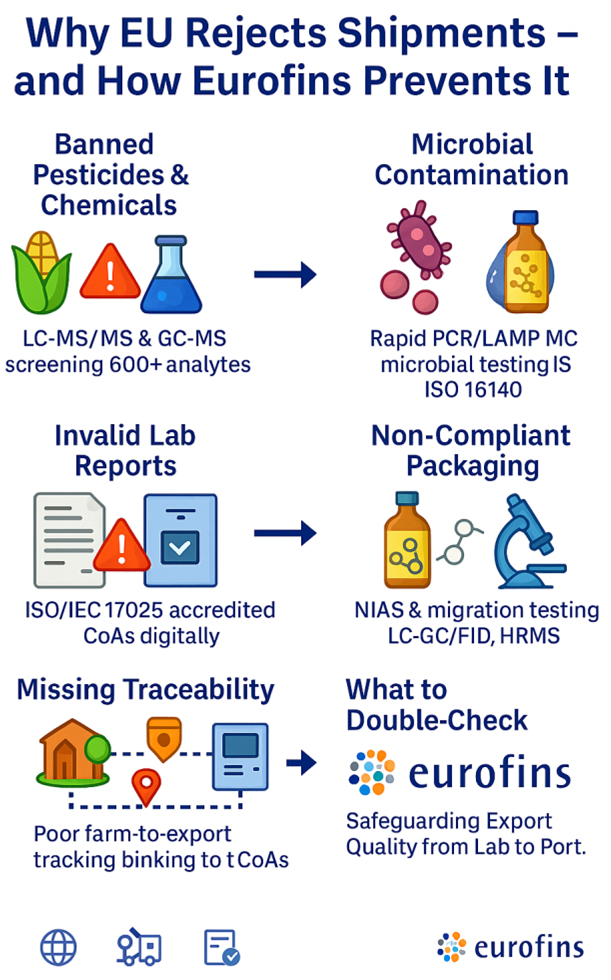
- Banned Pesticides and Chemicals
EU regulations strictly prohibit the use of certain substances such as ethylene oxide, carbendazim, and tricyclazole in food exports. These chemicals, though still used in India, are considered hazardous in the EU due to their potential to cause health risks and environmental harm. Under REACH and Regulation (EC) 396/2005, any residue above Maximum Residue Limits (MRLs) results in automatic rejection. For example, shipments of Indian sesame seeds and spices have been flagged for ethylene oxide traces far exceeding EU limits.
Eurofins Solution: Eurofins performs multi-residue pesticide screening using advanced LC-MS/MS and GC-MS/MS platforms, covering over 600 analytes validated to SANTE/2023 criteria. This ensures exporters are alerted to possible violations before goods are shipped.
- Microbial Contamination
Microbial contamination is another frequent cause of rejections, especially in ready-to-eat and high-moisture foods. The EU Food Hygiene Regulation (852/2004) and Regulation (EU) 2024/2895 mandate zero tolerance for Listeria monocytogenes in 25g of ready-to-eat products. Contamination can occur during unhygienic processing, poor sanitation, or improper temperature control during transport.
Eurofins Solution: Eurofins employs ISO 16140-validated PCR and LAMP-based rapid microbial detection systems, providing results in hours instead of days. This allows corrective action at the source, ensuring clean, compliant consignments.
- Incomplete or Invalid Lab Reports
Many exporters face rejections not due to unsafe products but because of non-standardized or incomplete lab documentation. EU border control authorities require ISO/IEC 17025-accredited laboratory reports that confirm compliance across pesticide, microbial, and contaminant parameters.
Eurofins Solution: All Eurofins laboratories in India are ISO/IEC 17025 and NABL accredited, and recognized by FSSAI and APEDA. Exporters receive digitally verifiable Certificates of Analysis (CoA) with complete traceability and test references to EU standards—ensuring acceptance by DG SANTE and customs authorities.
- Non-Compliant Packaging Materials
The EU’s Regulation (EU) 2025/351 has raised safety standards for food-contact materials, requiring complete testing for migration and non-intentionally added substances (NIAS). Plastics, inks, or adhesives containing BPA, phthalates, or amine-based curing agents are no longer permitted.
Eurofins Solution: Eurofins performs NIAS and overall migration testing using LC-GC/FID, LC-HRMS, and GC-MS/MS, identifying potential leachates before packaging is used. Eurofins also provides validation reports ensuring compliance with EU 10/2011 and IS 15495: Printing Inks for Food Packaging standards.
- Missing Traceability Documentation
Traceability is a key focus of EU General Food Law (Regulation 178/2002). Authorities must be able to trace every ingredient and batch from farm to export. Missing records or supplier inconsistencies often lead to automatic rejection.
Eurofins Solution: Through SmartLIMS™, Eurofins provides exporters with digital dashboards linking raw material, batch data, and CoA in one secure system enabling seamless traceability audits by buyers or regulators.
Key EU Laws Behind the Rejections
|
Regulation / Directive |
Area Covered |
Purpose |
|
Regulation (EC) 178/2002 |
General Food Law |
Ensures food safety, traceability, and recall ability |
|
Regulation (EC) 852/2004 |
Food Hygiene |
Prevents microbial contamination through sanitation |
|
Regulation (EU) 2025/351 |
Food Contact Materials |
Ensures packaging purity and prevents chemical migration |
|
REACH Regulation |
Chemicals and Pesticides |
Bans hazardous substances harmful to health/environment |
|
Regulation (EU) 2019/1793 |
Risk-Based Import Controls |
Mandates testing for high-risk foods before entry |
|
Regulation (EU) 2024/2895 |
Microbiological Criteria |
Updates microbial limits for Listeria and pathogens |
Typical Indian Risk Points
|
Product Category |
Common Issues Detected by EU |
|
Spices (cumin, turmeric) |
Ethylene oxide, pesticide residues |
|
Rice and cereals |
Tricyclazole, aflatoxin contamination |
|
Peanuts and nuts |
Aflatoxins, mold growth, packaging leachates |
|
Herbal supplements |
Heavy metals, microbial load, labeling errors |
|
Ready-to-eat foods |
Listeria, poor sanitation validation |
How Eurofins Helps Exporters Ensure Compliance
|
Challenge |
Eurofins Testing and Support Solution |
|
Banned pesticide residues |
Multi-residue LC-MS/MS and GC-MS/MS analysis (600+ analytes) |
|
Aflatoxin or mold contamination |
Mycotoxin LC-MS/MS and storage condition assessment |
|
Microbial contamination |
Rapid PCR/LAMP for Listeria, Salmonella, E. coli |
|
Packaging contamination |
NIAS and migration testing (LC-HRMS, GC-MS/MS) |
|
Incomplete lab reports |
NABL & FSSAI accredited CoAs for global submission |
|
Traceability & records |
SmartLIMS™ digital tracking with farm-to-export linkage |
What Exporters Should Do
- Use EU-approved pesticides only. Avoid ethylene oxide, tricyclazole, and other banned chemicals.
- Maintain hygiene and process compliance. Follow HACCP and ISO 22000 systems.
- Rely on accredited labs. Eurofins provides recognized CoAs ensuring global acceptability.
- Check packaging materials. Use EU-compliant, inert, and safe materials.
- Digitize traceability. Adopt SmartLIMS™ for automatic record generation.
- Stay informed. Subscribe to Eurofins’ EU Regulatory Update Reports for the latest amendments.
Pre-Export Checklist
|
Parameter |
Verification Required |
|
Pesticide residues |
Confirm no banned actives or exceedances |
|
Lab reports |
Complete CoA from accredited lab |
|
Packaging |
EU-compliant food-contact certificate |
|
Hygiene |
Verified under HACCP/ISO 22000 |
|
Documentation |
Health certificate and export permits included |
|
Traceability |
Farm-to-batch linkage verified |
Eurofins’ Proven Approach
- Multi-Layer Testing
Comprehensive LC-MS/MS, GC-MS/MS, PCR, and biosensor platforms deliver high-precision contaminant analysis.
- Digital Traceability
SmartLIMS™ ensures audit-ready documentation for DG SANTE and APEDA requirements.
- RAFT™ Rapid Screening
Rapid Analytical Food Testing allows portable, on-site checks by FSSAI and exporters.
- Packaging Validation
Eurofins tests inks, plastics, and laminates for NIAS, amines, and migration under real storage conditions.
- Regulatory Consultation
Specialized Eurofins teams assist in implementing REACH, 2025/351, and 2024/2895 compliance at factory level.
- Case Study: From Rejection to Compliance
A major Indian spice exporter faced repeated shipment rejections in the EU due to ethylene oxide and aflatoxin residues.
Eurofins intervention:
- Introduced supplier-level residue monitoring.
- Implemented LC-MS/MS multi-residue testing before dispatch.
- Conducted rapid RAFT™ checks for ethylene oxide.
Outcome: Within three months, rejection rates dropped by 85%, restoring EU market access and exporter confidence.
The Eurofins Advantage
- Global network of 900+ ISO/IEC 17025 accredited laboratories.
- Validated EU-compliant methods across all food categories.
- Digital CoA and SmartLIMS™ traceability integration.
- FSSAI and APEDA recognition for export testing.
- Dedicated teams for EU regulation consulting and training.
Every export rejection represents a preventable loss. With Eurofins’ integrated scientific expertise, digital traceability systems, and rapid testing capabilities, Indian exporters can meet evolving EU food safety expectations confidently.
Partner with Eurofins your trusted pathway to compliant, export-ready food
Enquire now: www.eurofins.in/food-testing/enquire-now/

